Irish Gun Money Shilling
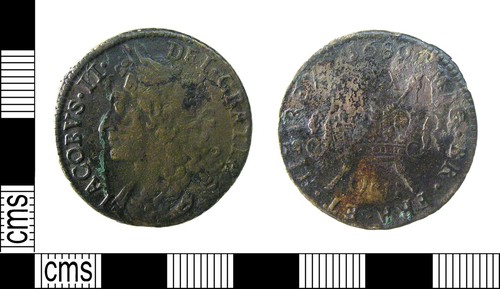
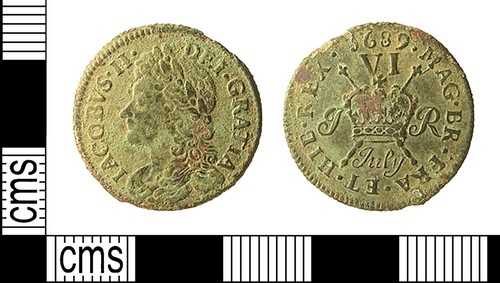
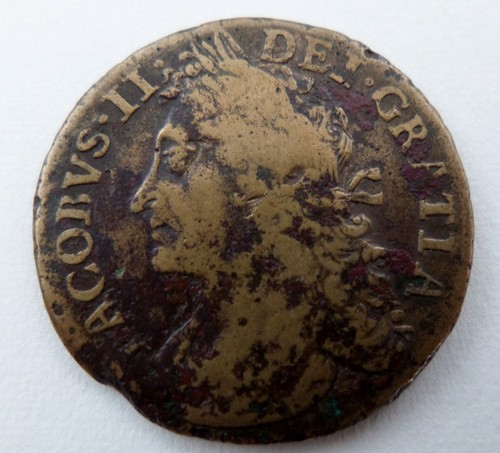
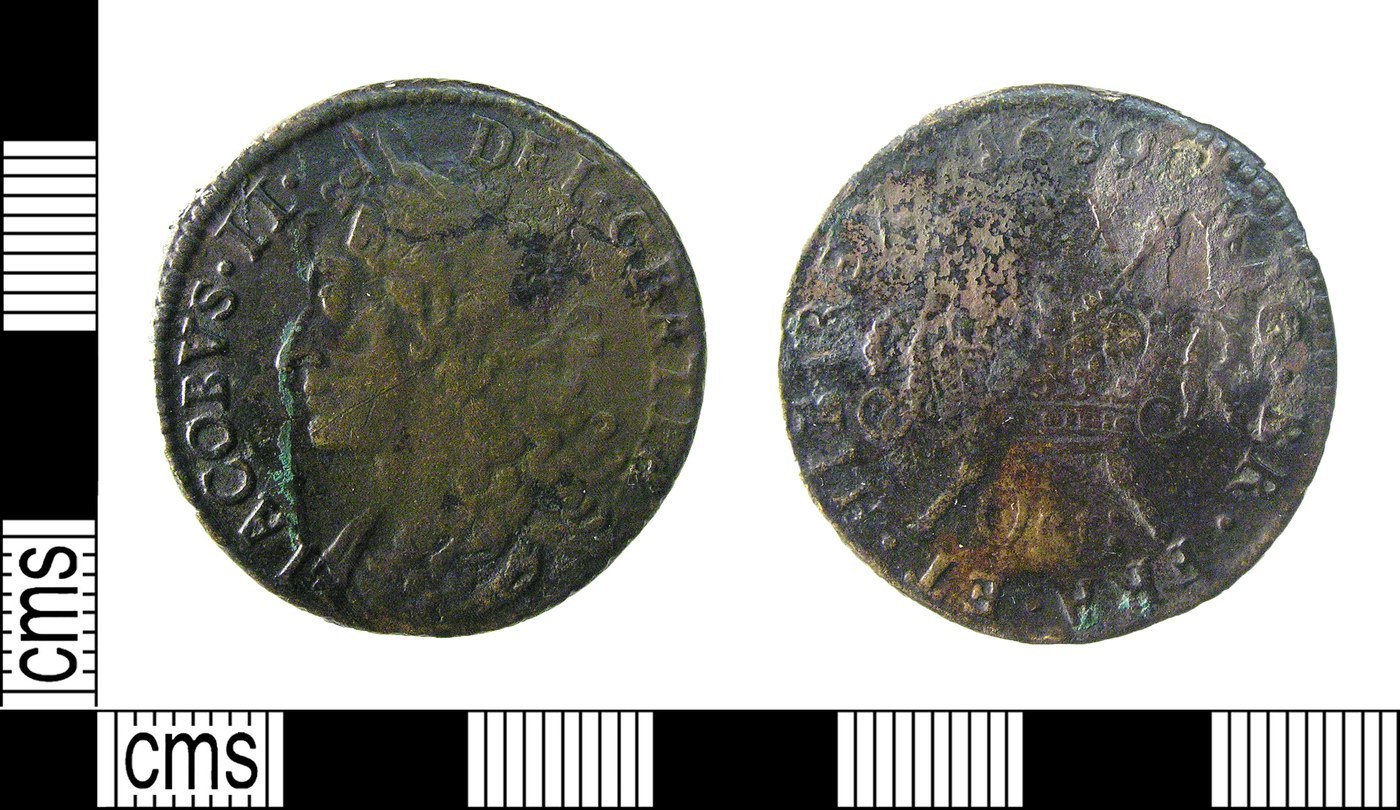
A base-metal Irish emergency shilling struck for James II in 1689-1690, with his laureate bust and a crowned reverse dated by month, here October 1689.
- Country
- Ireland
- Denomination
- Shilling
- Metal
- Copper alloy
Got a coin like this?
Identify any coin from a photo, free.
Overview
The Irish Gun Money Shilling is a base-metal emergency coin struck in Ireland for the exiled King James II during the Williamite War of 1689-1691. The obverse carries a laureate profile bust of James II facing left with a Latin royal legend, while the reverse shows a large crown over crossed sceptres, accompanied by the royal titles and, unusually, the month and year of striking. The example described here is dated October 1689.
The series takes its popular name, "gun money," from the story that the coins were struck from melted-down cannon, bells, old brass and other scrap metal gathered when James lacked silver and gold to pay his army. As a result the coins are made of a copper alloy rather than precious metal, and their value rested entirely on the King's promise to redeem them in good coin once he had recovered his throne.
Dating each coin by the month was a deliberate accounting device, allowing the pieces to be redeemed in the order they were issued. Because James was defeated and never made good on that promise, the gun money remained an emergency token, but its month-by-month dating makes it one of the most distinctive and collectable emergency coinages of the British Isles.
History & Background
After being deposed in England in 1688, James II landed in Ireland in 1689 seeking to regain his three kingdoms with French support. Cut off from the royal mints and short of silver, his government in Dublin authorised an emergency coinage struck in base metal, produced at mints in Dublin and Limerick. Shillings, sixpences, halfcrowns and crowns were issued, each dated by both month and year so the issues could be tracked and, in theory, redeemed in sequence.
The coinage is usually divided into "large" gun money, struck from mid-1689 into 1690, and "small" gun money of 1690, made on smaller flans as metal grew scarce. An October 1689 shilling belongs to the large gun money phase. As the war turned against James, metal shortages forced the reduction in size, and some larger denominations were later cut down or restruck as smaller ones.
James's cause collapsed after defeats at the Boyne in 1690 and Aughrim in 1691. The Williamite government demonetised the gun money, and it was officially reduced to a fraction of its face value, leaving holders with a heavy loss. What survives today is prized precisely because of that turbulent history and the coinage's unique dating system.
How to Identify
Begin with the obverse. A Gun Money Shilling shows James II in profile facing left, wearing a laurel wreath, with an abbreviated Latin legend naming him as king (IACOBVS II DEI GRATIA and titles). The reverse is dominated by a large crown above two crossed sceptres, with the continuation of the royal titles and the date expressed as a month abbreviation together with the year, such as an October 1689 dating on this piece.
The defining diagnostic is the month-and-year dating on the reverse, a feature almost unique to this emergency coinage and not found on ordinary regnal issues. The coin is struck in a yellowish-to-brown copper alloy rather than silver, so it will not have the colour, ring or weight of a true silver shilling. Large gun money shillings are struck on broad flans in the region of 27-29 mm.
Denomination within the series is judged mainly by size and the crowned design: the shilling sits between the smaller sixpence and the larger halfcrown and crown. Because striking quality varied under wartime conditions, legends and dates can be weak or partly off the flan, so tilting the coin to read the month and year is often necessary to confirm the issue.
Value & Collectibility
Gun money is one of the more affordable historic emergency coinages, and common months of the large 1689 shilling in worn, honest condition are widely available at modest prices. Because the coins are base metal that saw hard use and were later demonetised, many survivors are heavily worn or corroded, and condition is the biggest driver of value.
Scarcer months, overstrikes, mint varieties and the small gun money issues command more, and a sharply struck shilling with a clear bust, full crown and a legible month-and-year date is worth considerably more than a smooth, pitted example. Because it is a copper alloy, surface quality matters greatly: green corrosion, pitting and edge damage reduce value.
As with any historic coin, prices span a wide range depending on the specific month, variety and grade. For a purchase of consequence, confirm the attribution and condition through a specialist dealer or a reputable auction record rather than relying on a single listing.
Frequently asked questions
Why is it called "gun money"?
The name comes from the tradition that James II's emergency coins were struck from melted-down brass and bronze scrap, including old cannon, bells and utensils, because he lacked silver and gold to pay his army. The coins are base-metal tokens, not precious metal.
Why does my Gun Money Shilling show a month as well as a year?
The month-and-year dating was a deliberate feature so the coins could be redeemed in the order they were issued once James recovered his throne. It is one of the most distinctive traits of the gun money series and helps confirm the coin.
Is a Gun Money Shilling made of silver?
No. Despite being a shilling denomination, it is struck in a copper alloy rather than silver. Its face value depended on the King's promise to redeem it later in good coin, a promise that was never kept after his defeat.
What is the difference between large and small gun money?
Large gun money was struck from 1689 into 1690 on broad flans; small gun money of 1690 was made on smaller flans as metal ran short. An October 1689 shilling is a large gun money piece.
Irish Gun Money Shilling guides
In-depth guides for identifying, valuing, and collecting Irish Gun Money Shilling.