
How to Identify the Irish Gun Money Shilling
A collector's walkthrough for attributing a James II Irish gun money shilling by its laureate bust, crowned reverse, month-and-year date and base-metal alloy.
Read the full Irish Gun Money Shilling encyclopedia entry →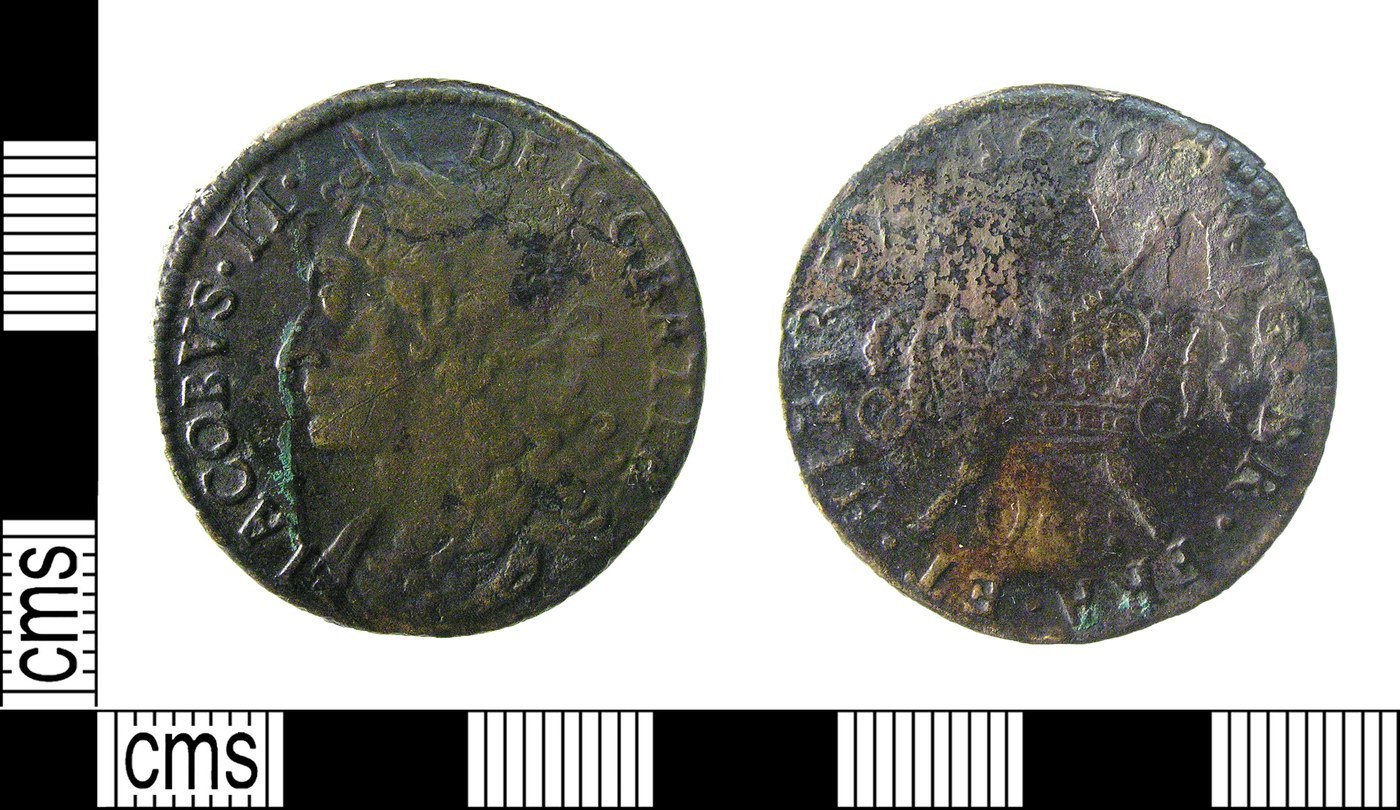
Start with the metal, because it separates gun money from ordinary shillings at a glance. A Gun Money Shilling is struck in a yellowish-to-brown copper alloy, not silver, so it lacks the white colour, weight and ring of a true silver shilling and often shows a warm brown or coppery tone under any toning. A large 1689 shilling is struck on a broad flan roughly 27-29 mm across; anything that feels and looks like silver is a different coin.
Read the obverse next. You should see James II in profile facing left, wearing a laurel wreath, with an abbreviated Latin legend naming him as king. The bust style is the neat, classical laureate head typical of the series, and the legend runs around the edge. A crowned, un-laureate portrait or an English legend points to a different coin entirely.
Turn to the reverse for the decisive diagnostic. Gun money shows a large crown above two crossed sceptres, with the royal titles around and, crucially, the month and year of striking in the field, such as an October 1689 date. This month-by-month dating is almost unique to the gun money and is the single most reliable confirmation of the type. Tilt the coin to read the month if the strike is weak, as wartime striking was often uneven.
Judge the denomination by size and design. Within the series the shilling sits between the smaller sixpence and the larger halfcrown and crown, all of which share the crowned reverse and month dating, so measuring the flan and comparing against published sizes is the safe way to confirm you have a shilling rather than a neighbouring value. Watch also for overstrikes and restrikes, where a larger coin was cut down or re-dated as metal ran short, which can leave traces of an earlier design.
Be cautious with authentication. Because gun money is base metal, it is vulnerable to corrosion, pitting and tooling, and worn or cleaned pieces can be hard to read; genuine examples are struck rather than cast, so look for crisp die detail and avoid coins with casting seams, soft mushy surfaces or a suspiciously smooth, sandy texture. For any scarcer month, variety or higher-grade piece, confirm the attribution with a specialist in Irish coinage or a reputable auction record before paying a premium.
Frequently asked questions
What is the quickest way to confirm a Gun Money Shilling?
Check for the base-metal copper alloy colour, the laureate bust of James II facing left, and above all the month-and-year date on the crowned reverse. That month dating is the hallmark of the gun money and rarely appears on other coins.
How do I tell a shilling from a halfcrown or sixpence in the series?
They share the same crowned reverse and month dating, so judge by size. The shilling sits between the smaller sixpence and the larger halfcrown and crown; measuring the flan against published diameters is the reliable way to separate them.
My coin's date is hard to read. Is that normal?
Yes. Gun money was struck quickly under wartime conditions, so legends and dates are often weak or partly off the flan. Tilting the coin under light to pick out the month abbreviation and year usually reveals the issue.
How do I avoid a fake or a cast copy?
Genuine gun money is struck, so look for sharp die detail and no casting seams or bubbles. Be wary of soft, sandy surfaces, wrong weight, or artificial patina. For valuable months and varieties, buy from a specialist or trusted auction.