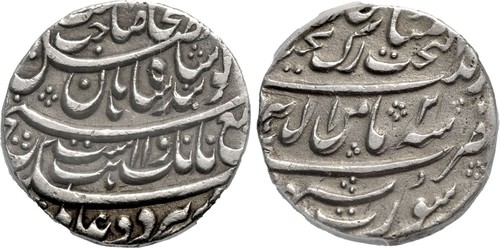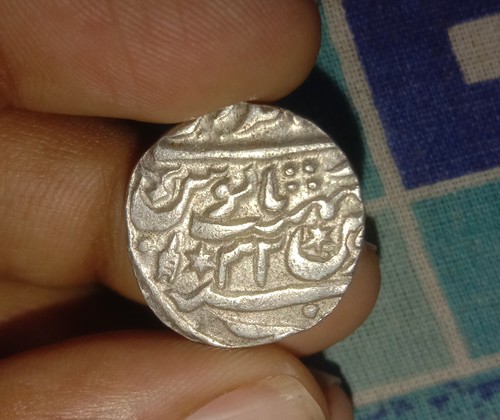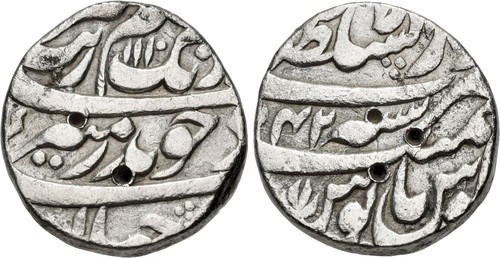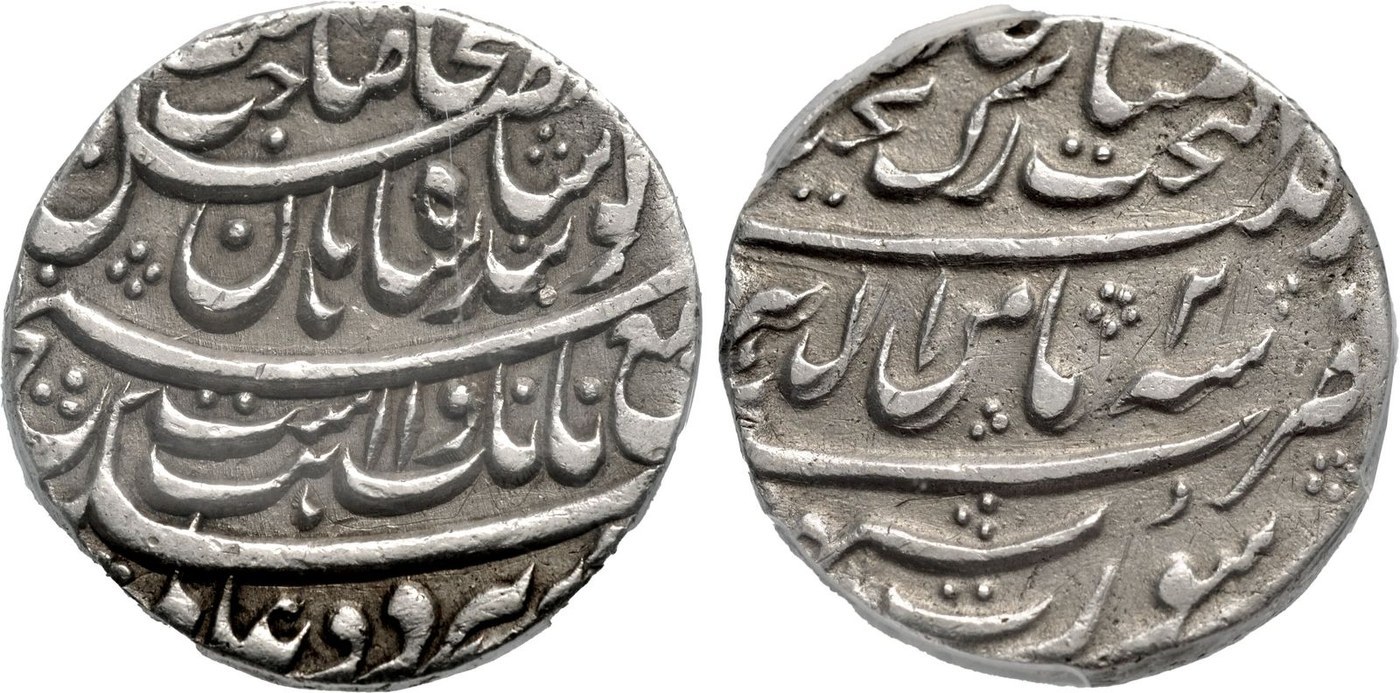
Banda Singh Bahadur Sikh Rupee
A hand-struck silver rupee of the early Sikh Khalsa, issued in the name of the Sikh Gurus during Banda Singh Bahadur's short-lived sovereignty, dated Khalsa Era Year 2.
- Country
- India
- Denomination
- Rupee
- Metal
- Silver
Got a coin like this?
Identify any coin from a photo, free.
Overview
The Banda Singh Bahadur Sikh rupee is a hand-struck silver coin from the earliest phase of Sikh coinage, the period of independent Sikh rule established in the Punjab by the military commander Banda Singh Bahadur in the years after 1710. The example shown carries script set within decorative bands framed by dots and flourishes on both faces, and is dated to Year 2 of the Khalsa Era, corresponding to about 1711.
Like other coins of this tradition, it is entirely aniconic: it bears no portrait or figure, only calligraphic legends. Rather than naming a king, the classic legend of this coinage invokes the Sikh Gurus — Guru Nanak and Guru Gobind Singh — presenting the coin as struck by the grace of the Guru rather than by a temporal monarch.
Genuine early pieces of this exact type are historically important and were produced only briefly, so the surviving record is small. Coins bearing this design and the Khalsa-era dating are prized as tangible relics of the moment Sikh sovereignty was first proclaimed on money.
History & Background
Banda Singh Bahadur (1670–1716) was a Sikh military leader appointed by Guru Gobind Singh to lead the Khalsa against Mughal authority in the Punjab. After his forces captured Sirhind in 1710, he established a short-lived independent Sikh administration and, according to the numismatic tradition, ordered coinage struck in the name of the Gurus to mark that sovereignty.
The coinage introduced its own dating system, the Khalsa Era (sometimes called the Nanakshahi era), counted from the founding of Sikh rule rather than from the Hijri or Mughal regnal calendars. A coin dated Year 2 of this era therefore belongs to the very beginning of the series, around 1711, at the height of Banda's campaigns.
Banda's rule was brief. Mughal forces regrouped, besieged his stronghold, and he was captured and executed in 1716. The coinage he inaugurated, however, set the template for later Sikh money: the same Guru-centered legend and Persian couplet form were revived and continued by the Sikh misls and, ultimately, the Sikh Empire under Ranjit Singh later in the eighteenth and nineteenth centuries.
How to Identify
This is a broad, hand-struck silver rupee, roughly circular but often irregular, generally in the size and weight range of the contemporary Mughal rupee standard — on the order of about 20–24 mm across and near 11 grams. Because it was struck by hand from dies that were larger than the blank, the legend is usually only partly visible and the coin frequently appears off-center.
The defining features are the calligraphic legends set within ornamental bands and cartouches, surrounded by dots and floral flourishes, on both obverse and reverse. The classic couplet of this coinage credits victory and grace to Guru Nanak and Guru Gobind Singh rather than to a named ruler, while the reverse carries a mint-and-era formula. The presence of the Khalsa-era dating — here Year 2 — rather than a Hijri (AH) date or a Mughal regnal year is a key marker separating this coinage from ordinary Mughal rupees.
There is no image, coat of arms, or Latin lettering, only Arabic-script Persian calligraphy (and, on some pieces, Gurmukhi elements). Reading the legend to confirm the Guru couplet and the Khalsa-era year is the surest way to place a coin in this earliest Sikh series rather than mistaking it for a look-alike Mughal or later Sikh issue.
Value & Collectibility
Authentic early Sikh rupees tied to Banda Singh Bahadur's brief sovereignty are historically significant and were made only in small numbers over a short span, so genuine, well-attributed examples are scarce and can command strong collector interest well above their silver content.
At the same time, the Guru-couplet legend and the Nanakshahi form were reused across the much larger later Sikh coinage of the misls and the Sikh Empire, and modern commemorative strikes and replicas of this famous type also circulate. As a result, many coins offered under this name are in fact later issues, restrikes, or reproductions, and value depends heavily on confirming that a given piece truly belongs to the early Khalsa-era series.
Because of that, precise pricing is impossible to state in the abstract: an ordinary later Sikh rupee, a commemorative, and a securely attributed early Banda-period coin sit at very different levels. Condition, completeness of the legend, and — above all — reliable attribution and authentication are the decisive factors, so figures here are general context rather than fixed values.
Frequently asked questions
Who was Banda Singh Bahadur?
Banda Singh Bahadur (1670–1716) was a Sikh military commander sent by Guru Gobind Singh to lead the Khalsa in the Punjab. After capturing Sirhind in 1710 he established a short-lived independent Sikh rule and is credited with inaugurating Sikh coinage before his capture and execution in 1716.
Whose name is on the coin?
Unlike Mughal coins that name an emperor, this coinage honors the Sikh Gurus. The classic legend credits grace and victory to Guru Nanak and Guru Gobind Singh, presenting the coin as struck by the Guru's authority rather than a temporal king.
What does 'Khalsa Era Year 2' mean?
The coinage used its own calendar, the Khalsa (or Nanakshahi) Era, counted from the founding of Sikh rule rather than from the Hijri or Mughal calendars. Year 2 places the coin at the very start of the series, around 1711.
Is the coin made of silver?
Yes. It follows the silver rupee standard of the period, a broad hand-struck coin of roughly 11 grams. It is essentially silver rather than a base-metal alloy.
Why does the coin have no picture on it?
Sikh coinage, like Mughal coinage, was aniconic — it avoided portraits and figures. Instead it carries only calligraphic legends set within decorative bands and flourishes, naming the Gurus and giving the mint-and-era formula.
Banda Singh Bahadur Sikh Rupee guides
In-depth guides for identifying, valuing, and collecting Banda Singh Bahadur Sikh Rupee.