Aurangzeb Rupee
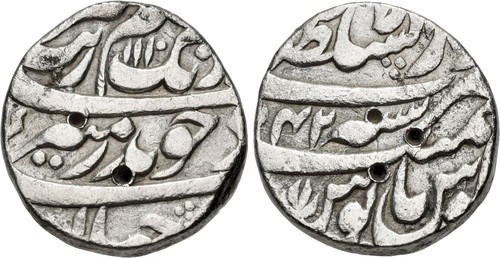
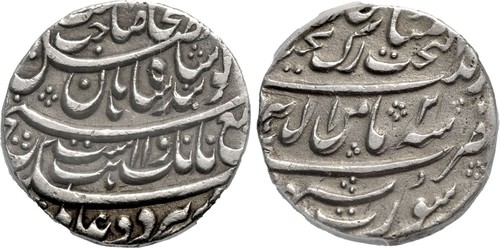
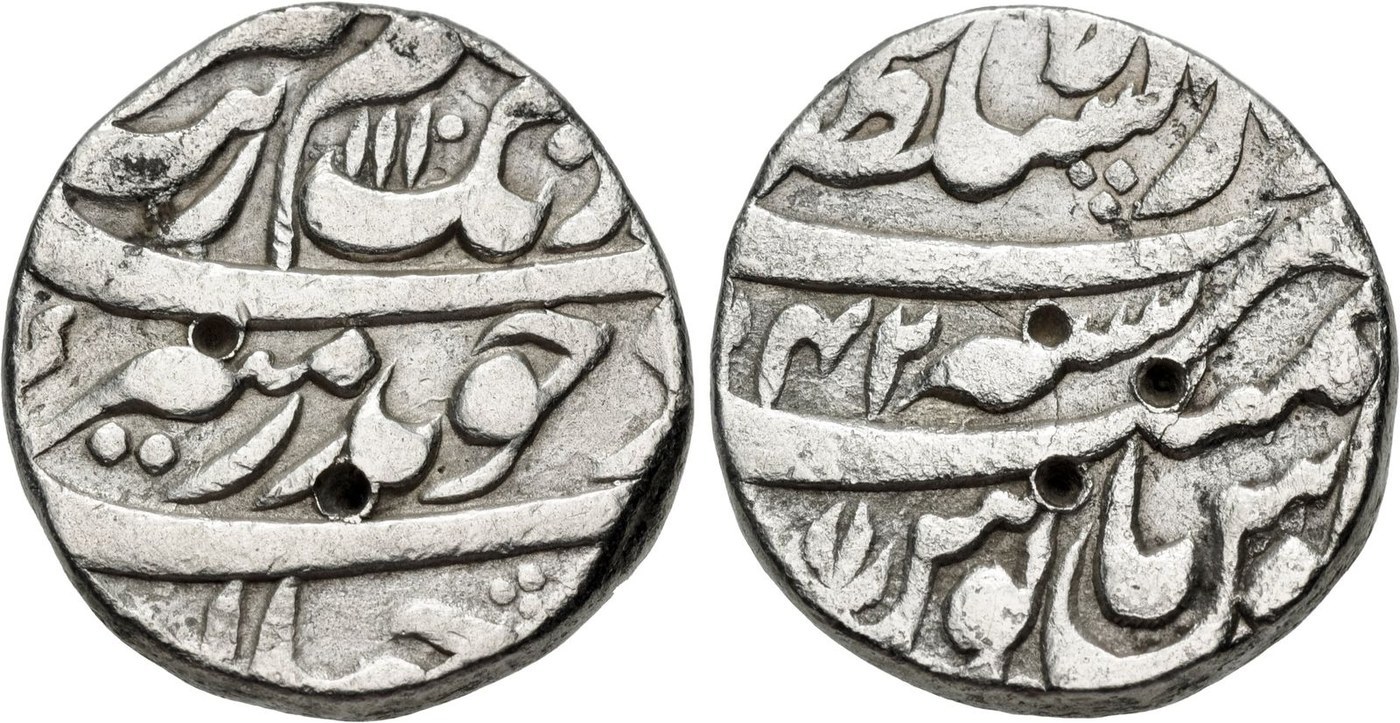
A broad, hand-struck silver rupee of the Mughal emperor Aurangzeb (Alamgir), carrying a Persian couplet and mint-and-year data rather than the usual Islamic creed.
- Country
- India
- Denomination
- Rupee
- Metal
- Silver
Got a coin like this?
Identify any coin from a photo, free.
Overview
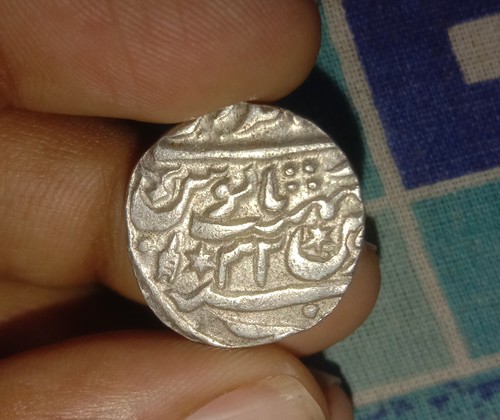
The Aurangzeb rupee is a hand-struck silver coin issued during the long reign of the Mughal emperor Aurangzeb, who ruled under the title Alamgir from 1658 to 1707. The example shown carries Persian inscriptions set within cartouches on the obverse and further Persian legends framed by ornamental patterns on the reverse, dated AH 1110 (AD 1699–1700).
Like other Mughal rupees, it is a wholly aniconic coin: it bears no portrait or figural imagery, only calligraphic Persian text. The coin's identity as an Aurangzeb issue is established by the ruler's name and title woven into the obverse legend, while the reverse records where and when it was struck.
Because Aurangzeb reigned for nearly half a century and coined at a large number of mints, his rupees are among the most frequently encountered pieces of Mughal silver in the collector market today.
History & Background
Aurangzeb (1618–1707) was the sixth Mughal emperor and reigned for roughly 49 years, one of the longest reigns in the dynasty's history. The silver rupee was the principal coin of the Mughal monetary system, complemented by the gold mohur above it and copper dam and paisa below it, and it circulated across a vast territory covering much of the Indian subcontinent.
Aurangzeb is well known for altering the standard Mughal coin legend. Where earlier emperors placed the Islamic kalima (declaration of faith) on their coinage, he replaced it with a Persian couplet praising the ruler, reportedly out of concern that the sacred text should not be handled or defiled in everyday commerce. This royal couplet, naming Aurangzeb Alamgir, becomes a defining feature of his rupees.
The coin dated AH 1110 falls late in his reign, around his fourth decade on the throne, a period when the empire was heavily engaged in prolonged campaigns in the Deccan. Mughal rupee production continued under his successors, and the rupee standard he maintained went on to influence coinage across India for generations.
How to Identify
An Aurangzeb rupee is a fairly broad, roughly circular to slightly irregular silver coin, typically in the range of about 21–24 mm across and near 11.0–11.6 grams, reflecting the Mughal rupee weight standard. Because the coins were struck by hand from dies larger than the flan, the legend is often only partly visible and the piece can look off-center.
The obverse carries a Persian couplet naming the emperor, with the words distributed among cartouches; the reverse gives the mint formula — typically the phrase "zarb" (struck at) followed by the mint city, the regnal (julus) year, and often the Hijri date — surrounded by ornamental devices. The example here is dated AH 1110 (AD 1699–1700). Reading the ruler's name in the obverse legend is the surest way to attribute the coin to Aurangzeb rather than to an earlier or later Mughal emperor.
There is no portrait, coat of arms, or Latin lettering — only Arabic-script Persian calligraphy. The absence of the kalima and the presence of Aurangzeb's laudatory couplet help separate his issues from those of predecessors such as Shah Jahan, whose coins more commonly carry the creed.
Value & Collectibility
Aurangzeb rupees are, as a group, among the more affordable pieces of Mughal silver. His very long reign and the large number of active mints produced enormous quantities of these coins, so ordinary examples in average circulated grade typically trade at modest premiums over their silver content rather than at scarce-coin prices.
Value within the series is driven mainly by the mint, the specific date and regnal year, the completeness and sharpness of the legend, and overall condition. Coins from rare or short-lived mints, unusually well-centered strikes showing the full couplet, and pieces with clear attribution can command significantly more than common issues.
As with all hand-struck early coins, precise pricing depends on grade, eye appeal, and specialist demand, so figures here are general context rather than fixed values. For a coin like this, an accurate reading of the mint and date is the single biggest factor in determining where it sits in the market.
Frequently asked questions
Who was Aurangzeb and when did he rule?
Aurangzeb, who took the imperial title Alamgir, was the sixth Mughal emperor and ruled from 1658 to 1707. Coins in his name, including this rupee dated AH 1110, were struck throughout that long reign.
Is the Aurangzeb rupee made of real silver?
Yes. The Mughal rupee was a high-purity silver coin struck to a standard weight of roughly 11 grams. Aurangzeb's rupees follow that standard and are essentially silver, not a base-metal alloy.
Why is there no image of the emperor on the coin?
Mughal coinage was aniconic, meaning it avoided portraits and figures. Instead the coin carries only Persian calligraphy — a royal couplet naming Aurangzeb on one side and the mint, date and regnal year on the other.
What does AH 1110 mean?
AH refers to the Islamic Hijri calendar. AH 1110 corresponds to roughly AD 1699–1700, placing this coin in the later part of Aurangzeb's reign.
Are Aurangzeb rupees rare or valuable?
Most are common because he ruled nearly 49 years and coined at many mints, so ordinary examples carry only a modest premium over silver value. Rare mints, scarce dates, and exceptionally well-struck coins are worth more.
Aurangzeb Rupee guides
In-depth guides for identifying, valuing, and collecting Aurangzeb Rupee.