
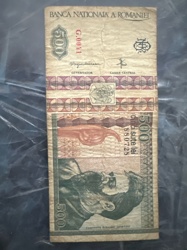
500 Lei (1991)
Romania · 1991
500 Lei
Category
Browse uncertain; could be from various european or mediterranean regions coins identified by the Coin Identifier community.
500 Lei (1991)
Romania · 1991
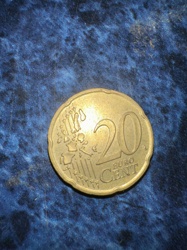
Euro Cent
Eurozone (specific country not identifiable from image, as obverse is not shown) · 2002 (based on common initial issue year for Euro coins; specific year not identifiable from this image alone)
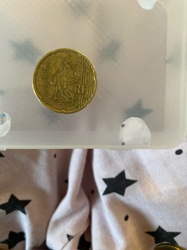
50 Euro Cent
France · Likely early 2000s (exact year not visible, but design is from early Euro series)
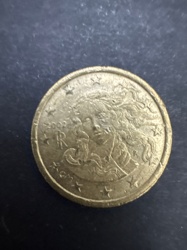
20 Cents Euro Coin
Italy · 2002

2 Euro Coin
Eurozone (Various countries) · 2011

1 Euro (Maltese National Side)
Malta · 2008 (first year of issue for Maltese Euro coins) onwards
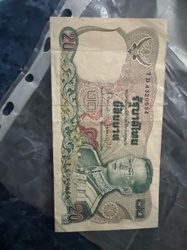
20 Baht Banknote (Type 12)
Thailand · 1991 (Buddhist Era 2534)
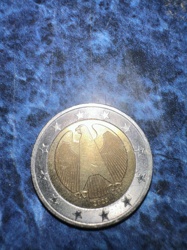
German 2 Euro Coin (Bundesadler)
Germany · 2008
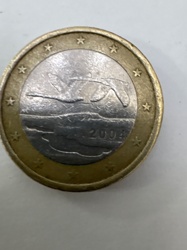
Finnish 1 Euro Coin
Finland · 2004
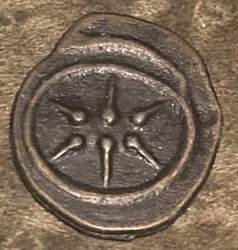
Ancient Roman or Byzantine Seal/Amulet (likely not a coin)
Roman Empire or Byzantine Empire (approximation) · Unknown (likely Ancient to Medieval period)
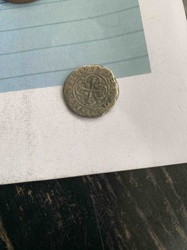
Medieval Silver Penny
Likely England or a Northern European region · Likely 12th to 14th Century AD (Medieval Period)
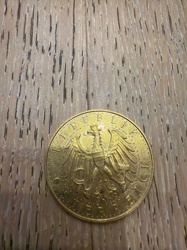
Austrian 4 Ducat
Austria · Restrike (various dates, commonly 1915)

Washington Quarter
United States of America · The year is not clearly visible in the provided image. It is likely a modern quarter issued after 1964 based on the apparent composition (non-silver). To determine the exact year, the date on the coin would need to be visible.
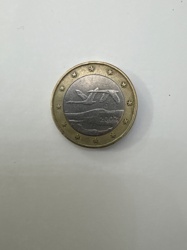
Finnish 1 Euro Coin
Finland · 2002
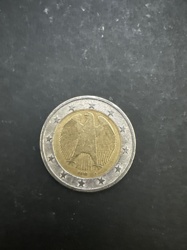
2 Euro Coin (German)
Germany · 2018

2 Euro Coin (Common Design)
Austria · 2007
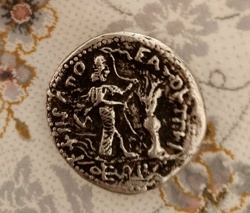
Denarius, Marcus Aurelius or Commodus
Roman Empire · Circa 161-192 AD (based on similar examples of common reverses for these emperors)
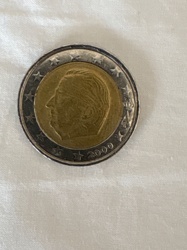
Belgian 2 Euro Coin (First Series)
Belgium · 2000
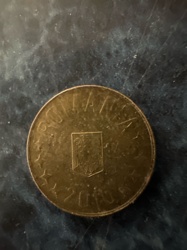
50 Euro Cent
Romania (as a commemorative coin for the National Bank of Romania) · 2010
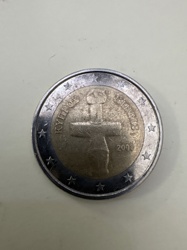
Cyprus 2 Euro Coin (Pomos Idol)
Cyprus · 2008
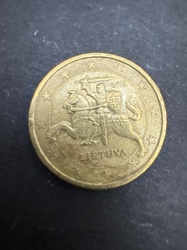
Lithuanian Euro Cent (Vytis)
Lithuania · 2015
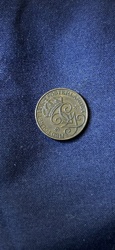
5 Ore (likely)
Sweden · 1916 (inferred from common Swedish coinage designs of the era which closely match the presented image, particularly the monogram of Gustaf V and the specific motto used on 5 öre coins)
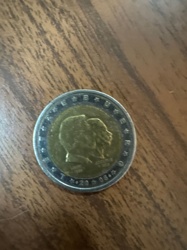
2 Euro Commemorative Coin - Grand Duke Henri and Grand Duke Guillaume IV
Luxembourg · 2006
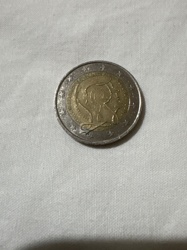
2 Euro Commemorative Coin (Beatrix and Claus)
Netherlands · 2006
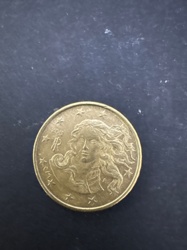
50 Euro Cent
Italy · 2002 (based on image, though could be a later year with same design)
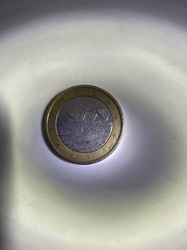
Spanish 2 Euro Commemorative Coin - Escorial (2013)
Spain · 2013
Could potentially be a Shilling, Sixpence, or similar denomination of British coinage.
United Kingdom (Great Britain) · Unable to determine the exact year from the provided image due to blurriness and distance. However, based on the design elements visible, it likely dates from the late 19th or early to mid-20th century. For example, the shield design with crown is present on various British coins across different reigns, including Victoria, Edward VII, George V, and George VI.
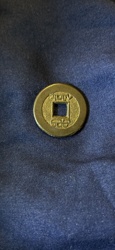
Chinese Cash Coin (e.g., Kai Yuan Tong Bao, Song Dynasty Cash Coin, Qing Dynasty Cash Coin, etc. - specific name depends on characters)
China · Uncertain from the image alone, but likely dates from a period between the Tang Dynasty (618-907 AD) and the Qing Dynasty (1644-1912 AD), as this style was common throughout these periods.
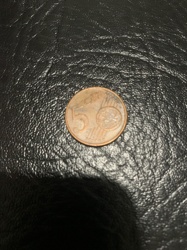
5 Euro Cent Coin
Eurozone (any member state of the European Union that has adopted the Euro) · The exact year is not clearly visible in the image, but these coins were first issued in 2002 and continue to be minted annually by various Eurozone countries.
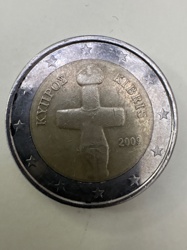
Cyprus 2 Euro Coin (Cruciform Idol)
Cyprus · 2009
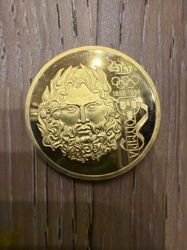
Olympic Games Centennial Commemorative Medal (Zeus/Olympia)
Greece · 1996
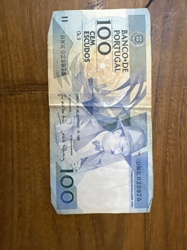
100 Escudos Banknote (Series of 1988)
Portugal · November 1988
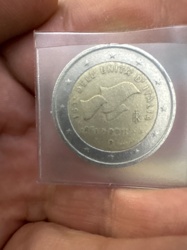
Italian 2 Euro Commemorative Coin - 150th Anniversary of Italian Unification
Italy · 2011
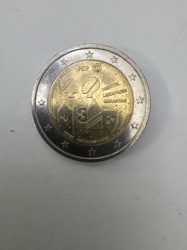
2 Euro Commemorative Coin - 150 Years of the Public Security Police (PSP)
Portugal · 2017
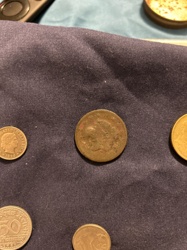
Due to the heavy wear, the exact coin name for the central coin is difficult to determine without clearer images of both sides. It might be a British Penny or Halfpenny, or a coin from another European country, given the other coins in the image. The coin on the left is a Swiss 10 Rappen.
The central coin's country of origin is uncertain due to poor visibility. The coin on the left is from Switzerland. The coin below it seems to be from Denmark. · The year of issue for the central coin is undeterminable from the image. The Swiss coin on the left is from 1938. The specific year for the 50 Ore coin is not fully visible, but it appears to be a 20th-century coin.
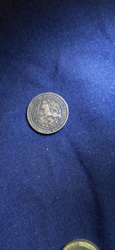
Lion Daalder
Dutch Republic (specifically, provinces such as Zeeland - 'ZEL' in the inscription) · Based on the visible inscription 'MO: ARG: ORD: ZEL: TRA: IMP: CIVT: ZEL:', this coin is a Zeeland (ZEL) issue. The exact year is not clearly visible in the image, but Lion Daalders were minted from 1577 until the late 17th century. To determine the precise year, a clearer view of the obverse or reverse would be needed, typically found near the bottom of the lion or on the reverse design. Given the general design, it is likely from the 17th century.
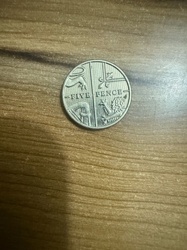
Five Pence Coin
United Kingdom · Due to the commonality of this design (introduced in 2008) and the lack of a visible date in the image, it is difficult to determine the exact year. It could be any year from 2008 onwards until newer designs are introduced or the coin is demonetized. The change in composition to steel plated with nickel occurred in 2011 for cost-saving measures, which can help narrow down the date if the coin's weight or magnetic properties are known.
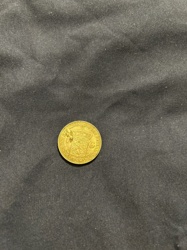
Dutch Gold Ducat (Netherlands Ducat)
Netherlands · Based on the visual characteristics, especially the style of the coat of arms and the visible text indicating 'BELG. PROV. FOED.', this coin appears to be a Dutch Gold Ducat. While an exact year is not clearly visible in the image, these ducats were minted for many years. Given the clarity of the design and the general appearance, it could range from the 18th to the early 20th century. A definitive year cannot be provided without a clearer image of the date, but many were struck in the 18th and 19th centuries.
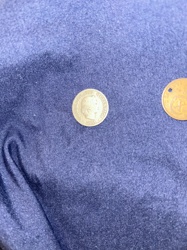
1 Gulden (Queen Wilhelmina)
Netherlands · Based on the visible portrait of Queen Wilhelmina, the year could be anywhere from 1898 to 1945, as this design was used for various denominations, including the Gulden, during her long reign. A precise year cannot be determined without seeing the reverse side or a clearer view of the obverse date. However, the visible inscription '19' suggests it is from the early 20th century, possibly '190X' or '191X'.
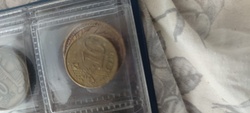
Greece 10 Euro Cent (Rigas Feraios)
Greece / Hellenic Republic · 2006
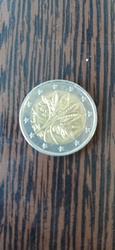
France 2 Euro (Tree of Life)
France (French Republic) · 1999-2006 (specific date unclear due to image focus)
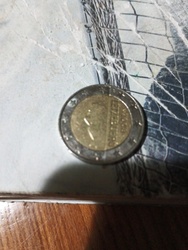
Luxembourg 2 Euro (Grand Duke Henri)
Luxembourg · 2002-2024