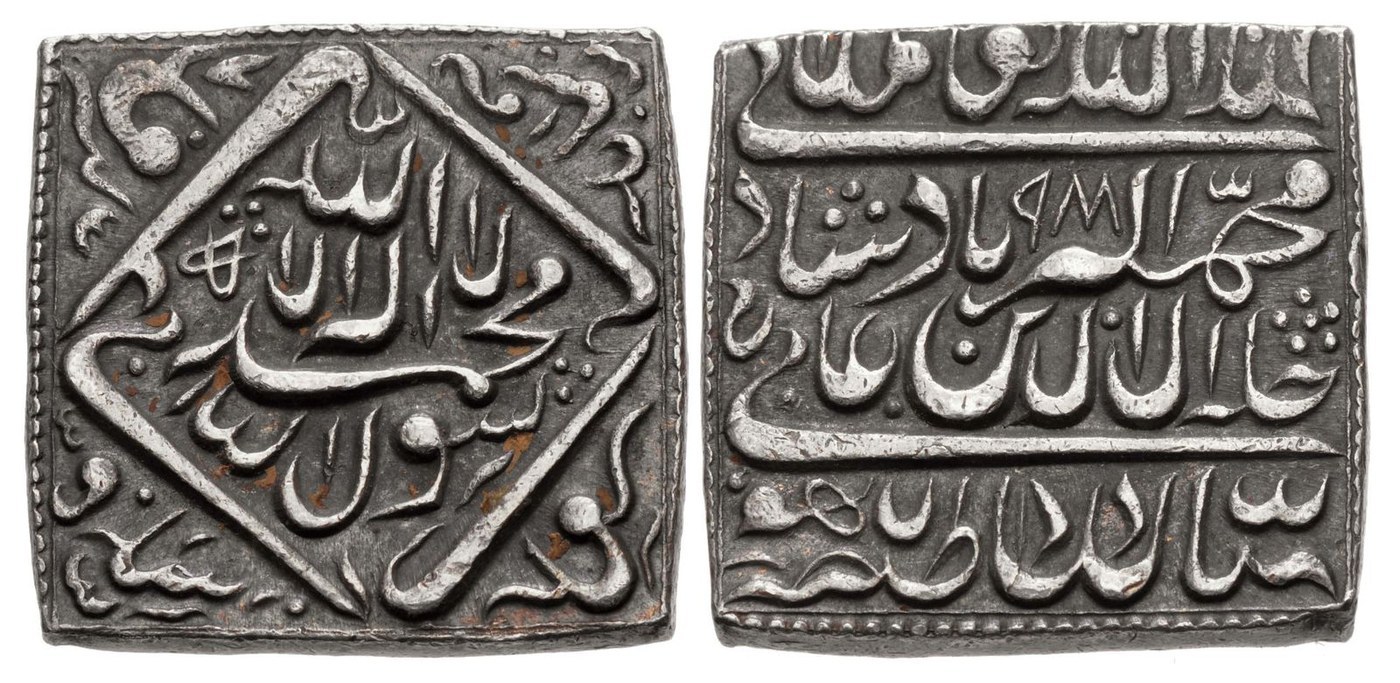
Mughal Square Rupee Token
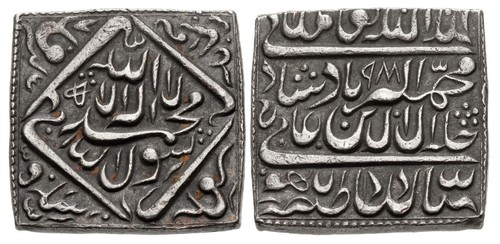
A square silver-colored token copying a Mughal square rupee, with Persian and Islamic inscriptions and an AH 988 date, produced as a later reproduction.
- Country
- India (Mughal Empire)
- Denomination
- Square Rupee
- Metal
- Silver
Got a coin like this?
Identify any coin from a photo, free.
Overview
The Mughal Square Rupee Token is a square-format silver-colored piece that reproduces the design of a Mughal Empire square rupee, an unusual four-cornered coin type associated with the era of Emperor Akbar in the late sixteenth century. The example pictured carries Persian calligraphy arranged within a square on one face and additional Islamic inscriptions on the other, following the layout of the historic original.
Crucially, this item is catalogued as a token or reproduction rather than an authentic period rupee. It bears the original design's date of AH 988 (roughly 1580 CE), but the piece itself is understood to be a 19th-century or later copy. Such copies were made as souvenirs, jewelry blanks, temple tokens and collector novelties, and they circulate widely today among world-coin enthusiasts.
As a token it is valued for its decorative and historical interest in evoking Mughal square coinage, not as a genuine Akbar-era rupee. The square shape, the flowing Persian script and the religious formulae make it an attractive and educational piece, while the reproduction status keeps it firmly in the affordable, low-liability category.
History & Background
The genuine Mughal square rupee belongs to the reign of Akbar (1556-1605), who reformed the empire's coinage and issued distinctive square (mihrabi) silver rupees alongside the more common round type. These coins typically bore the Kalima (the Islamic declaration of faith) and the names of the first four caliphs, along with mint and date information rendered in elegant Persian and Arabic script. The date AH 988 corresponds to about 1580 CE, within Akbar's reign, and reflects the Islamic (Hijri) calendar used across the Mughal state.
The token or copy pictured here reproduces that historic type but was made much later, generally dated to the nineteenth century or after. Reproductions of Mughal square rupees were produced in India and beyond for a range of purposes: souvenirs for travelers, ornamental pieces mounted in jewelry, religious and festival tokens, and study pieces for collectors who could not obtain the rare originals.
Because the design was frozen at its original AH 988 date, the copy carries that year even though the object itself is far younger. This is a common practice with reproductions, which faithfully imitate the historic inscriptions and date while being manufactured generations later. The result documents ongoing fascination with Akbar's unusual square coinage rather than the coinage of 1580 itself.
How to Identify
Identify the piece first by its square format and silver color. It is a four-cornered (square) token, a shape that immediately recalls the Mughal square rupee and separates it from ordinary round coins. The surfaces show Persian and Arabic calligraphy rather than portraits or heraldry, laid out within the square field.
One face carries Persian calligraphy arranged in the square giving the ruler's or mint's inscription, while the other bears additional Islamic inscriptions, following the Kalima-and-caliphs layout of the original type. The AH 988 date appears as part of the design. Fully aniconic (image-free) script-based devices are typical of Mughal and Islamic coinage and are reproduced here.
Treat this specific item as a token or reproduction, not a certified original. Copies often differ from genuine Akbar rupees in weight, fineness, sharpness of the calligraphy and surface finish, and may show casting texture or modern manufacturing traces. Authentic Mughal square rupees are rare and heavily studied, so any square rupee should be assessed against specialized references and, where value is at stake, by an expert in Indian and Islamic coinage.
Value & Collectibility
As a token or later reproduction, the Mughal Square Rupee Token trades in a modest, affordable collectible range rather than at the prices commanded by genuine Akbar-era square rupees. Its worth comes from decorative appeal, novelty and educational interest, not from rarity or precious-metal content, and the silver color may or may not correspond to significant silver.
By contrast, authentic Mughal square rupees of Akbar are scarce and can be highly valuable, so the gap between a genuine coin and a copy is large. This makes correct attribution essential: a piece confirmed as a modern token should be priced as such, while an item suspected to be genuine warrants professional evaluation before any sale or purchase.
Because reproductions vary in quality and materials, treat any single figure with caution and compare against recent sales of clearly identified tokens. For any square rupee presented as authentic, third-party authentication is strongly advised, as this design has been widely copied and reproductions are common in the market.
Frequently asked questions
Is this a real Mughal coin?
No. This item is catalogued as a token or reproduction that copies a Mughal square rupee. It imitates the historic design and its AH 988 date but is understood to be a 19th-century or later copy, not an authentic Akbar-era coin.
Why is the coin square?
It reproduces the Mughal square rupee, an unusual four-cornered silver coin type associated with Emperor Akbar in the late 1500s. The square (mihrabi) format is the design's most distinctive feature, and the token faithfully copies it.
What does AH 988 mean?
AH 988 is a date in the Islamic (Hijri) calendar, corresponding to about 1580 CE during Akbar's reign. The token carries this date because it copies the original design, even though the piece itself was made much later.
What do the inscriptions say?
The faces carry Persian and Arabic calligraphy following the original type, typically including the Kalima (the Islamic declaration of faith) and related religious and mint formulae. The coin is aniconic, using script rather than images.
Is it worth a lot of money?
As a token or reproduction, it sits in an affordable range valued for novelty and historical interest. Genuine Akbar square rupees are rare and far more valuable, so correct identification matters. Have any suspected original professionally authenticated.
Mughal Square Rupee Token guides
In-depth guides for identifying, valuing, and collecting Mughal Square Rupee Token.