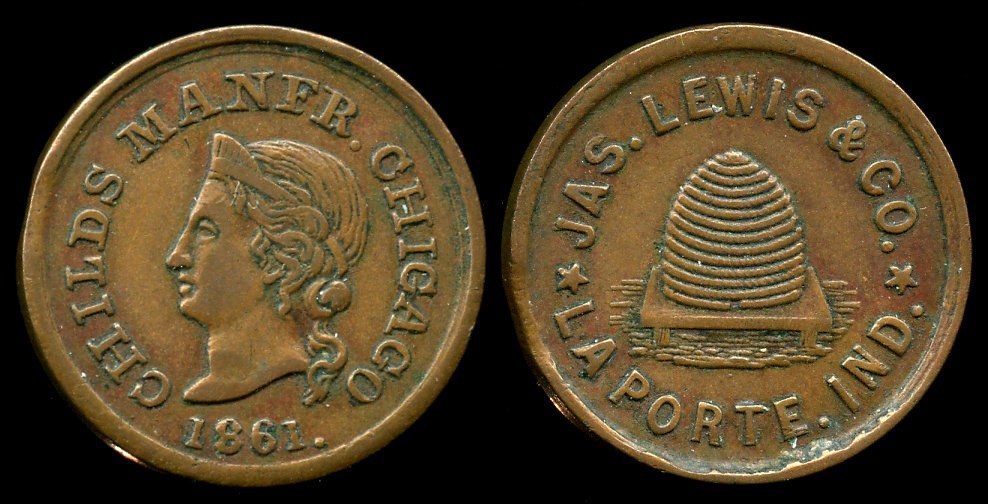
James Lewis and Company Civil War Token
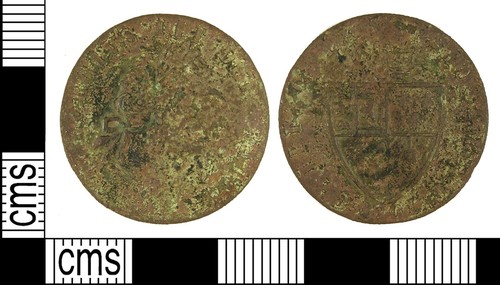
A privately struck Civil War store card advertising Jas. Lewis & Co. of La Porte, Indiana, with a classical head obverse and a beehive reverse.
- Country
- United States
- Denomination
- 1 Cent Token
- Metal
- Copper
Got a coin like this?
Identify any coin from a photo, free.
Overview
The James Lewis and Company token is a Civil War store card: a privately produced cent-sized copper piece issued during the coin shortage of the early 1860s. Its obverse shows a classical male head facing left with the legend "CHILDS MANUFACTO CHEO" and the date 1861, while the reverse carries a beehive and the merchant advertising "JAS LEWIS & CO" of "LA PORTE IND."
Store cards like this one served two purposes at once. They passed at retail as an informal substitute for the scarce federal cent, and they advertised the business whose name appeared on the die. The beehive is a traditional emblem of industry and thrift, a common motif on nineteenth-century commercial tokens.
Because it names a specific merchant and town, this piece belongs to the tradesman or store-card branch of Civil War tokens rather than the anonymous "patriotic" branch. Collectors pursue it both as an Indiana merchant token and as an example of the die-sinker stock designs of the period.
History & Background
Civil War tokens were struck privately from about 1861 to 1864, when hoarding drove official cents out of circulation. Merchants, die sinkers, and manufacturers filled the gap with millions of copper pieces roughly the size of the small cent, most of which were accepted at face value in everyday trade.
This token was made for James Lewis and Company, a business in La Porte, Indiana. Its obverse die was cut by a commercial die sinker whose own advertising appears in the legend "CHILDS MANUFACTO CHEO," a reference to the Childs firm associated with Chicago die and stamp work. Reusing a die maker's stock or self-advertising obverse alongside a merchant reverse was standard practice, which is why the same head-and-date obverse can appear on tokens for several unrelated businesses.
Congress effectively ended the series by outlawing private one-cent tokens in 1864, after which these pieces left circulation and became collectibles. Indiana store cards are catalogued today in the standard Fuld reference system by town and merchant, alongside the broader Civil War token series.
How to Identify
Look first at the two legends. The obverse reads "CHILDS MANUFACTO CHEO" around a left-facing classical male profile with the date 1861; the reverse shows a centered beehive with "JAS LEWIS & CO" and "LA PORTE IND." The pairing of a Childs-style advertising obverse with the Lewis beehive reverse is what identifies this specific store card.
The piece is copper, cent-sized (roughly 19-20 mm), thin, and struck with a plain edge, matching typical Civil War store cards. Genuine examples usually show honest brown or reddish-brown toning and the slightly uneven strike characteristic of small private mints of the 1860s.
Do not confuse the 1861 date with a mintage or a federal issue; on Civil War tokens the date reflects the die, and pieces circulated for several years afterward. The absence of "United States," "One Cent," or any federal device confirms it is a private token rather than official coinage.
Value & Collectibility
As with most Civil War store cards, value depends on rarity of the specific merchant, the metal, and condition rather than on the copper content, which is negligible. Common Indiana store cards in circulated grades typically trade in the low tens of dollars, while scarcer merchants, higher grades, or off-metal strikings (brass, copper-nickel, silver) can bring substantially more.
Well-preserved brown or red-brown examples with sharp beehive detail and full legends command a premium over worn, corroded, or cleaned pieces. Because die pairings vary, an exact attribution to the correct Fuld Indiana number can meaningfully affect price.
For a specific valuation, match the token to its Fuld store-card listing and compare recent sales of the same die pairing and grade. Treat any single figure with caution; token prices move with collector demand for the particular town and merchant.
Frequently asked questions
Is this an official United States one-cent coin?
No. It is a privately struck Civil War token that circulated as an informal cent substitute during the early 1860s coin shortage. It carries no federal denomination or authority and is classified as a merchant store card.
Why does it say both 'Childs' and 'Jas Lewis & Co'?
The obverse advertises the die-sinking firm (Childs) that cut the die, while the reverse advertises the merchant, James Lewis and Company of La Porte, Indiana. Pairing a die maker's stock obverse with a merchant reverse was common practice.
What does the beehive on the reverse mean?
The beehive is a traditional symbol of industry, thrift, and cooperative labor. It was a popular decorative emblem on nineteenth-century American commercial tokens and does not indicate a specific location or value.
Does the 1861 date mean it was made only in 1861?
Not necessarily. On Civil War tokens the date reflects the die that was engraved. Pieces bearing 1861 often continued to circulate through about 1864, when private cent-sized tokens were outlawed.
James Lewis and Company Civil War Token guides
In-depth guides for identifying, valuing, and collecting James Lewis and Company Civil War Token.
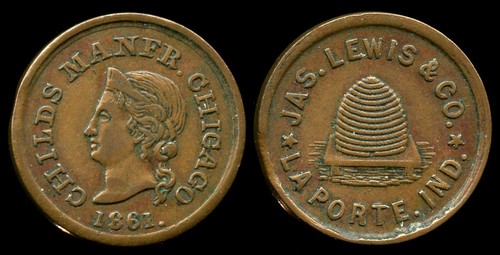
James Lewis and Company Civil War Token identified by the community
Real coins identified with Coin Identifier.