How to Identify the James Lewis and Company Civil War Token
Diagnostic features for the Jas. Lewis & Co. La Porte, Indiana store card: legends, beehive reverse, copper cent size, and authentication tips.
Read the full James Lewis and Company Civil War Token encyclopedia entry →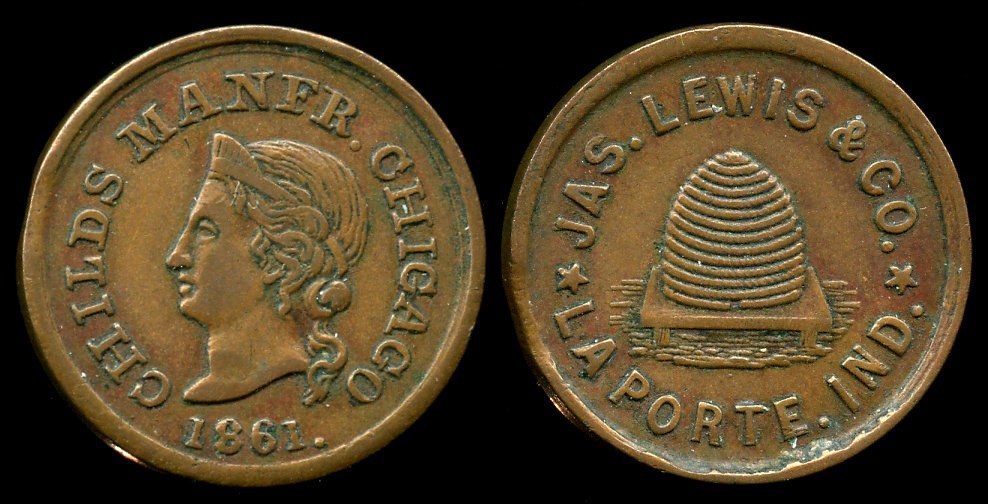
Start with the legends, because they are the surest fingerprint. Confirm the reverse reads "JAS LEWIS & CO" with "LA PORTE IND" around a centered beehive, and that the obverse reads "CHILDS MANUFACTO CHEO" around a left-facing classical head dated 1861. Both sides together confirm this exact store card; either side alone can appear in other combinations.
Check the physical profile next. The token should be copper, about 19-20 mm across, thin, plain-edged, and light in hand, matching the small cent it substituted for. Weigh and measure it if you can: a modern novelty copy or a much larger, thicker, or magnetic piece is a warning sign.
Examine the surfaces for age-consistent wear. Genuine examples show even brown to red-brown patina, softened high points on the head and beehive, and the minor die and centering irregularities typical of small 1860s private mints. Uniform bright color, seams, casting bubbles, or a suspiciously sharp "new" look can indicate a cast copy or a cleaned piece.
Watch for look-alikes and cross-attribution. The same classical-head obverse die was used with reverses for other merchants, so identification depends on the Lewis beehive reverse. To pin down catalog value, match the piece to its Fuld Indiana store-card number rather than relying on the 1861 date alone, which is a die date and not a mintage year.
When in doubt, consult a Civil War token specialist or a third-party grading service. Because store cards vary in rarity by merchant and metal, professional attribution protects against both counterfeits and misidentified die pairings.
Frequently asked questions
What is the quickest way to identify this specific token?
Read both legends. The reverse 'JAS LEWIS & CO / LA PORTE IND' with a beehive, paired with the obverse 'CHILDS MANUFACTO CHEO' classical head dated 1861, uniquely identifies this store card.
What size and metal should a genuine example be?
It should be copper, roughly 19-20 mm in diameter, thin, non-magnetic, and plain-edged, close to the size and weight of an 1860s U.S. small cent.
How can I tell a real token from a modern copy?
Look for even period brown patina, honest wear on the head and beehive, and small strike irregularities. Casting seams, bubbles, uniform artificial color, magnetism, or off dimensions suggest a reproduction.
Why does attribution to a Fuld number matter?
The same obverse die appears on other merchants' tokens, so value and rarity are tied to the exact die pairing. Matching the Fuld Indiana store-card listing confirms the correct variety and its market range.
James Lewis and Company Civil War Token identified by the community
Recent James Lewis and Company Civil War Token coins identified with Coin Identifier.