How to Identify the Julius Caesar Elephant Denarius
A visual guide to the widely-issued elephant-and-serpent denarius struck for Julius Caesar, covering its obverse elephant design, reverse priestly implements, and telltale legend.
Read the full Julius Caesar Elephant Denarius encyclopedia entry →
What It Is
This silver denarius, struck in Caesar's name around 49-48 BC as he marched toward Rome at the start of civil war, is one of the most commonly encountered coins associated with Julius Caesar due to its comparatively large mintage, produced to help fund his military campaign. It does not show Caesar's portrait, which came slightly later in his coinage.
Obverse (Front)
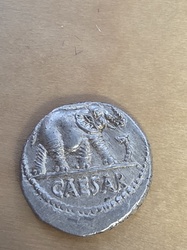
The obverse shows an elephant walking right, trampling on what is usually interpreted as a horned serpent or dragon, with the legend "CAESAR" in raised letters below or beside the elephant.
Reverse (Back)
The reverse depicts a set of Roman priestly and sacrificial implements: typically a simpulum (ladle), aspergillum (sprinkler), securis (axe), and apex (a priest's pointed cap), symbols referencing Caesar's role as Pontifex Maximus, the chief priest of Rome. The reverse generally carries no additional legend beyond the symbols themselves.
Size, Weight, Metal, and Edge
The coin is silver, roughly 18-20 mm in diameter, and weighs approximately 3.5-4 grams, consistent with denarii of the late Republican period. As a hand-struck ancient coin, it often shows an irregular, non-perfectly round flan and varying centering from piece to piece.
Mint Marks
This issue does not carry a mint mark in the modern sense; it is generally attributed to a mobile military mint that traveled with Caesar's forces rather than a fixed civic mint, an attribution based on style and hoard evidence rather than an explicit mark on the coin.
Telling It Apart from Similar Coins
Because of its high original mintage, this type survives in relatively large numbers compared to many other Republican denarii, but it should not be confused with other Caesar-related issues, particularly the later portrait denarii struck in the final months of his life, which show his actual likeness on the obverse rather than the elephant design. The elephant-and-serpent imagery combined with the simple "CAESAR" legend, and the four priestly implements on the reverse, form a distinctive and specific combination unlike other Republican types.
Judging Condition at a Glance
Look at the sharpness of the elephant's outline and tusk, the legibility of "CAESAR," and how clearly the four priestly implements are defined on the reverse. Because so many examples were struck relatively quickly for military pay, strike quality varies considerably, and a coin with light circulation wear but a naturally strong original strike can look better than a technically less-worn but weakly struck example.
Authenticity Red Flags
Given its popularity as one of the most recognizable coins connected to Julius Caesar, this type is frequently reproduced as both cast forgeries and modern replicas sold openly as souvenirs. Cast fakes typically show a grainy or pitted surface, a seam line around the edge, and soft, rounded detail rather than the crisp lines of genuine die-struck silver; a coin that is unusually shiny, too perfectly round, or has an incorrect weight compared to genuine examples warrants closer examination before assuming it is ancient.
Frequently asked questions
Does this coin show a portrait of Julius Caesar?
No. The obverse shows an elephant trampling a serpent-like creature with the legend 'CAESAR'; portrait coinage of Caesar himself came later, near the end of his life.
What do the symbols on the reverse mean?
They represent priestly and sacrificial implements (a ladle, sprinkler, axe, and priest's cap), referencing Caesar's position as Pontifex Maximus, Rome's chief priest.
Why is this particular denarius so commonly found today?
It was struck in large quantities to help pay Caesar's troops during his 49-48 BC campaign, so more examples have survived compared to many other Republican coin types.
Is there a mint mark showing where it was struck?
No explicit mint mark appears; numismatists attribute it to a traveling military mint based on style and archaeological hoard evidence rather than any mark on the coin itself.
Julius Caesar Elephant Denarius identified by the community
Recent Julius Caesar Elephant Denarius coins identified with Coin Identifier.