
How to Identify the Daniel Boone Bicentennial Half Dollar
A collector's checklist for confirming a Boone Bicentennial half—design, legends, silver specs, mint marks, the added 1934 date, and altered-coin cautions.
Read the full Daniel Boone Bicentennial Half Dollar encyclopedia entry →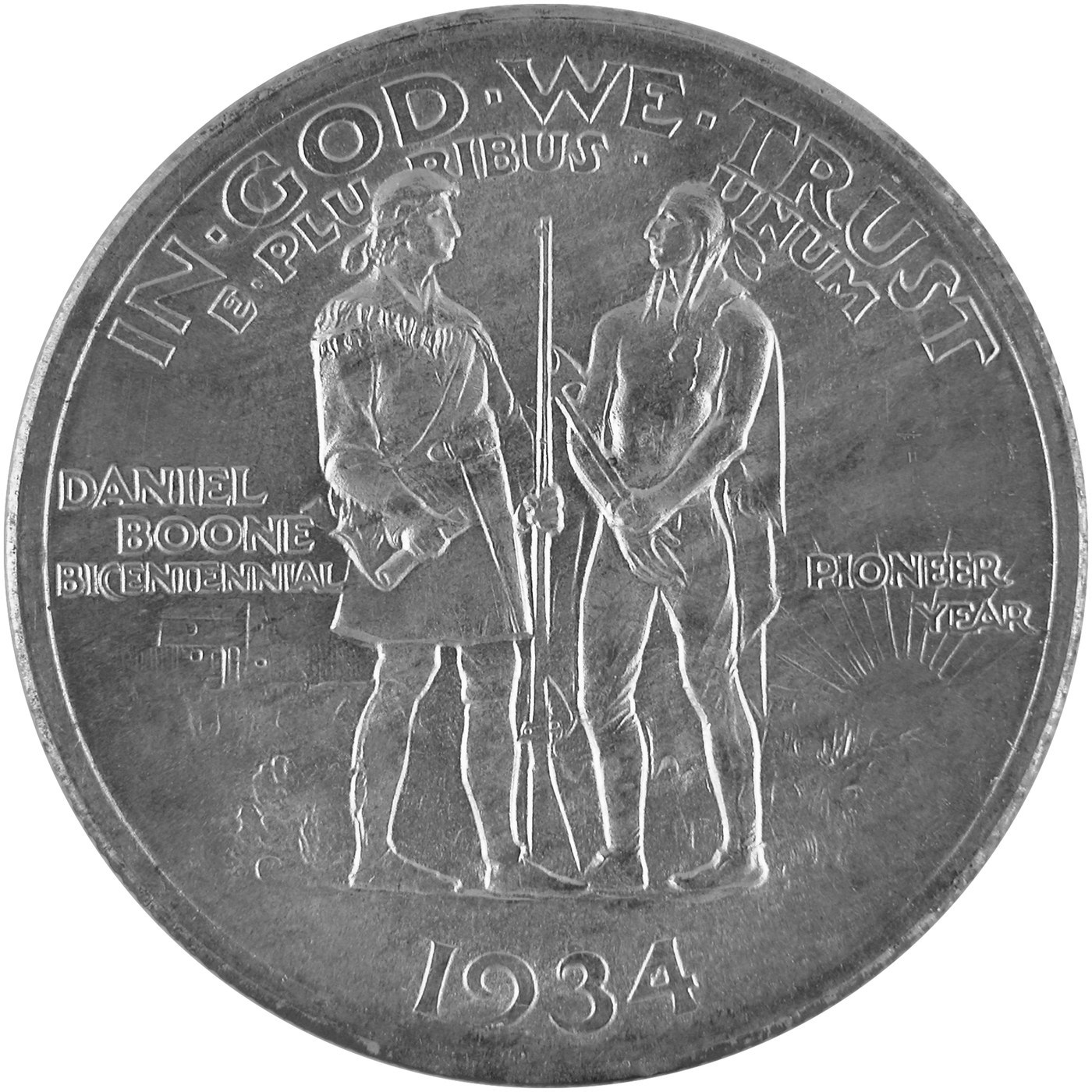
Start with the imagery and legends. A genuine Boone half has two distinct sides: a left-facing portrait bust of Daniel Boone with "LIBERTY," "IN GOD WE TRUST," "UNITED STATES OF AMERICA," and "HALF DOLLAR"; and a frontier scene showing Boone standing beside Chief Black Fish, a Shawnee leader, inscribed "PIONEER YEAR" with the date 1934 and Boone bicentennial wording. If you can read the Boone name, the two-figure frontier scene, and the "PIONEER YEAR" legend, you have the right type.
Confirm the physical specifications. The coin should be 90% silver, about 30.6 mm in diameter, roughly 12.5 grams, with a reeded edge—identical in size and metal to circulating U.S. half dollars of the 1930s. A calibrated scale and calipers are the most reliable check; a piece that is off in weight or diameter, or that responds to a magnet, is a warning sign.
Locate the mint mark and the added date. A small "D" or "S" on the frontier side indicates Denver or San Francisco; no mint mark means Philadelphia. On 1935 and later issues a small "1934" also appears in the field. Reading these together tells you the exact issue and whether you have an original 1934 coin or a later small-date striking, which matters because the branch-mint and low-mintage issues are far scarcer.
Watch for look-alikes and alterations. Many classic silver commemorative halves share this size and 90% silver alloy, so rely on the specific Boone design rather than the format alone. Because certain branch-mint issues are valuable, added or altered mint marks exist; examine the mint-mark area for tooling, mismatched surfaces, or unnatural spacing under magnification.
For any coin of consequence, favor professional authentication. Third-party grading services (PCGS, NGC) confirm authenticity, grade, and variety, which is especially important given the price spread across the series and the existence of altered examples.
Frequently asked questions
How do I tell a common Boone half from a rare one?
Check the mint mark and the small added date. Philadelphia coins have no mint mark; a "D" or "S" plus the added "1934" on 1935–1938 issues can indicate a scarcer, more valuable striking. Verify the exact issue before assigning value.
What should a genuine Boone half weigh and measure?
About 12.5 grams and roughly 30.6 mm in diameter, struck in 90% silver with a reeded edge. Figures that don't match, or any magnetic response, point to a counterfeit or wrong coin.
Where is the mint mark located?
On the frontier side showing Boone and Chief Black Fish, as a small "D" or "S." Philadelphia coins carry no mint mark. Inspect this area closely, since added mint marks are a known form of alteration.
Could this be confused with another commemorative half?
Yes. Many 1930s classic commemorative halves share the same 90% silver, 30.6 mm format. Identify by the specific Boone portrait and the two-figure "PIONEER YEAR" scene rather than by size and metal alone.