
How to Identify the Zanzibar Riyal
The Zanzibar riyal is a silver Islamic coin struck in the 1880s under Sultan Barghash bin Said, identified by Arabic script, a central seal, and an Islamic calendar date.
Read the full Zanzibar Riyal encyclopedia entry →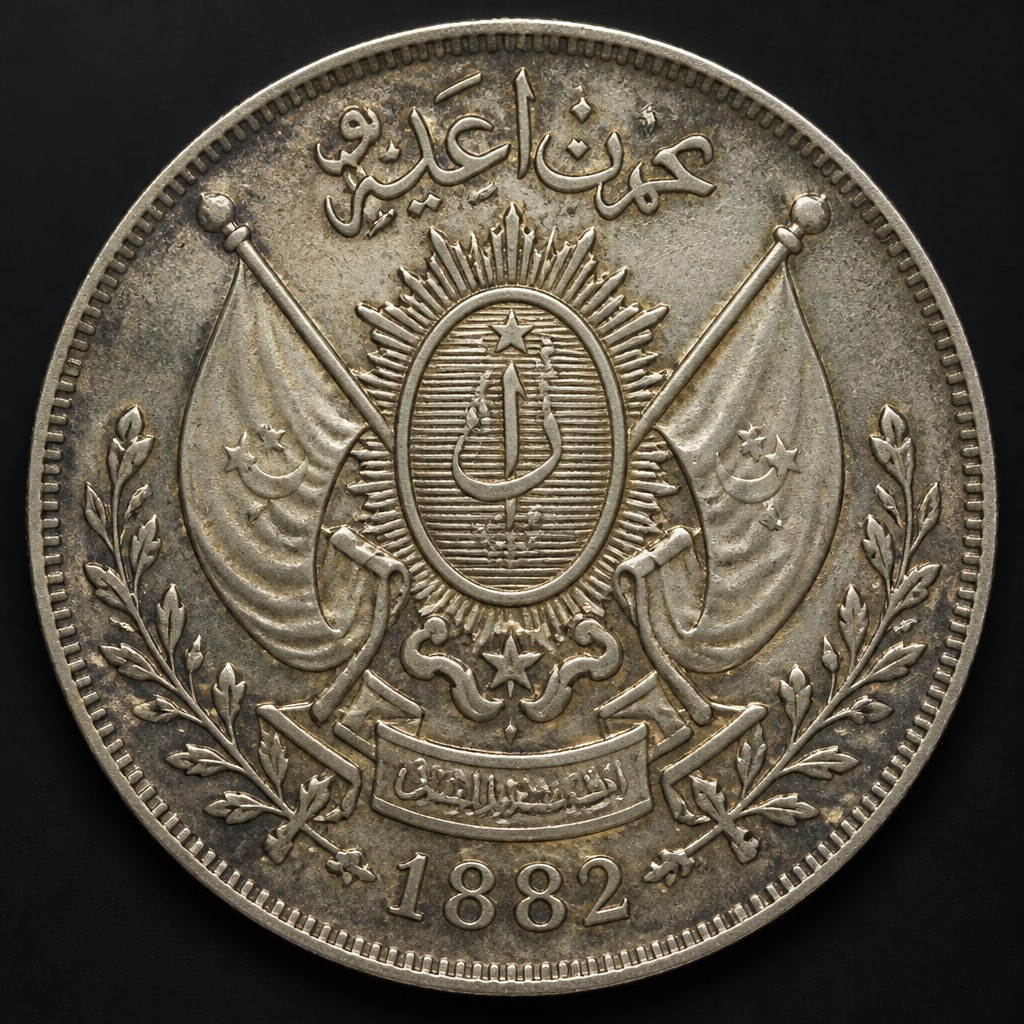
What It Is
The Zanzibar riyal is a silver coin struck for the Sultanate of Zanzibar in the early 1880s under Sultan Barghash bin Said. It was one of the few locally minted coins of the East African sultanate before British influence reorganized the currency system and eventually shifted the region toward rupee-based coinage. Collectors encounter it mainly as a historical silver crown-sized piece rather than a common circulation coin, and it is often studied alongside other Indian Ocean trade coinage from the same era.
Obverse Design & Inscriptions
The obverse typically carries a dense band of Arabic calligraphy naming the Sultan and citing the mint authority of Zanzibar. There is no portrait; Islamic coinage of this era avoided human imagery. The lettering is arranged in concentric or banded lines, often bordered by a beaded or linear rim.
Reverse Design & Inscriptions
The reverse mirrors the obverse in style, showing additional Arabic text that usually states the value, the mint location (Zanzibar), and the Hijri (Islamic lunar calendar) date. There is no Western numeral date on most pieces, so dates must be converted from the Arabic numerals used in the Hijri system.
Size, Weight, Metal, and Edge
The riyal is a silver coin roughly comparable in size to other 19th-century crown-sized silver pieces, generally in the 34-36mm range with a weight near 28-29 grams, though slight variations exist between issues. The edge is typically plain or lightly reeded depending on the strike.
Mint Marks and Where to Find Them
Because the coin was produced for a single regional authority, it does not use the multi-mint mark system seen on later colonial or modern coinage. Authenticity clues instead come from the consistency and depth of the Arabic script and the specific calligraphic style used in the 1880s issues.
Telling It Apart From Similar Coins
The Zanzibar riyal can be confused with other Islamic-world silver coins of similar size, such as Omani or Muscat issues, since Zanzibar's ruling dynasty had ties to Oman and shared similar calligraphic conventions. It can also resemble Maria Theresa thalers, which circulated widely across East Africa and the Arabian Peninsula during the same period. Careful reading of the inscribed sultan's name and the specific mint reference is the most reliable way to distinguish it from related regional coinage.
Judging Condition at a Glance
Grade is judged by the sharpness of the Arabic lettering, especially in the central words, and by how much of the beaded border remains intact. Wear typically shows first on the highest points of the script strokes and on the rim, while the fields between letters wear more slowly.
Authenticity Red Flags
Because the coin is scarce and its script is unfamiliar to many collectors, watch for cast reproductions with mushy, indistinct lettering, seams along the edge, or a noticeably lighter weight than genuine silver examples. Uneven or blurry Arabic characters, incorrect proportions, or a suspiciously new-looking surface on a supposedly 140-year-old coin are common signs of a modern fake. When possible, comparing a suspect piece against published photographs of confirmed genuine examples from established references is a useful step before assuming authenticity.
Frequently asked questions
What language is on the Zanzibar riyal?
It is inscribed entirely in Arabic script, naming the Sultan and the Zanzibar mint, with no Latin lettering or portrait.
How can I read the date on a Zanzibar riyal?
The date appears in Arabic numerals following the Islamic Hijri calendar rather than the Gregorian calendar, so it must be converted to find the equivalent Western year.
Is the Zanzibar riyal made of solid silver?
Genuine examples are struck in silver at a weight and size comparable to other 19th-century crown-sized coins; a piece that feels unusually light may not be genuine silver.
Does the Zanzibar riyal have a mint mark?
No separate mint mark system was used; the mint location is spelled out in the Arabic inscription itself rather than shown as a small symbol or letter.