
How to Identify the Yuan Shikai 'Fatman' Dollar (1914)
The Yuan Shikai 'Fatman' Dollar is a 1914 Chinese silver coin showing a side profile portrait of President Yuan Shikai, nicknamed for his rounded facial features, with a wreath-and-value reverse design.
Read the full Yuan Shikai 'Fatman' Dollar (1914) encyclopedia entry →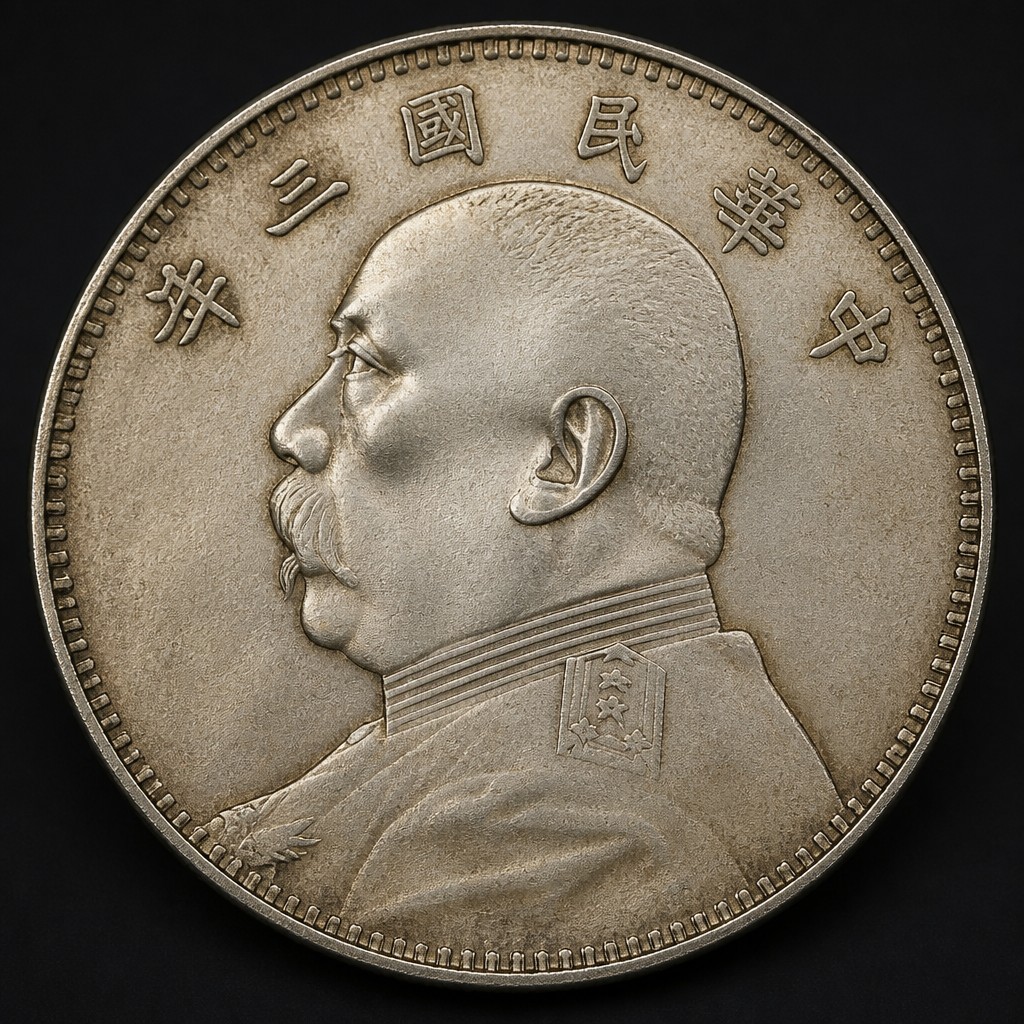
What It Is
Minted starting in 1914, this silver dollar bears the portrait of Yuan Shikai, the first formal President of the Republic of China, and became one of the most widely circulated Chinese silver coins of the early 20th century due to its standardized weight and long production run across subsequent years. Its sheer volume of production means it remains one of the more commonly encountered historical Chinese silver dollars among collectors today.
Obverse Design
The obverse shows a left-facing profile bust of Yuan Shikai in military dress, distinguished by his rounded, fuller facial features — the source of the coin's enduring "Fatman dollar" nickname among collectors. A Chinese inscription identifying him and the year of the Republic (Year 3, corresponding to 1914) appears around the rim.
Reverse Design
The reverse displays the denomination "ONE DOLLAR" in Chinese characters, typically framed within a wreath of grain stalks or floral sprays, with the design kept relatively simple and symmetrical compared to more elaborate dragon or ship motifs used on other Chinese coinage of the era.
Size, Weight & Metal
The coin follows the standard Chinese dollar format: approximately 39mm in diameter and about 26.6 grams, struck in silver at a fineness generally cited around .890, making it comparable in size and weight to other major world trade dollars of the period.
Mint Marks and Where to Find Them
Because this design was struck over multiple years (extending well beyond 1914 with later dates), the specific year appears prominently in the obverse legend in Chinese numerals, functioning as the primary way to distinguish which striking batch a given example belongs to; subtle die variety differences in the collar or wreath can further help specialists pinpoint exact minting details.
Telling It Apart from Similar Coins
The simple wreath-and-value reverse, without a dragon, ship, or elaborate scene, combined with Yuan Shikai's distinctive rounded profile, makes this coin fairly easy to distinguish from contemporaries like the Sun Yat-sen Junk Dollar or earlier Qing dragon dollars. Confirm the specific portrait and the plain wreath reverse to identify this type confidently.
Judging Condition at a Glance
Look at the fine detail of Yuan Shikai's facial features, epaulettes, and collar for flatness, as these are the first points to wear. On the reverse, check the grain stalks or floral sprays in the wreath for sharp, well-defined individual elements versus a smoothed, indistinct appearance.
Authenticity Red Flags
As one of the most commonly encountered — and consequently most commonly counterfeited — Chinese silver dollars, careful scrutiny is warranted. Watch for coins with soft or doughy facial features, incorrect weight or diameter, an unnatural or overly shiny surface, or wreath details that appear crude or asymmetrical compared to genuine strikes; given how widely this type has been reproduced, comparing suspect pieces against trusted reference sources is especially important.
Frequently asked questions
Why is this coin called the 'Fatman dollar'?
The nickname comes from Yuan Shikai's rounded, fuller facial features as depicted in his portrait on the coin's obverse, a distinctive look collectors quickly associate with this type.
Was this coin only minted in 1914?
No, although the original design dates to 1914 (Year 3 of the Republic), the same basic design continued to be struck in subsequent years with updated dates.
What does the reverse of this coin show?
The reverse displays the denomination 'ONE DOLLAR' in Chinese characters, framed by a simple wreath of grain stalks or floral sprays, without any dragon or ship imagery.
Why is this coin so frequently counterfeited?
Its historical popularity and wide original circulation created strong collector demand, making it one of the more commonly reproduced Chinese silver dollar types, so careful verification of weight, detail, and surface texture is important.
What is the coin's approximate silver fineness?
It is typically cited around .890 fine silver, consistent with standard Chinese dollar coinage of the Republican era.