
How to Identify the Yellowstone National Park Silver Dollar
A collector's checklist for confirming a 1999 Yellowstone commemorative dollar — Old Faithful and bison designs, silver specs, mint marks, and authentication tips.
Read the full Yellowstone National Park Silver Dollar encyclopedia entry →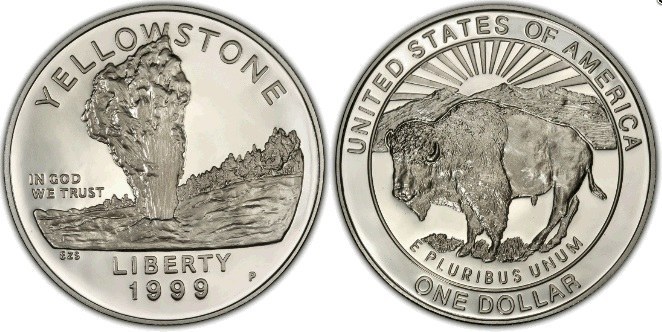
Start with the two designs, which are unique to this issue. The obverse shows the Old Faithful geyser erupting in a tall plume, surrounded by "YELLOWSTONE," "LIBERTY," "IN GOD WE TRUST," and the date "1999." The reverse shows a single standing American bison encircled by "UNITED STATES OF AMERICA," "ONE DOLLAR," and "E PLURIBUS UNUM." This geyser-and-bison pairing is the fastest way to confirm the type and to separate it from other modern commemorative dollars.
Confirm the date and denomination. A genuine example is dated 1999 on the obverse and states "ONE DOLLAR" on the reverse. There is only one year for this type, so any other date rules it out. Because it is a commemorative rather than a circulating coin, it will not resemble a Sacagawea, Eisenhower, or Susan B. Anthony dollar.
Check the physical specifications. The coin is a standard silver dollar: about 38.1 mm in diameter, roughly 26.73 grams, struck in 90% silver with a reeded edge. A calibrated scale and calipers are the best confirmation; a piece that is off in weight, diameter, or edge reeding is a warning sign. The silver surface should have the color and heft of a 90% silver dollar, not the lighter feel of a base-metal coin.
Locate the mint mark on the obverse. A "P" indicates the Philadelphia proof issue, which has mirror-like fields and frosted devices, while a "D" indicates the Denver uncirculated issue with a matte, satin-like business-strike finish. Matching the finish to the mint mark is a useful authenticity and attribution check.
Be cautious with condition and packaging rather than counterfeits, which are uncommon for this issue. Value is closely tied to grade, original U.S. Mint packaging, and the certificate of authenticity, so inspect for hairlines, spots, or cleaning. For any higher-value or certified purchase, rely on reputable dealers and third-party grading (PCGS, NGC) rather than eye appeal alone.
Frequently asked questions
How do I tell the proof from the uncirculated version?
Check the finish and mint mark. The proof carries a 'P' (Philadelphia) and has mirror-like fields with frosted devices; the uncirculated carries a 'D' (Denver) and has a satin, matte business-strike surface.
How can I be sure it is not an ordinary dollar coin?
Look at the designs and metal. The Old Faithful geyser obverse and lone bison reverse are unique to this 1999 commemorative, and the coin is 90% silver at about 26.73 grams — unlike the base-metal Sacagawea or Susan B. Anthony dollars.
What should a genuine example weigh and measure?
About 26.73 grams and roughly 38.1 mm in diameter, in 90% silver with a reeded edge. Figures that don't match a standard silver dollar are a warning sign.
Does original packaging matter?
Yes. Coins still in their U.S. Mint capsule and box with the certificate of authenticity generally sell better than loose examples, and intact packaging supports both value and authenticity.