
How to Identify the World War II 50th Anniversary Silver Dollar
A collector's guide to recognizing the 1993 WWII silver dollar by its D-Day soldier, Eisenhower-quote eagle reverse, dual date, and silver specs.
Read the full World War II 50th Anniversary Silver Dollar encyclopedia entry →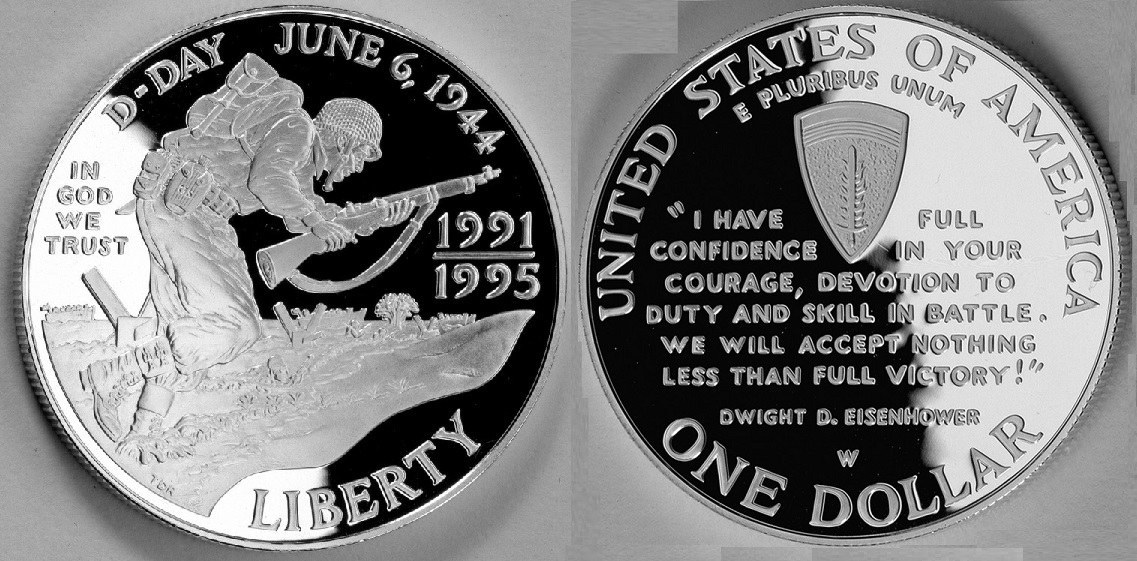
Start with the obverse imagery. The defining feature is a helmeted infantryman in full combat gear holding a rifle, combined with the inscription 'D-DAY JUNE 6, 1944.' You should also see 'IN GOD WE TRUST' and 'LIBERTY.' A wartime soldier scene, rather than a bust or seated figure, immediately points to this commemorative type.
Confirm with the reverse and denomination. The reverse shows a large eagle over a shield, a quotation attributed to Eisenhower, and the legends 'UNITED STATES OF AMERICA' and 'ONE DOLLAR.' The 'ONE DOLLAR' denomination is your key check for separating this coin from its siblings in the same program: the copper-nickel clad half dollar reads 'HALF DOLLAR,' and the gold coin reads 'FIVE DOLLARS.' Only the silver dollar carries 'ONE DOLLAR' at this large 38 mm size.
Verify size, weight, and metal. This is a standard U.S. silver dollar format: about 38.1 mm across, roughly 26.7 grams, a reeded edge, and a bright 90% silver surface (10% copper). If a coin claiming to be this type is noticeably lighter, smaller, or has a plain edge, be skeptical. The dual date 1991-1995 should be present; a single-year date means you are looking at a different modern commemorative.
Check the mint mark and format. A small mint mark sits in the design field: uncirculated coins generally show a 'D' (Denver) and proof coins a 'W' (West Point). Proofs have mirror-like fields and frosted devices, while uncirculated pieces have a satin-to-lustrous finish. Neither is worth more purely on mint mark, but noting it helps you match the coin to catalog listings.
Watch for look-alikes and authentication cautions. Do not confuse this issue with unofficial 'tribute' medals, colorized novelty pieces, or gold-plated privately produced items that borrow WWII imagery but lack the correct legends, denomination, or silver specs. Genuine coins came in U.S. Mint packaging with a certificate of authenticity. When in doubt, weigh the coin, confirm the exact inscriptions, and for higher-value examples rely on third-party grading and authentication.
Frequently asked questions
How do I tell the silver dollar from the other coins in the set?
Read the denomination on the reverse. The silver dollar says 'ONE DOLLAR' and is about 38 mm wide; the clad half dollar says 'HALF DOLLAR' and is smaller, while the gold coin reads 'FIVE DOLLARS.'
Where is the mint mark and what should it be?
Look for a small letter in the design field. Uncirculated examples typically carry a 'D' for Denver and proofs a 'W' for West Point. Confirm the letter against catalog listings for the format you have.
How can I check that it is real silver?
Verify the specs: roughly 38.1 mm diameter, about 26.7 grams, reeded edge, and a 90% silver look. A magnet test should show no attraction, and off-spec weight or a plain edge is a warning sign.
Are colorized or gold-plated versions official?
No. The genuine U.S. Mint coin is uncolored 90% silver (or gold for the separate $5 piece). Colorized, plated, or medal versions are aftermarket products and are not the official commemorative.