
How to Identify the Westward Journey Nickel
A collector's guide to recognizing the 2004 keelboat Jefferson nickel by its reverse scene, date, mint marks, and copper-nickel specs.
Read the full Westward Journey Nickel encyclopedia entry →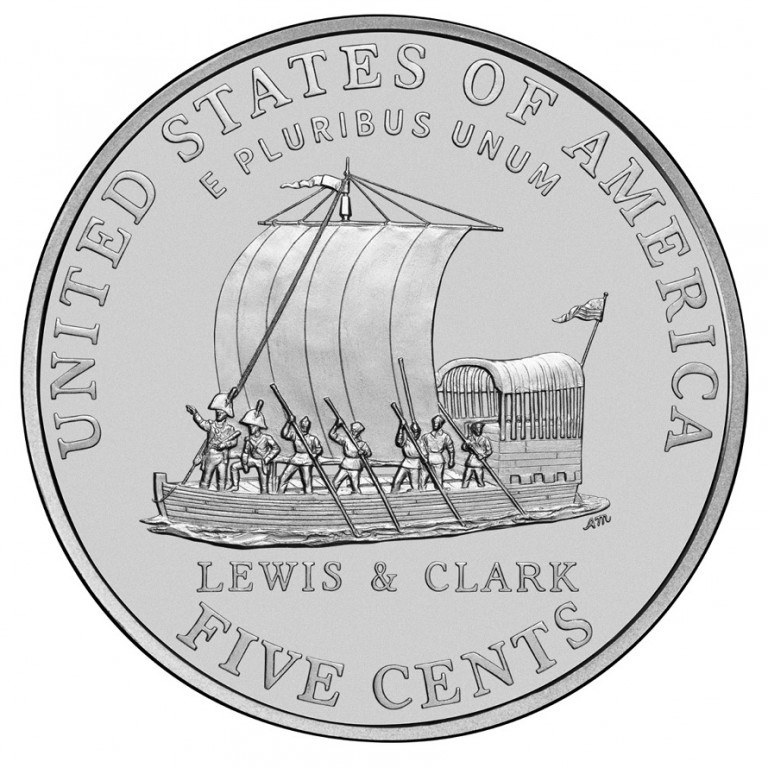
Begin with the reverse, which is the defining feature. The 2004 keelboat nickel shows a single-masted keelboat under sail with crew members aboard, moving across water, and the inscriptions "UNITED STATES OF AMERICA," "FIVE CENTS," and "Lewis & Clark 1804." If the reverse instead shows Monticello, a bison, a coastline, or a clasped-hands peace-medal design, you are looking at a different nickel.
Confirm the obverse and date. This coin carries the traditional left-facing profile of Thomas Jefferson, with "LIBERTY" and the date to the right and "IN GOD WE TRUST" to the left. The keelboat reverse was struck only in 2004, so the date should read 2004; any other year with a similar boat scene would be incorrect. The 2005 nickels, by contrast, use a newer close-up Jefferson portrait, which helps distinguish the years.
Check the physical specifications. A genuine coin is about 21.2 mm in diameter, weighs close to 5 grams, has a plain smooth edge, and is struck in 75% copper and 25% nickel, giving a uniform silvery-gray tone. There should be no reeding on the edge and no reddish copper color on an undamaged coin.
Locate the mint mark on the obverse near the date. A "P" indicates Philadelphia and a "D" indicates Denver; both are common. Proof coins struck at San Francisco carry an "S" and have mirrored fields and frosted devices, distinguishing them from the business strikes found in change.
Beware of look-alikes within the same series and of altered novelty pieces. The other 2004 reverse (Peace Medal) and the 2005 bison and "Ocean in View" reverses are related but separate designs, so match both the year and the specific scene. Colorized or plated keelboat nickels sold as souvenirs are common; these are altered after minting and are not distinct varieties, so any unusual color or coating should be treated as post-mint decoration rather than a rare error.
Frequently asked questions
How do I tell the 2004 keelboat nickel from the 2004 Peace Medal nickel?
Both share the 2004 date and the classic Jefferson profile, but the keelboat reverse shows a boat under sail with crew, while the Peace Medal reverse shows clasped hands above a crossed pipe and hatchet.
Does the keelboat nickel have a mint mark, and where?
Yes. Look on the obverse near the date for a small P (Philadelphia) or D (Denver); proof examples from San Francisco show an S.
My keelboat nickel is colored or gold-plated — is it a valuable error?
No. Colorized or plated keelboat nickels are novelty pieces decorated after leaving the Mint; they are not official varieties or mint errors and generally carry little collector value.
What size and weight confirm a genuine keelboat nickel?
It should measure about 21.2 mm in diameter, weigh roughly 5 grams, have a plain edge, and be struck in a copper-nickel alloy with a silvery-gray color.