
How to Identify the Western Satrap Silver Drachm
A silver coin of the Western Kshatrapa rulers of ancient western India, recognizable by its profile portrait, three-arched hill symbol, and dated Brahmi legend.
Read the full Western Satrap Silver Drachm encyclopedia entry →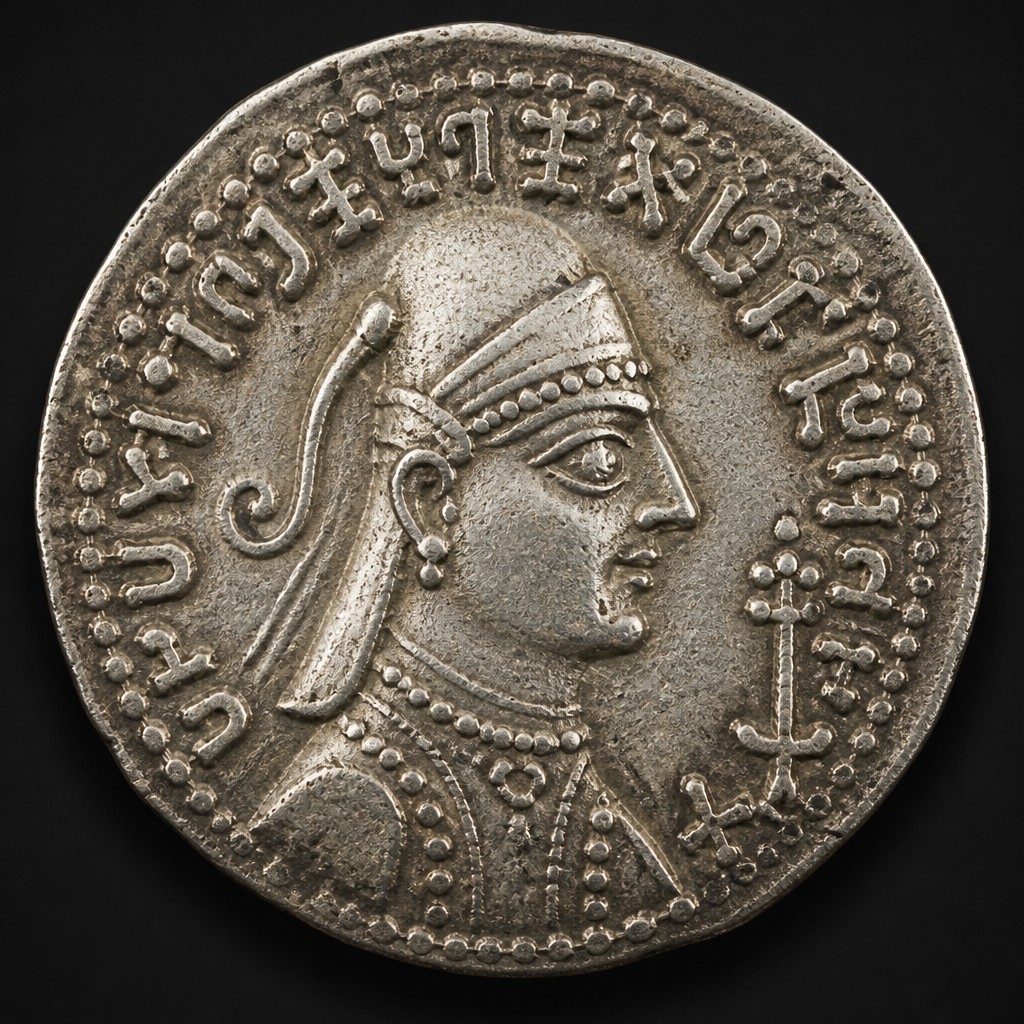
What the Coin Is
The Western Satraps (Western Kshatrapas) were a series of Indo-Scythian and Saka rulers who governed parts of western and central India from roughly the 1st through 4th centuries CE. Their silver drachms are notable as one of the earliest Indian coinages to regularly include a legible date, making them a useful reference point for regional chronology.
Obverse Design & Inscription
The obverse shows the ruler's bust in profile, generally facing right, wearing a diadem or headdress in a style adapted from earlier Indo-Greek and Indo-Scythian coin portraiture. Surrounding the bust is a legend in corrupted, blundered Greek letters, a legacy of earlier Greek-influenced coinage in the region, though the letters no longer form genuine Greek words by this later period.
Reverse Design & Inscription
The reverse centers on a three-arched hill or "chaitya" symbol, flanked by a crescent moon and star above, with a wavy line beneath sometimes representing a river. Around this design runs a legend in Brahmi script, and sometimes also Kharoshthi, giving the ruler's name, patronymic, and title, along with a date expressed in numerals of the Saka era.
Size, Weight, Metal, Edge
These drachms are struck in silver, typically around 2 to 2.2 grams, with a diameter of roughly 14-16 mm. The edge is plain and irregular, typical of ancient hand-struck coinage, and the flan is often slightly concave or convex from striking.
Telling It Apart from Similar Coins
The three-arched hill with crescent and star reverse is distinctive to Western Satrap coinage and is not found on Indo-Greek, Kushan, or Gupta coins, making it an easy first identifier. Because the series spans many rulers over centuries, the specific ruler is determined by reading the Brahmi legend's name and comparing portrait style; later Gupta coins that imitate this type after the Gupta conquest of the region can be distinguished by their own dynastic legends and generally cruder execution of the hill symbol.
Judging Condition & Reading the Date
A key identification skill for this series is reading the date numerals in the Brahmi legend, usually placed before the king's bust; a clear, legible date greatly aids identifying the specific ruler and year. Look for full, sharp legends on both sides; because the coins are small and often struck slightly off-center, a well-centered example showing the full portrait, hill symbol, and complete legend is considered a nicer specimen.
Authenticity Red Flags
Watch for legends that appear garbled beyond the normal "blundered Greek" pattern in a way that doesn't correspond to any known ruler, an incorrectly styled hill symbol, or a surface that looks too smooth and lacks the natural granularity of ancient hand-struck silver. Reproductions sometimes get the crescent-and-star placement or the number of arches on the hill symbol wrong, which is worth checking against known genuine types.
Frequently asked questions
What is the three-arched symbol on the reverse?
It is a chaitya, a stylized hill or shrine symbol that is the hallmark reverse design of Western Satrap coinage across nearly all rulers in the series.
Why does the obverse legend look like garbled Greek?
Earlier Indo-Greek and Indo-Scythian coinage used genuine Greek legends, and Western Satrap engravers continued copying Greek letterforms decoratively even though the words no longer carried real meaning.
How can I find the coin's date?
Look for a short string of Brahmi numerals placed near the king's bust on the obverse or within the reverse legend, recording a year in the Saka calendar era.
Were these coins used only by one ruler?
No, the Western Satrap dynasty included many successive rulers over roughly three centuries, and each issued drachms with their own name in the Brahmi legend while keeping the same general design.
How is this different from a Gupta imitation of the type?
Gupta rulers later struck their own version of this coin type after conquering the region, but their coins carry Gupta royal names and titles and generally show a somewhat different, often less refined rendering of the hill symbol.