
How to Identify the Württemberg Kreuzer
Recognize a Württemberg Kreuzer by its heraldic arms and 1690 date, its crowned shield over scrollwork reverse, and its small, thin silver form.
Read the full Württemberg Kreuzer encyclopedia entry →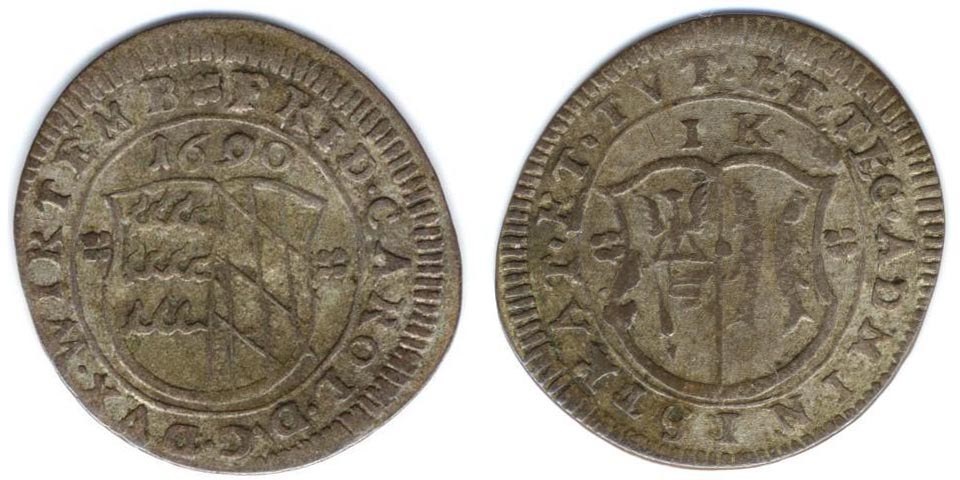
Start with the heraldry and the date. The obverse of this type centers on a coat of arms with a shield and heraldic supporting elements, accompanied by the date 1690. Identifying the arms as those of the Duchy of Württemberg — confirmed by the surrounding legend naming the duke or territory — is the key step in attributing the coin. Read the legend carefully, as 17th-century abbreviations in Latin or German record the issuer.
Check the reverse layout. Expect a heraldic shield beneath a crown, sitting above decorative scrollwork. The mark of value should appear on the coin; a 1 Kreuzer will indicate the value of one. The combination of crowned shield and ornamental frame helps separate this small denomination from larger or plainer issues.
Confirm size and metal. A Kreuzer is a small, thin silver coin, often struck in a lower-grade silver alloy typical of minor change. Weigh and measure it and compare against catalog figures for Württemberg Kreuzer of the period. Hand-struck coins of the 1690s commonly show soft strike, slight off-centering, and irregular flans; this is normal and not itself a sign of a fake.
Watch for look-alikes. Many German states, imperial cities, and Austrian lands struck near-identical small Kreuzer coins with crowned shields and heraldic arms. Do not assume Württemberg from the general layout alone — verify the specific coat of arms and the legend. Similar-looking pieces from Bavaria, Baden, Salzburg, and others are easy to confuse.
Authenticate with care. Small silver of this era attracts tooled, cleaned, and occasionally cast copies. Look for casting seams on the edge, unnaturally smooth or grainy surfaces, and detail that is soft in a way inconsistent with honest wear. Harsh cleaning and corrosion reduce value. For any scarcer date or higher-grade example, get a specialist or third-party opinion before buying or selling.
Frequently asked questions
How do I know it is Württemberg and not another German state?
Confirm the specific coat of arms and read the legend naming the duke or the duchy. Many states struck similar crowned-shield Kreuzer coins, so the arms and inscription — not the general design — settle the attribution.
Where is the date and denomination?
The date 1690 appears with the obverse arms, and the mark of value (one, for 1 Kreuzer) is shown on the coin. Legible date and value greatly aid identification and raise a coin's appeal.
Is a soft, off-center strike a problem?
Not by itself. Hand-struck 17th-century minor coins often show soft or off-center detail and irregular flans. Judge the coin against known genuine examples rather than expecting machine-made sharpness.
What are the warning signs of a fake or altered coin?
Edge casting seams, grainy or unnaturally smooth surfaces, wrong weight or diameter, and detail softness that does not match honest wear. Cleaning and corrosion also hurt value; authenticate valuable examples professionally.