
How to Identify the Visigothic Gold Tremissis
A small, crudely struck gold coin of the Visigothic kings of Spain, copying Byzantine tremissis designs with a frontal royal bust and a stepped cross.
Read the full Visigothic Gold Tremissis encyclopedia entry →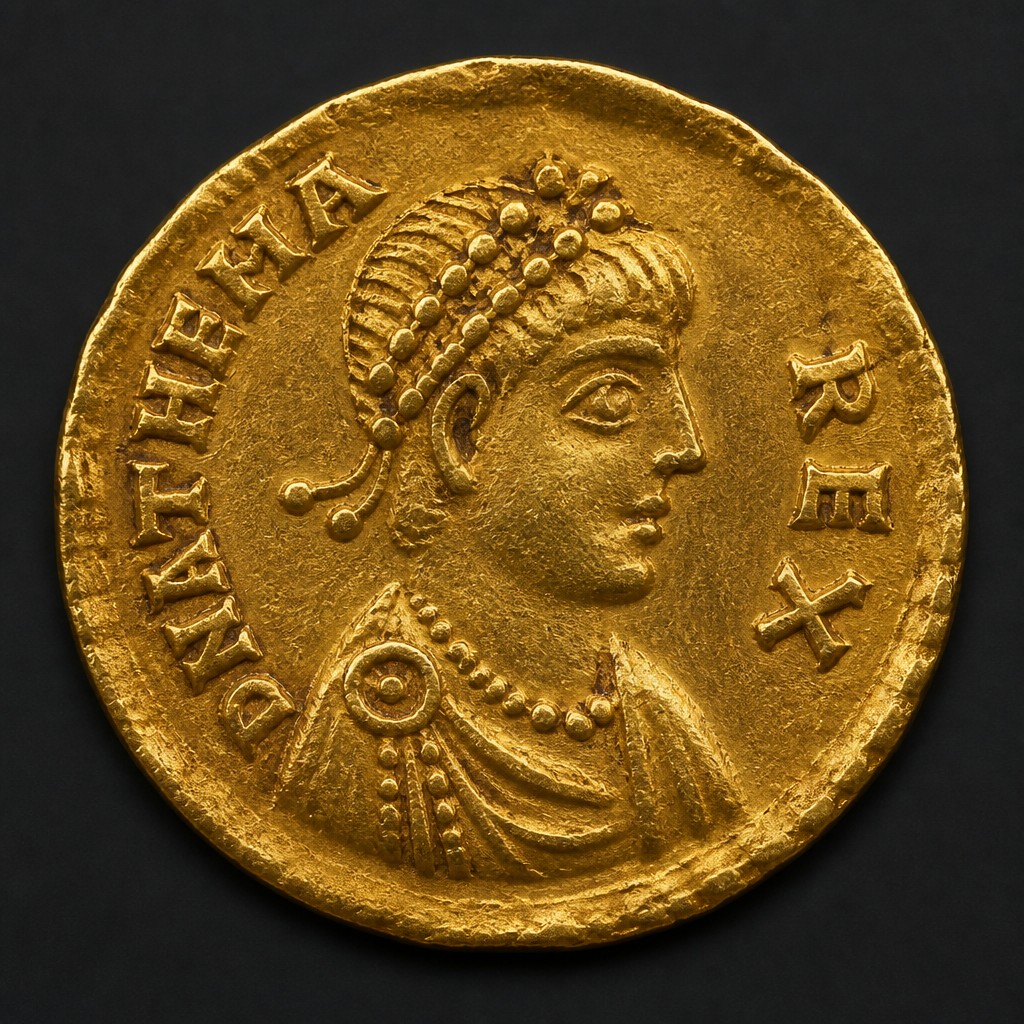
What It Is
The Visigothic tremissis is a small gold coin struck by the Visigothic kings who ruled Spain and southern Gaul from the late 5th to early 8th century, a kingdom that endured until the Muslim conquest of Iberia in 711. It represents one-third of a Roman/Byzantine solidus and was the main gold denomination the Visigoths issued once they began striking coins in their own kings' names, starting with Leovigild in the later 6th century. Earlier Visigothic gold, struck before Leovigild's reforms, had instead imitated the coinage of reigning Byzantine emperors, so a coin naming an actual Visigothic king marks the later, more independent phase of the kingdom's coinage.
Obverse Design
The obverse shows a stylized, frontal bust of the king, often crude and stiff compared to Roman or Byzantine models, sometimes wearing a diadem or crown-like headdress. Around the bust runs a legend giving the king's name in a Latinized form, frequently blundered or abbreviated, such as forms of Leovigild, Reccared, Suintila, Chindasuinth, Recceswinth, Wamba, Egica, or Achila. The bust is usually rendered with large, staring eyes and simplified facial features, a stylistic hallmark that helps separate Visigothic royal portraiture from the more naturalistic modeling seen on Roman and early Byzantine prototypes.
Reverse Design
The reverse typically depicts a cross, either a plain cross on a base of steps or a simple cross potent, echoing the Byzantine cross-on-steps tremissis type. The surrounding legend names the mint city (such as Toleto for Toledo, Emerita for Mérida, or Hispalis for Seville) along with the moneyer responsible for striking the coin.
Size, Weight, and Metal
Tremisses are tiny, roughly 12-14mm across, and were struck in gold, though the gold content declined noticeably over the seventh century as the kingdom's finances weakened. Weight generally sits near 1.5 grams, though underweight and heavily debased examples are common in the later series.
Mint Marks and Where to Find Them
Unlike later medieval coinages that use a distinct mint symbol, Visigothic tremisses identify their mint through the city name spelled out in the reverse legend, not through a separate mark. The moneyer's name usually appears alongside or beneath the mint name.
Telling It Apart from Similar Coins
Compared to genuine Byzantine tremisses, Visigothic pieces are noticeably cruder in style, with flatter, more geometric busts and often garbled Latin. Compared to Ostrogothic or Suevic issues from the same general era, the Visigothic examples are distinguished by their specific king names and Spanish mint city legends rather than imperial names or monograms.
Judging Condition at a Glance
Because the flans are small and the strikes often off-center or weakly struck to begin with, look at how much of the legend survives and whether the high points of the bust and cross show flattening from circulation versus a naturally soft strike. A well-preserved example will show a complete, readable ring of legend on both sides, while a heavily worn or poorly struck piece may only show fragments of the king's name or mint city.
Authenticity Red Flags
Be cautious of examples with a legend that does not correspond to any known combination of mint and moneyer, unnaturally bright or pale gold color suggesting a modern alloy, incorrect weight for the period, or a suspiciously sharp, mechanical strike that lacks the hand-cut die irregularities typical of the era.
Frequently asked questions
How can I tell which Visigothic king struck my tremissis?
Read the obverse legend around the bust carefully; it names the king, though letters are often blundered or abbreviated, so comparison with reference lists of known name forms is usually needed.
Why is the gold color sometimes pale or dull?
Visigothic mints steadily reduced the gold fineness through the 7th century, so later tremisses often contain noticeably less pure gold than earlier ones.
Is there a separate mint mark symbol?
No, the mint city is spelled out as part of the reverse legend rather than represented by a small symbol or letter.
What is the easiest way to spot a fake?
Check that the weight is close to the expected roughly 1.5 grams and that the legend matches a documented king, mint, and moneyer combination rather than random letters.