
How to Identify the Vijayanagara Gold Pagoda
A small, thick South Indian gold coin from the Vijayanagara Empire, typically depicting Hindu deities on the obverse with a script legend on the reverse.
Read the full Vijayanagara Gold Pagoda encyclopedia entry →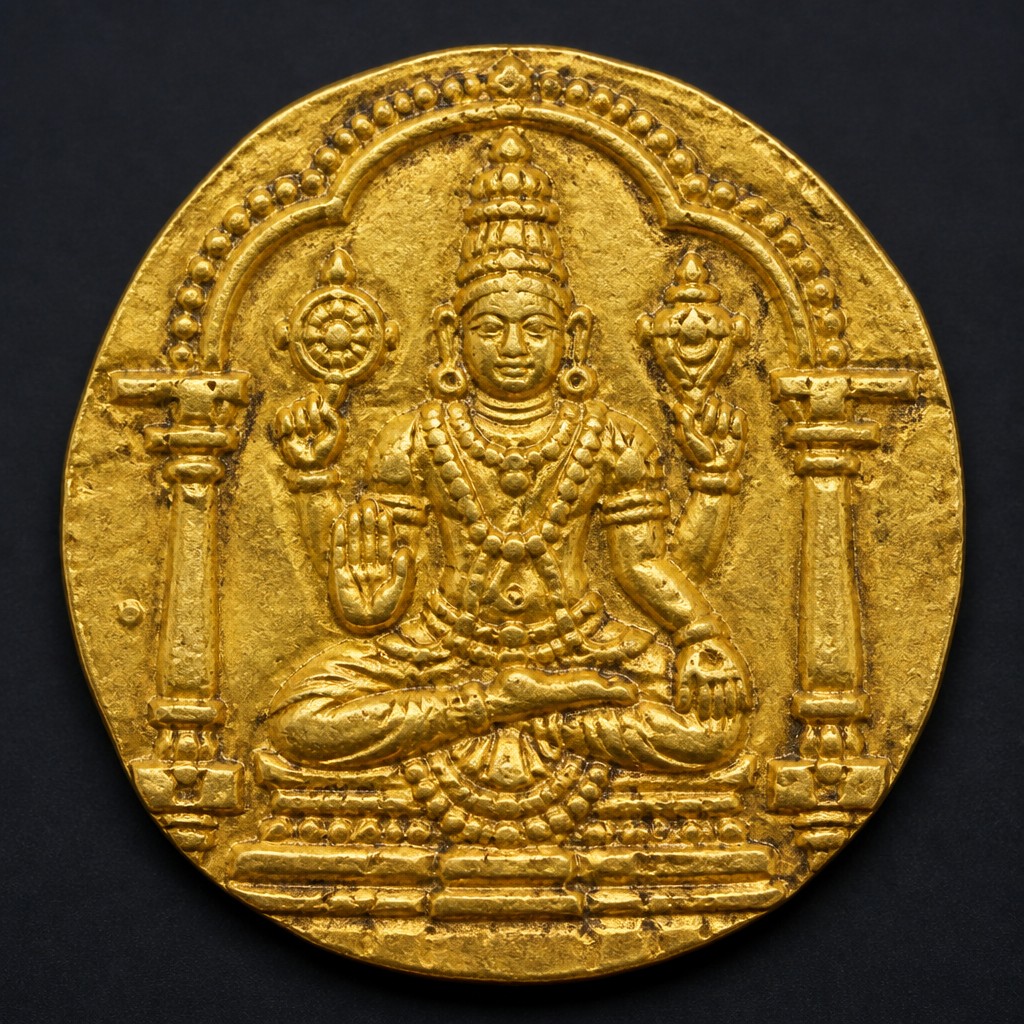
What the Coin Is
The gold pagoda, also called varaha or gadyana, was the standard gold coin of the Vijayanagara Empire, which ruled much of South India from the 14th to 17th centuries. It continued a long regional tradition of small, thick, dumpy gold coinage and became so influential that "pagoda" was later used by European traders as a general term for South Indian gold coins.
Obverse Design
Most Vijayanagara pagodas depict Hindu religious imagery rather than the ruler's portrait, most commonly Balakrishna, the infant Krishna, seated cross-legged, or a deity couple such as Shiva and Parvati, or Venkateshwara/Vishnu standing with attendant symbols. The choice of deity often varied by issuing king or mint and is a primary way collectors classify different pagoda types.
Reverse Design & Inscriptions
The reverse typically carries a legend in Kannada or Nagari-derived script naming the issuing king, often abbreviated to just a portion of the royal name or title due to the coin's small size. Some varieties include additional small symbols alongside the legend.
Size, Weight, Metal, Edge
Pagodas are small and notably thick or dumpy rather than broad and flat, generally around 10-13 mm in diameter, with a weight typically in the range of 3.4 to 3.6 grams for the standard full pagoda denomination; half and quarter pagoda fractions also exist at proportionally smaller weight. The metal is high-purity gold, and the edge is plain, irregular, and unmilled.
Telling It Apart from Similar Coins
The devotional deity imagery, such as Balakrishna, Shiva-Parvati, or Venkateshwara, distinguishes Vijayanagara pagodas from the more heraldic tiger-fish-bow emblem style of earlier Chola gold coinage. Later South Indian gold "star pagodas" issued by European trading companies, including the English East India Company, imitate the general pagoda format but typically show a plain multi-pointed star pattern rather than a Hindu deity, making them straightforward to distinguish from genuine Vijayanagara issues.
Judging Condition at a Glance
Given the coin's small size, examine whether the deity figure's outline and any attributes, such as Krishna's pose or Shiva's trident, remain distinct, and whether the reverse legend is legible. Because these coins were struck on such small flans, some softness of strike is common even on lightly worn examples; a well-centered strike showing the full deity figure is considered a nicer example. Since the coin's thickness concentrates metal in a small area, genuine pieces also tend to feel notably dense and heavy for their diameter compared to a similarly sized but broader, thinner coin.
Authenticity Red Flags
Watch for a deity figure that is stylistically inconsistent with genuine period dies, such as proportions, pose, or attributes that look off, a gold color or luster that appears artificial, and casting seams or bubble marks that indicate a cast copy rather than a hand-struck coin. A reverse legend using script forms or a royal name that doesn't correspond to any known Vijayanagara ruler is also a red flag.
Frequently asked questions
Why is it called a "pagoda"?
European traders adopted the term "pagoda" for South Indian gold coins bearing temple-related deity imagery, and it became a generic name for this coin type and denomination.
What deities appear on genuine examples?
Common types show Balakrishna (infant Krishna), a Shiva-Parvati deity pair, or Venkateshwara/Vishnu, with the specific choice varying by king or mint.
How much should a full pagoda weigh?
Standard full pagodas generally weigh around 3.4-3.6 grams in gold; half and quarter pagoda fractions weigh proportionally less.
How do I tell a Vijayanagara pagoda from a later "star pagoda"?
Star pagodas issued by European trading companies show a plain multi-pointed star design rather than a Hindu deity figure, making them easy to distinguish.
Is the ruler's portrait shown on these coins?
No, unlike many other coinages, Vijayanagara pagodas usually show religious deity imagery rather than a portrait of the king.