
How to Identify the Victorian Silver Five Cents
The broad family of small silver five-cent coins struck for Canada from 1858 through 1901 under Queen Victoria, sharing a wreath reverse and a portrait obverse that evolved subtly over the reign.
Read the full Victorian Silver Five Cents encyclopedia entry →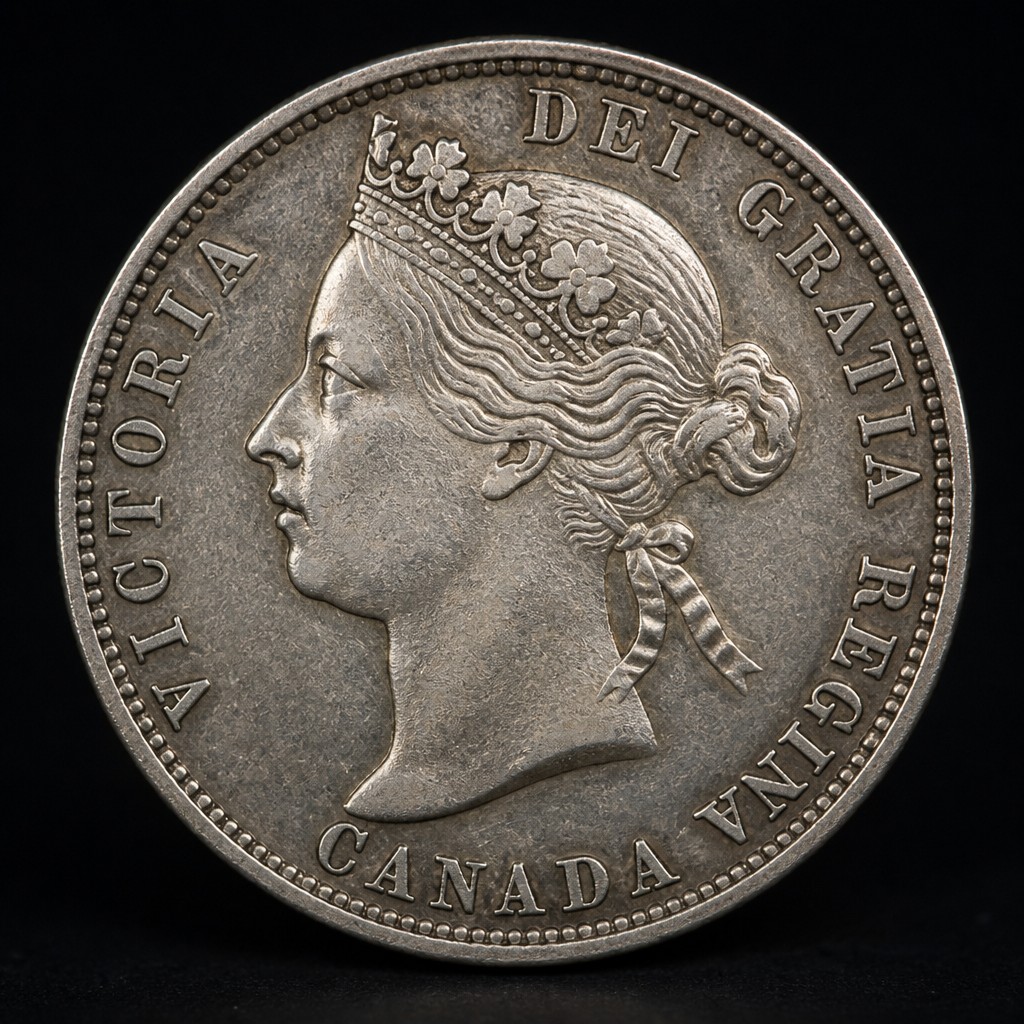
What It Is
This entry covers the general run of Canadian five-cent silver coins issued under Queen Victoria, beginning with the Province of Canada's first issue in 1858 and continuing through the Dominion of Canada's occasional strikings up to 1901, the year of Victoria's death. Rather than one single design, it is a decades-long series that shares a common format with only minor changes.
Obverse Design
Every coin in the series shows a portrait of Queen Victoria with the legend VICTORIA DEI GRATIA REGINA CANADA. The portrait style is essentially the same "young head" throughout the series, since Canada did not update to an older-looking royal portrait the way Britain periodically did.
Reverse Design
The reverse consistently shows a wreath of maple leaves surrounding "5 CENTS" and the date, with no other lettering.
Size, Weight, Metal & Edge
These are tiny coins struck in .925 sterling silver, about 15.5mm in diameter and roughly 1.16 grams in weight, with a reeded edge, nicknamed "fish scales" for their small, thin format.
Mint Marks
Most Victorian five-cent pieces were struck at the Royal Mint in London with no mintmark. Beginning in the mid-1870s, some years were struck under contract at Heaton's Mint in Birmingham and carry a small "H" below the date on the reverse. Spotting this tiny letter is essential to correctly identifying certain dates.
Telling Dates Apart
Because the design barely changed over more than four decades, the only reliable way to identify a specific year is to read the date clearly and check for the presence or absence of an "H" mintmark. Some years in this series were minted in much smaller numbers than others, so a clear, legible date is important for any further identification. It also helps to remember that no coins were struck for several years scattered throughout the reign, so a worn coin whose date cannot be fully confirmed should not automatically be assumed to be one of the more common years.
Judging Condition
Wear shows first on Victoria's hair details and the wreath's leaf veins, given the coin's low relief and small size. A coin with visible curls in the hair and sharp leaf edges will grade meaningfully better than one with smooth, rounded high points. Because these coins are so thin, they can also pick up bends, creases, or edge nicks more easily than thicker silver coins, and any such damage should be factored into an overall condition assessment.
Authenticity Red Flags
Because these coins are small and thin, they are relatively easy targets for tooling, particularly around the date or a claimed "H" mintmark. Examine any mintmark under magnification for signs it was added or altered, verify weight and diameter against known specifications, and be cautious of coins that have been chemically cleaned to hide true wear.
Frequently asked questions
How is a Victorian five-cent coin dated if it's badly worn?
Look closely at the digits under magnification and good light; if the date cannot be confidently read, precise year identification may not be possible.
What does the small 'H' on some coins mean?
It marks coins struck under contract at Heaton's Mint in Birmingham rather than the Royal Mint in London, and appears below the date on the reverse for certain years.
Why do all these coins look so similar?
The design remained essentially unchanged throughout Victoria's reign, with only the date and occasional mintmark differing from year to year.
What metal are they made of?
They are struck in .925 sterling silver, the standard fineness used for Canadian silver coinage before 1920.
How can I tell one from a similarly sized dime?
Check the wreath's central text, which reads '5 CENTS' rather than '10 CENTS.'