
How to Identify the Victoria Ten Cents (dime)
Canada's small silver ten-cent coin struck under Queen Victoria from 1858 through 1901, featuring her portrait and a maple leaf wreath reverse.
Read the full Victoria Ten Cents (dime) encyclopedia entry →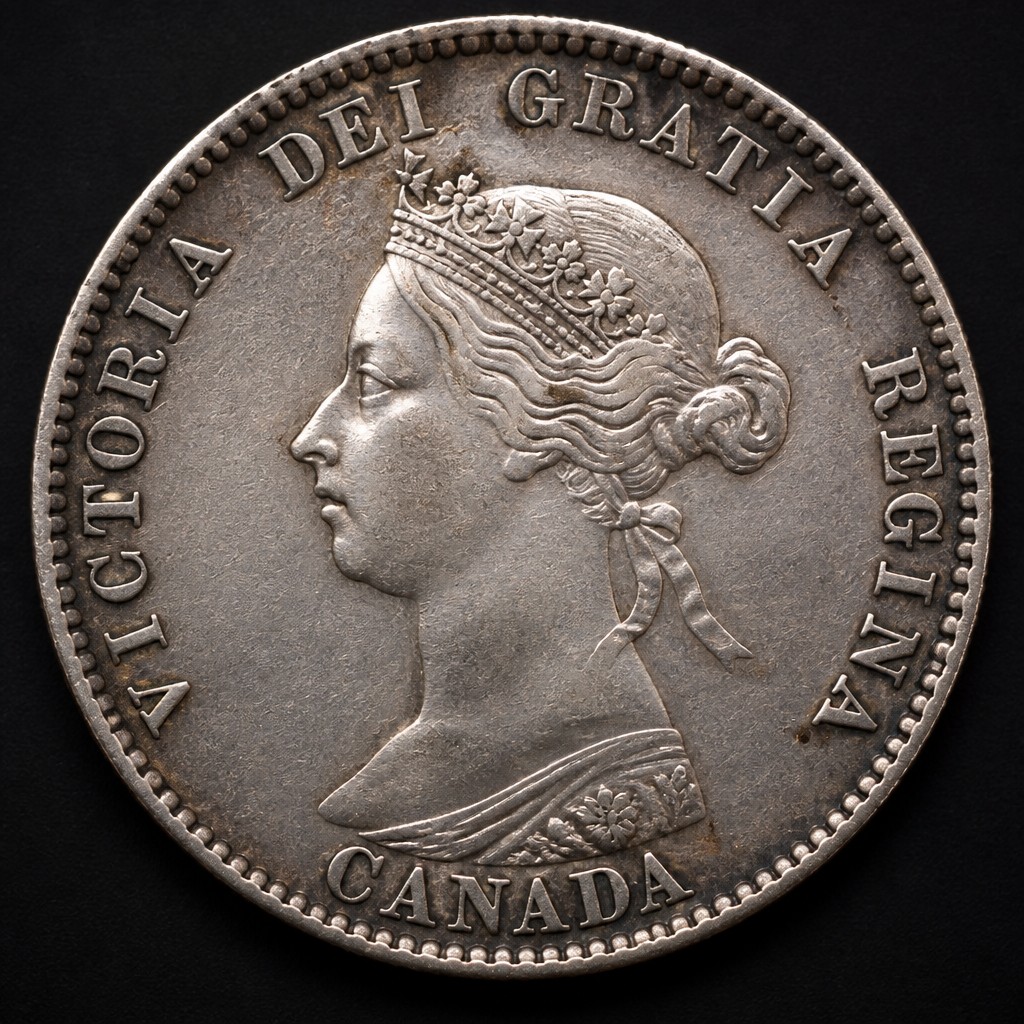
What It Is
This coin is Canada's original silver dime, issued from the introduction of decimal coinage in 1858 by the Province of Canada through the end of Queen Victoria's reign in 1901, spanning both the pre-Confederation and Dominion periods.
Obverse Design
The obverse shows a young portrait of Queen Victoria facing left, with the legend VICTORIA DEI GRATIA REGINA CANADA around the rim.
Reverse Design
The reverse displays a wreath of maple leaves surrounding "10 CENTS" and the date, with no additional lettering.
Size, Weight, Metal & Edge
The coin is struck in .925 sterling silver, measuring about 18mm in diameter and weighing roughly 2.32 grams, with a reeded edge.
Mint Marks
Most Victorian dimes were produced by the Royal Mint in London with no mintmark. Beginning in the mid-1870s, some years were struck under contract at Heaton's Mint in Birmingham and carry a small "H" below the date on the reverse.
Telling It Apart From Similar Coins
This coin is easily confused with the much smaller, thinner Victoria five-cent piece of the same design family; checking the reverse text ("10 CENTS" versus "5 CENTS") settles the denomination immediately. It should also be distinguished from the short-lived 1858 twenty-cent piece, which is larger and states a different value, and from later Edward VII dimes, which carry a different, more mature royal portrait. Because the design changed so little across more than forty years of Victoria's reign, a clearly legible date and mintmark are ultimately the only way to identify a specific year within this long series.
Judging Condition
Check Victoria's hair curls and the ribbon in her hair on the obverse, and the wreath's leaf veins on the reverse, for flattening from wear. Sharp, well-defined details in these areas indicate a higher grade. Given the coin's age and the decades of hand-to-hand circulation many examples endured, finding one with strong original detail and an even, undamaged surface takes some searching.
Authenticity Red Flags
Because these coins are old, small, and silver, watch for tooling around the date or any claimed "H" mintmark, as both are common targets for alteration. Verify diameter and weight against known specifications if a coin seems unusual, and be cautious of unnaturally bright or polished surfaces that may be concealing actual wear or damage. A magnifying glass under raking light is one of the simplest ways to spot re-cut digits or an added mintmark, since altered areas often show slightly different metal texture from the surrounding, naturally worn surface.
Frequently asked questions
How do I tell this dime apart from the Victorian five-cent coin?
Check the reverse wording, which reads '10 CENTS' rather than '5 CENTS,' since the two share a similar overall design but differ noticeably in size.
What does the small 'H' mean on some examples?
It indicates the coin was struck under contract at Heaton's Mint in Birmingham rather than the Royal Mint in London, and appears only on certain years from the mid-1870s onward.
What metal is the coin made of?
It is .925 sterling silver, the standard fineness for Canadian silver coinage before 1920.
How was this coin used before Canadian Confederation?
It circulated as part of the Province of Canada's original decimal coinage system introduced in 1858, continuing after 1867 as part of the new Dominion of Canada's currency.
What should I check if I suspect a fake?
Verify the coin's weight and diameter with precise tools, and examine the date and any mintmark area under magnification for signs of tooling or alteration.