
How to Identify the Victoria Large Cent
How to identify a Canadian Victoria large cent by its laureate portrait obverse, maple leaf wreath reverse, bronze composition, and H mintmark.
Read the full Victoria Large Cent encyclopedia entry →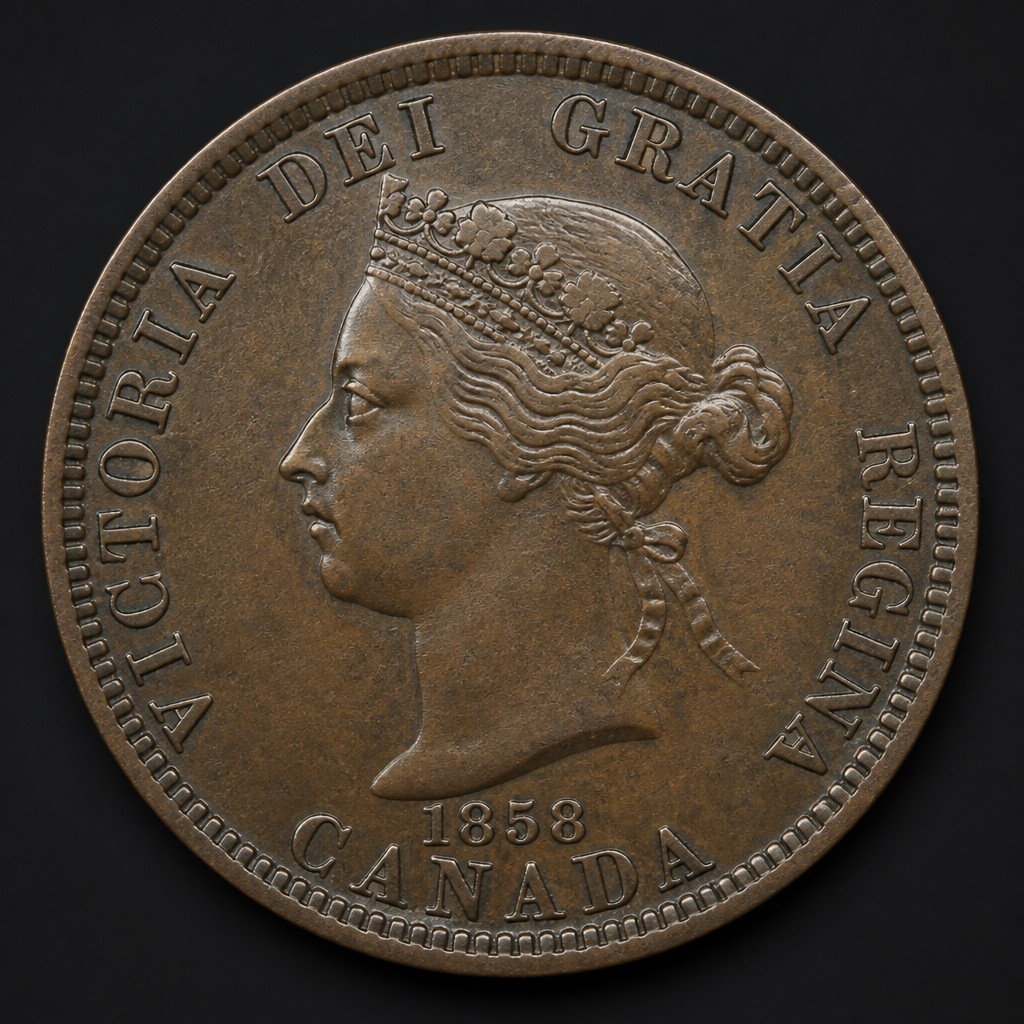
What It Is
The Victoria large cent was Canada's earliest bronze one-cent coin, first struck in 1858 for the Province of Canada and continued after Confederation for the Dominion of Canada through 1901, the year of Queen Victoria's death. It is notably larger than the small cents used from 1920 onward.
Obverse Design & Inscriptions
The obverse shows a laureate portrait of Queen Victoria facing left, with a legend such as "VICTORIA DEI GRATIA REGINA" around the border, and "CANADA" appearing in the full legend on most issues.
Reverse Design & Inscriptions
The reverse shows a wreath of maple leaves tied with a bow at the bottom, encircling "ONE CENT" and the date.
Size, Weight, Metal, and Edge
Struck in bronze, the coin measures about 25.4mm in diameter, noticeably larger than modern cents, with weight varying by year from roughly 4.5 to 5.7 grams and a plain edge.
Mint Marks & Where to Find Them
Since Canada had no mint of its own until 1908, these cents were struck mainly at the Royal Mint in London or the Heaton Mint in Birmingham. Heaton-struck coins carry a small "H" mintmark below the date; coins struck in London show no mintmark at all.
Telling It Apart From Similar Coins
The earlier 1858-1859 Province of Canada issues, which had smaller original production runs and include some notable varieties, are scarcer than the more common 1876-1901 Dominion of Canada issues. Check the exact date and look for the "H" mintmark beneath the date to identify Heaton mint coins.
Judging Condition & Grade
Grading focuses on the detail remaining in Victoria's hair and braid and the crown or leaf tips of the wreath. Old copper coins are prone to corrosion, verdigris, and heavy circulation wear, so surface condition varies a great deal between individual coins.
Authenticity Red Flags
Watch for re-engraved or altered dates, a common way to make a common year appear as a scarcer one, along with cleaned or artificially toned surfaces meant to disguise damage, and mintmark placement or style that does not match genuine Heaton "H" coins.
Frequently asked questions
How do I know if a Victoria large cent was struck at the Heaton Mint?
Look for a small H mintmark directly below the date; coins without it were struck at the Royal Mint in London.
Why is the Victoria large cent so much bigger than a modern Canadian cent?
Canada's earliest bronze cents followed a larger British-style coin size that was used until 1920, when the country switched to the smaller cent diameter still used today.
Which Victoria large cents are considered scarcer?
The earlier 1858-1859 Province of Canada issues generally had smaller original mintages and include some notable date varieties compared to the more common 1876-1901 Dominion issues.
What should I check for signs of an altered date?
Look closely at the spacing, font, and surface around the last digit of the date for tool marks or inconsistencies, since altering a common date to mimic a scarcer one is a known issue on old copper cents.