
How to Identify the Vermont Copper
Post-Revolutionary coinage from the independent Vermont Republic (1785-1788), including an early landscape design and a later British-style bust type.
Read the full Vermont Copper encyclopedia entry →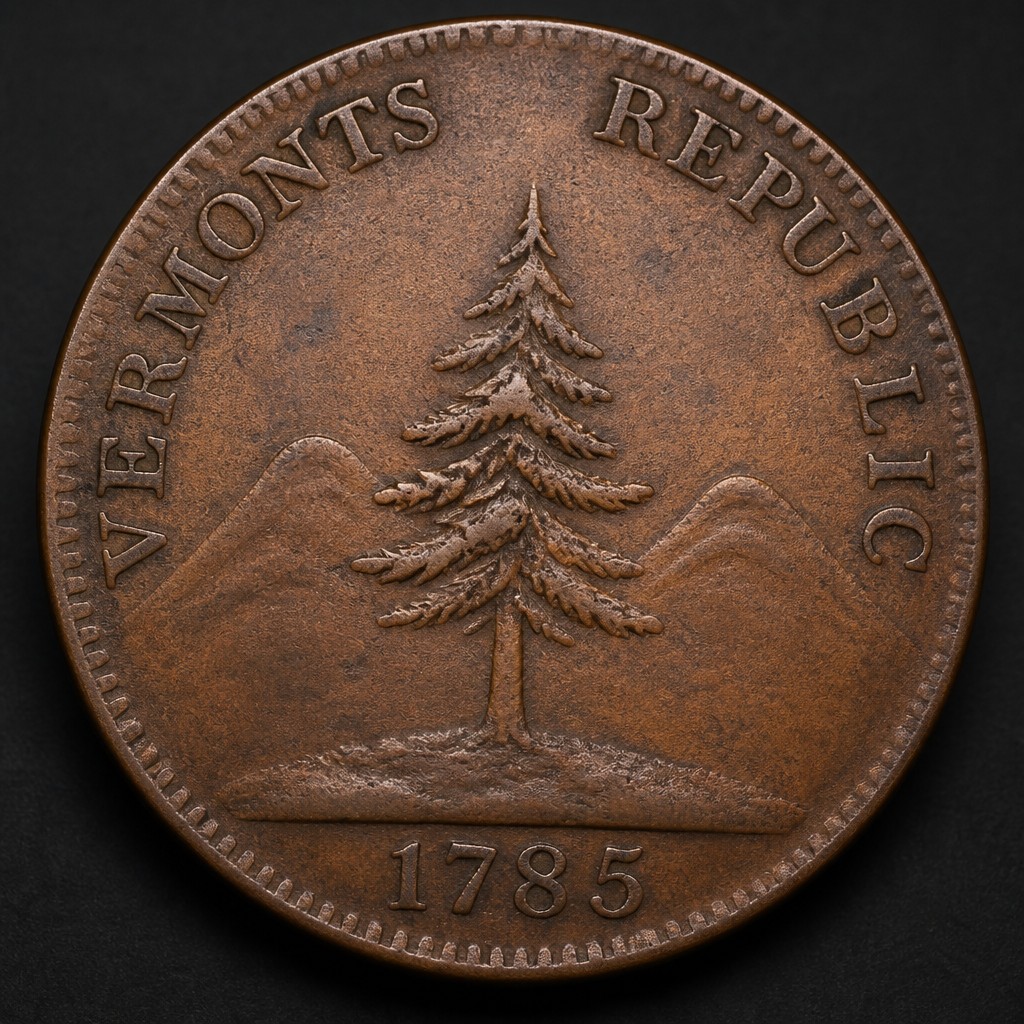
What It Is
Vermont coppers were struck between 1785 and 1788 by authority of the Vermont Republic, which at the time was an independent entity not yet admitted to the United States. Like other contemporary state and republic coinages, Vermont coppers were issued to address a practical shortage of small-denomination coinage following the Revolutionary War, and the series includes two visually distinct design phases.
Obverse Design & Inscriptions
Early Vermont coppers show a landscape scene with a rising sun over hills or mountains and a plow in the foreground, accompanied by the Latin legend "VERMONTS RES PUBLICA" (or similar spelling variants, meaning "Vermont, the Republic"). Later issues switched to a right-facing bust design more closely resembling contemporary British halfpence, with a legend referencing authority rather than the landscape scene.
Reverse Design & Inscriptions
The early landscape-type reverse displays a radiant eye surrounded by stars with the Latin legend "STELLA QUARTA DECIMA" (the fourteenth star, referencing Vermont's aspiration to become the fourteenth state). The later bust-type reverse instead imitates the seated Britannia design found on British halfpence, with a corresponding legend.
Size, Weight, Metal & Edge
Vermont coppers are similar in size to a British halfpenny, struck in copper with plain, unmilled edges consistent with the hand-operated screw-press methods used by contemporary private minters. Weight varies somewhat between issues and even between individual coins due to the loosely regulated striking process of the period.
Mint Marks & Where to Find Them
There is no formal mint-mark system on these coins; identification relies on comparing the specific design type (landscape versus bust), the exact legend wording and spelling, and the date, since numismatists have cataloged numerous die varieties within both the early and later Vermont copper phases.
Telling It Apart From Similar Coins
The two Vermont design types are easy to tell apart from each other visually, since one shows a rural landscape scene and the other imitates a European-style bust portrait. Distinguishing genuine Vermont coppers from contemporary Connecticut, New Jersey, or Massachusetts coppers, and from British halfpence that the later bust-type Vermont coppers were designed to resemble, requires reading the specific legend text, since Vermont's wording differs from all of these even when the general bust-and-seated-figure format looks similar at a glance.
Judging Condition at a Glance
For the landscape type, check the clarity of the sun's rays, the plow, and the radiant eye and stars on the reverse; for the bust type, check the sharpness of the facial profile and the seated figure's drapery. As with other coppers of this era, environmental corrosion and porosity are common in addition to ordinary wear, so assess surface quality and design sharpness separately.
Authenticity Red Flags
Because the later bust-type Vermont copper was deliberately designed to resemble British halfpence, careful attention to the legend is essential to avoid confusing a genuine Vermont issue with an actual British halfpenny or a deceptive imitation. General red flags include tool marks near the date suggesting alteration, weight or diameter outside the normal range documented for genuine examples, and lettering or design details that do not match any recognized die variety for the series. Given the number of legitimate varieties, comparison against detailed reference catalogs is important before drawing conclusions from an unfamiliar example.
Frequently asked questions
Why does Vermont copper coinage have two very different designs?
Vermont issued an earlier landscape-and-radiant-eye design first, then switched to a later design imitating British halfpence with a bust and seated figure, both produced between 1785 and 1788 under the independent Vermont Republic's authority.
What does 'Stella Quarta Decima' refer to?
It means 'the fourteenth star,' reflecting Vermont's status as an independent republic at the time and its aspiration to eventually join the United States as its fourteenth state.
How do I avoid confusing the later Vermont copper with an actual British halfpenny?
Read the legend carefully; the later Vermont bust-type coppers were designed to resemble British halfpence closely, but the specific wording referencing Vermont's authority differs from genuine British coinage.
Why do Vermont coppers vary so much in weight?
They were struck by hand under a loosely regulated private minting process typical of post-Revolutionary state coinage, so weight and strike quality vary noticeably between individual coins even within the same design type.