
How to Identify the Venezuela Bolivar Silver (Bolívar Fuerte)
A guide to identifying Venezuela's 'fuerte' silver coinage, featuring Simon Bolivar's portrait, the national arms, and the small denominations struck in the early 1900s.
Read the full Venezuela Bolivar Silver (Bolívar Fuerte) encyclopedia entry →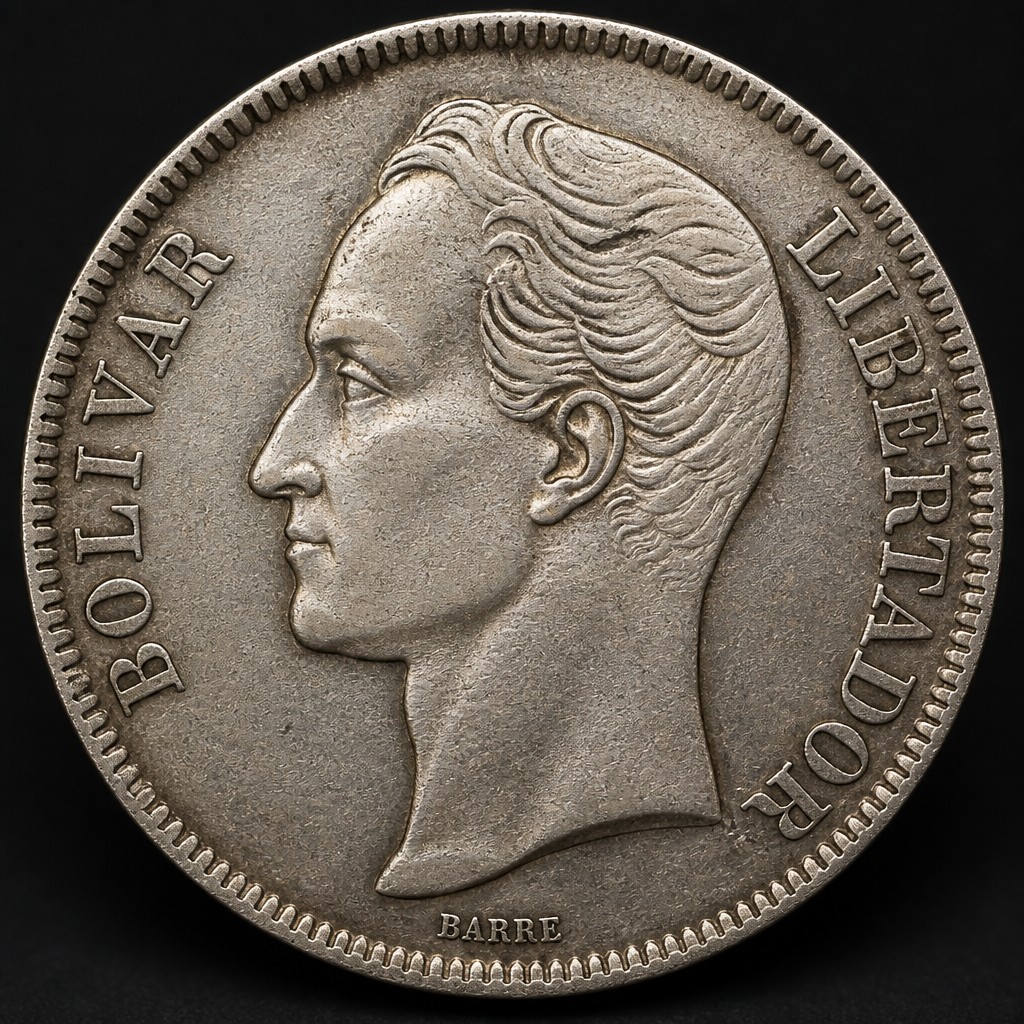
What It Is
"Fuerte" (meaning "strong") coinage refers to a Venezuelan silver series struck in the early 20th century, so named to distinguish it from earlier, more debased 19th-century silver issues. These smaller-denomination coins (such as 25 and 50 centimos and 1 and 2 bolivares) circulated alongside the larger 5 Bolivares crown and share the same design family and portrait.
Obverse Design
The obverse carries a left- or right-facing portrait bust of Simon Bolivar, the South American independence leader after whom Venezuela's currency is named, along with the date and a legend naming the republic.
Reverse Design
The reverse shows Venezuela's national coat of arms, featuring symbols such as a horse, sheaves of grain, and crossed flags or cornucopias depending on the exact period design, along with the denomination spelled out in the legend.
Size, Weight, Metal, and Edge
These are subsidiary silver coins, notably smaller than the 5 Bolivares crown, generally struck in .835 or .900 fine silver depending on denomination and date, with weight scaled to the face value. The edge is typically reeded.
Mint Marks
Many of these coins were struck under contract at foreign mints, including facilities in Europe and the United States, so look for small mintmark letters near the rim; a Philadelphia Mint issue, for example, may carry no mark or a small identifying letter depending on the year.
Telling It Apart From Similar Coins
Because several denominations share the same basic Bolivar-portrait design, telling them apart comes down to reading the denomination in the legend and comparing overall diameter—smaller face values are noticeably smaller coins, not just lighter versions of the same size.
Judging Condition
Wear shows first on Bolivar's cheek, hair, and the tip of his nose, as well as on the raised elements of the coat of arms. A coin with crisp hair detail and a fully readable legend is in better condition than one where the portrait has smoothed and softened.
Authenticity Red Flags
Watch for coins that are noticeably off in weight or diameter for their stated denomination, a blurry or mushy portrait suggesting a cast copy, or a mintmark that looks re-engraved or inconsistent with known issues for that date. A genuine silver coin should ring clearly when gently spun on a hard surface and should not respond to a magnet.
Frequently asked questions
What does "fuerte" mean on Venezuelan coinage?
It means "strong" and refers to a more consistent, higher-quality silver standard introduced in the early 1900s to replace earlier, more debased 19th-century coinage.
Whose portrait appears on the coin?
Simon Bolivar, the South American independence leader for whom Venezuela's currency unit is named.
How do I tell the different fuerte denominations apart?
Compare the diameter of the coin and read the denomination spelled out in the legend, since smaller face values were struck as physically smaller coins.
Were these coins struck in Venezuela?
Many were struck under contract at foreign mints, so it is normal to find small foreign mintmarks or no mintmark at all on genuine examples.