
How to Identify the Valentinian I Solidus
A gold solidus of Valentinian I, the soldier-emperor who founded the Valentinianic dynasty, typically showing him holding a standard and Victory on the reverse.
Read the full Valentinian I Solidus encyclopedia entry →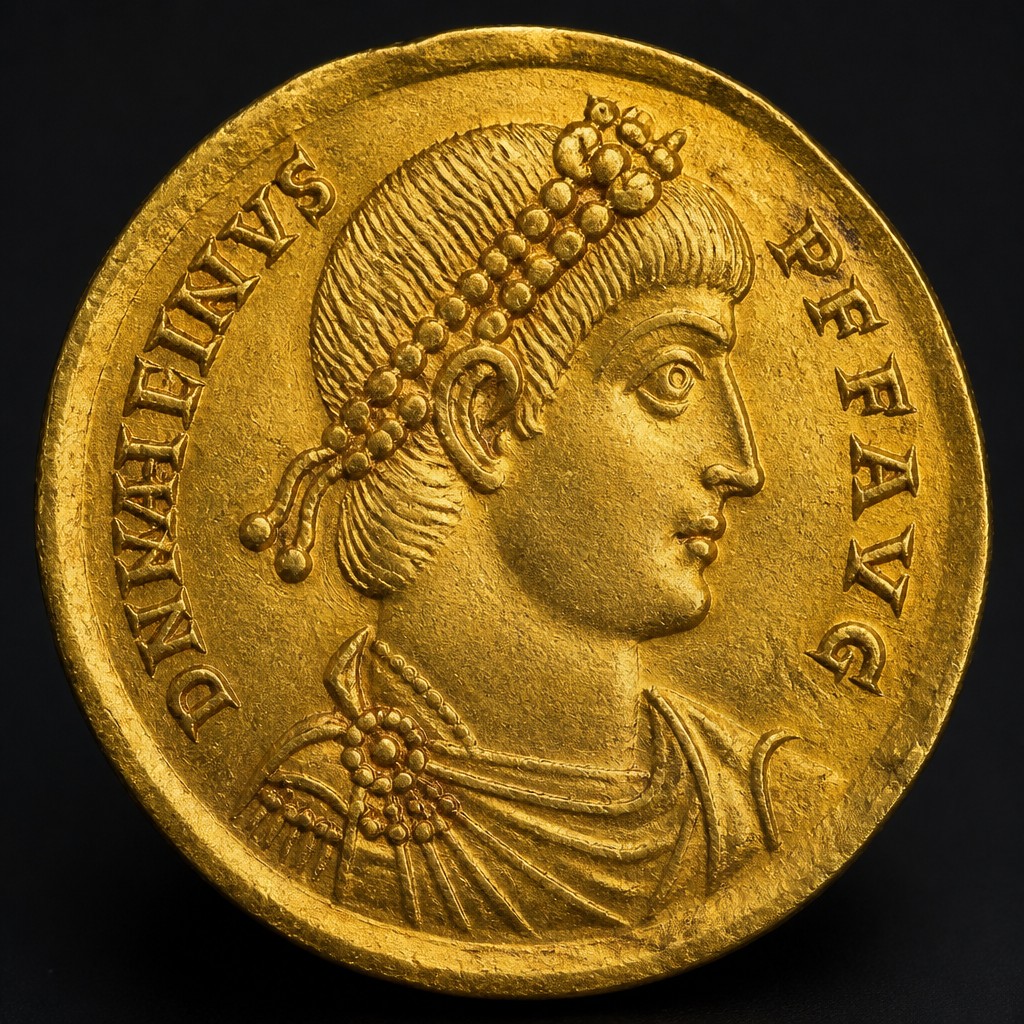
What This Coin Is
This gold solidus was struck for Valentinian I, a career military officer elevated to emperor in 364 AD who went on to found a durable imperial dynasty and split administration of the empire with his brother Valens. The solidus was the stable, high-purity gold coin introduced by Constantine that remained the backbone of the late Roman monetary system for centuries.
Obverse Design & Inscriptions
The obverse shows a pearl-diademed, draped-and-cuirassed bust of Valentinian I facing right. The legend reads D N VALENTINI ANVS P F AVG, spelling out his name across the full legend space in the standard format for the period.
Reverse Design & Inscriptions
A common reverse shows the emperor standing facing, head turned right, holding a labarum (a military standard topped with the Chi-Rho) in one hand and a small Victory on a globe in the other, with a captive seated at his feet. The legend reads RESTITVTOR REI PVBLICAE ("restorer of the state"). Other reverse types from his reign include facing emperors holding a globe together or Victory advancing types.
Size, Weight, Metal, and Edge
Struck in high-purity gold, the solidus maintained a standard weight near 4.5 grams at roughly 20-21mm in diameter throughout this period, a consistency that made it trusted across the Mediterranean world for international trade and payments. The edge is plain, as struck.
Mint Marks and Where to Find Them
The exergue below the reverse scene carries the mint signature, such as TROBS (Trier), CONOB (Constantinople), or ANTOB (Antioch), where the final letters often indicate the metal (OB signifying pure gold, obryziacum) alongside the mint city abbreviation.
Telling It Apart From Similar Coins
Because Valentinian I ruled alongside his brother Valens and later his son Gratian, their coins share very similar styles and reverse types. The deciding factor is always the obverse legend spelling out the specific emperor's name; VALENTINI ANVS indicates Valentinian I (or occasionally Valentinian II, distinguished by portrait age and historical mint dating), while VALENS or GRATIANVS point to his brother or son respectively.
Judging Condition at a Glance
Gold solidi resist corrosion, so grade is determined almost entirely by strike quality and wear rather than surface damage. Look for sharp, high-relief portrait details, a fully legible legend, and good centering; because gold does not tone or oxidize like bronze, even ancient examples can appear remarkably lustrous when well preserved.
Authenticity Red Flags
Because gold solidi carry meaningful bullion and collector value, counterfeits are a real concern. Check the weight carefully against the roughly 4.5 gram standard, examine the color for a rich, consistent gold tone without any unusual pale or brassy hue suggesting base-metal alloy, and look at the edge and fields for file marks or filler suggesting the coin was hollowed out or has had metal removed or added. A qualified appraisal or specialist authentication is advisable for any high-value ancient gold purchase.
Frequently asked questions
What does RESTITVTOR REI PVBLICAE mean?
It means "restorer of the state," a common propaganda phrase used by several late Roman emperors, including Valentinian I, to project stability and renewal.
How do I tell Valentinian I's coins apart from his brother Valens?
The obverse legend spells out the emperor's specific name, so checking for VALENTINI ANVS versus VALENS is the reliable way to distinguish the two, since reverse types are often shared.
What does the OB at the end of the mint mark signify?
OB stands for obryziacum, indicating pure refined gold, and it typically appears attached to the mint city abbreviation in the exergue of gold solidi from this era.
Why is weight important for identifying a genuine solidus?
The solidus was minted to a strict standard near 4.5 grams for centuries, so a significant deviation in weight is one of the simplest checks against later imitations or damaged coins.