
How to Identify the US Seated Liberty Dollar
A 19th-century American silver dollar showing Liberty seated on a rock holding a shield and pole, struck from 1840 to 1873 across several minor design varieties.
Read the full US Seated Liberty Dollar encyclopedia entry →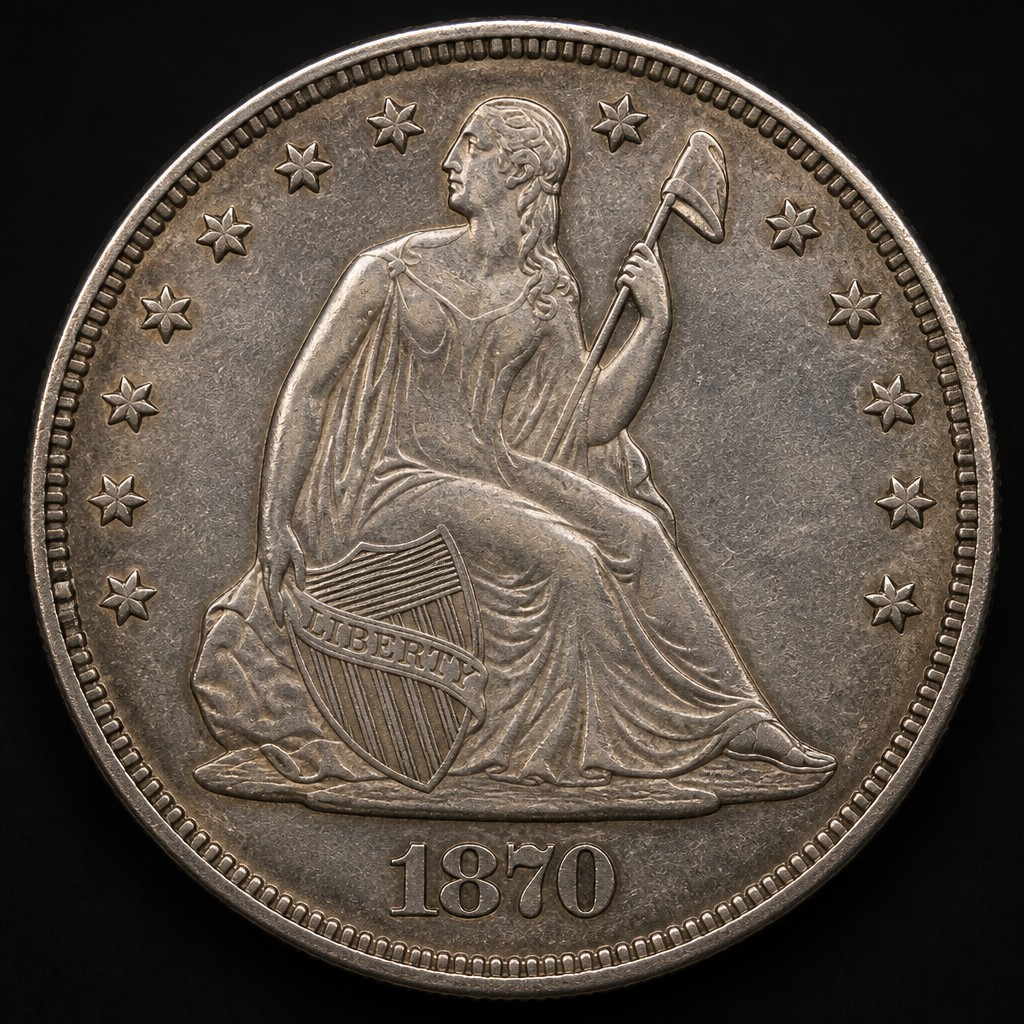
What This Coin Is
The US Seated Liberty Dollar is a silver dollar coin struck by the United States Mint from 1840 to 1873, part of the broader Seated Liberty design family used across multiple denominations in that era. Designed chiefly by Christian Gobrecht, it reflects the mid-19th century American allegorical style before being replaced by the Trade Dollar and later Morgan Dollar.
Obverse Design & Inscriptions
The obverse shows Liberty seated on a rock, facing left, holding a liberty pole topped with a Phrygian cap in one hand and resting the other on a shield inscribed "LIBERTY." She is surrounded by thirteen stars, with the date positioned below her at the base of the design.
Reverse Design & Inscriptions
The reverse displays a heraldic eagle with wings spread, holding an olive branch and arrows, encircled by "UNITED STATES OF AMERICA" and, on later dates, "IN GOD WE TRUST" on a ribbon above the eagle's head, a motto added starting in 1866. The denomination is implied by the coin's size rather than spelled out numerically on most dates.
Size, Weight, Metal, and Edge
The Seated Liberty Dollar measures 38.1 mm in diameter and weighs 26.73 grams, struck in 90% silver and 10% copper, with a reeded edge, matching the standard set for US silver dollars of the period.
Mint Marks and Where to Find Them
Mint marks appear on the reverse below the eagle, near the wreath or ribbon at the bottom of the design. Coins marked "O" were struck at New Orleans, "S" at San Francisco, and "CC" at Carson City, while coins with no letter came from the Philadelphia mint.
Telling It Apart From Similar Coins
The seated Liberty pose with shield and pole is unique to this design family and distinguishes it clearly from the later standing eagle-reverse Trade Dollar or the bust-portrait Morgan and Peace Dollars. Within the series itself, watch for the addition of "IN GOD WE TRUST" starting in 1866 and minor arrows-at-date varieties in certain years, which mark subtle design changes tied to metal weight adjustments.
Judging Condition at a Glance
Examine Liberty's knee, breast, and the eagle's breast feathers, the classic high points that wear first on this design. A well-preserved example retains sharp drapery lines on Liberty's gown and strong feather detail on the eagle, while a worn coin shows these areas smoothed and indistinct.
Authenticity Red Flags
Be cautious of coins with an added or altered mint mark, especially the rarer "CC" mark applied over a more common variety, since genuine mint marks display natural metal flow lines consistent with the surrounding design. Also verify the coin's weight and diameter against the standard silver dollar specification, and be wary of unusually soft, mushy details that suggest a cast reproduction.
Frequently asked questions
What years were Seated Liberty Dollars minted?
From 1840 to 1873, spanning several minor design variations within that range.
When was 'IN GOD WE TRUST' added?
Starting in 1866, the motto was added on a ribbon above the eagle on the reverse.
Where do I find the mint mark?
On the reverse, below the eagle near the wreath or ribbon at the bottom of the design.
What is the coin's silver content?
It is 90% silver and 10% copper, weighing 26.73 grams, the same standard used for later Morgan and Peace Dollars.
How do I know if a mint mark was added later?
Look under magnification for unnatural surface texture or interruption in the metal flow around the letter, which can indicate it was added after striking.