
How to Identify the US Peace Dollar
A silver dollar struck from 1921 to 1935 to commemorate the peace following World War I, featuring a radiant Liberty portrait and an eagle perched on a mountain.
Read the full US Peace Dollar encyclopedia entry →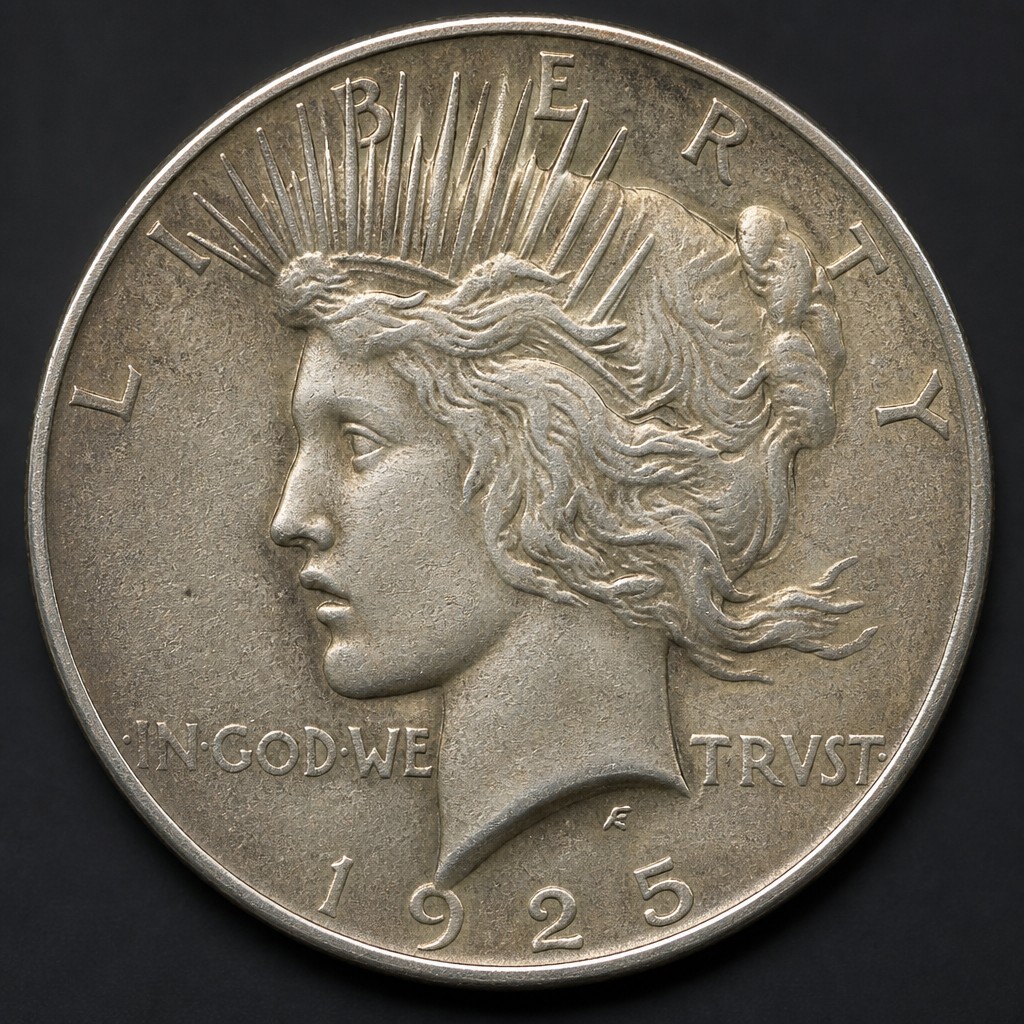
What This Coin Is
The US Peace Dollar is a silver dollar coin minted by the United States from 1921 through 1935, introduced specifically to commemorate the peace that followed World War I. Designed by Anthony de Francisci, it replaced the Morgan Dollar and carries distinctly different, more modern artistic styling, reflecting the Art Deco influences popular in American design of the 1920s.
Obverse Design & Inscriptions
The obverse shows a left-facing portrait of Liberty with flowing, windswept hair and a radiant crown of rays, evoking the Statue of Liberty. "LIBERTY" arcs above the portrait, the date appears below, and "IN GOD WE TRUST" is inscribed to the lower left of the neck.
Reverse Design & Inscriptions
The reverse depicts a bald eagle perched on a mountain crag, holding an olive branch, with the sun's rays rising behind it, and the word "PEACE" inscribed below the eagle on the mountain. "UNITED STATES OF AMERICA" and "E PLURIBUS UNUM" arc around the upper border, with "ONE DOLLAR" near the bottom.
Size, Weight, Metal, and Edge
The Peace Dollar shares the same specifications as its Morgan predecessor: 38.1 mm in diameter, 26.73 grams, struck in 90% silver and 10% copper, with a reeded edge.
Mint Marks and Where to Find Them
The mint mark, if present, sits on the reverse beneath "ONE" near the base of the mountain design. Coins from Denver carry a "D," those from San Francisco carry an "S," and coins with no letter were struck at Philadelphia.
Telling It Apart From Similar Coins
The Peace Dollar's distinct radiant tiara and windswept hair on Liberty, along with the perched eagle on a mountain rather than a heraldic spread-wing eagle, immediately separate it from the Morgan Dollar. The word "PEACE" prominently placed on the reverse is also a unique identifying feature not found on any other regular-issue US dollar coin.
Judging Condition at a Glance
Check Liberty's hair above the ear and the eagle's wing and leg feathers for wear, since these areas are the first to show flattening. A well-preserved coin displays full, unbroken luster in the fields and sharp, high-relief details, while a worn example shows a smooth, low-relief portrait and eagle, and many dates are also known for a naturally weak strike at the center that should not be mistaken for wear.
Authenticity Red Flags
Be cautious of coins with unusually weak strikes in the center combined with sharp rims, or a surface that looks artificially shiny or pitted, both potential signs of alteration or counterfeiting. Also confirm the weight and diameter match the standard silver dollar specification, since fakes are sometimes struck in the wrong alloy and feel noticeably lighter or heavier.
Frequently asked questions
What years were Peace Dollars minted?
From 1921 through 1935, with a gap in production during part of the late 1920s.
Why is 'PEACE' written on the coin?
The coin was designed to commemorate the peace following World War I, and the word appears on the reverse below the eagle.
Where is the mint mark?
On the reverse near the base of the mountain, beneath the word 'ONE.'
What is the coin's metal composition?
It is 90% silver and 10% copper, the same standard as the Morgan Dollar.
How do I distinguish it from a Morgan Dollar?
Look for Liberty's radiant tiara and windswept hair, and an eagle perched on a mountain rather than a heraldic spread-wing eagle.