
How to Identify the United States Trade Dollar
A heavier-than-standard silver dollar struck from 1873 to 1885 specifically for trade with Asia, featuring a seated Liberty facing a bale of merchandise and an eagle reverse.
Read the full United States Trade Dollar encyclopedia entry →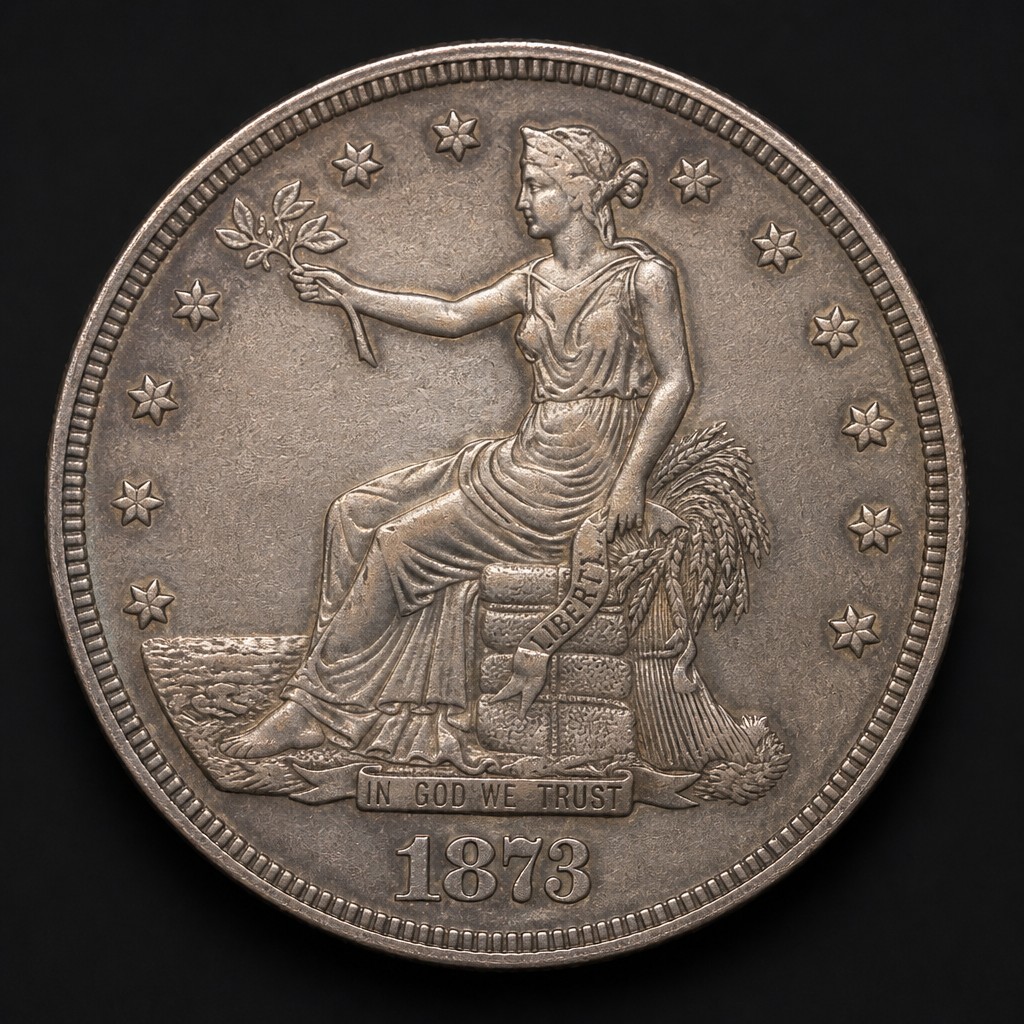
What the Coin Is
The Trade Dollar was struck by the United States Mint from 1873 to 1885 to compete with the Mexican and other trade dollars circulating widely in Asian commerce. It was deliberately made heavier than the standard silver dollar to be more readily accepted overseas, and business strikes ended in 1878, with only proof coins made in later years.
Obverse Design & Inscriptions
The obverse shows Liberty seated facing left on a bale of merchandise, holding an olive branch in her extended right hand, with a shield bearing stars and stripes behind her and wheat stalks nearby. LIBERTY appears on the base she sits upon, thirteen stars surround the design, and the date is below.
Reverse Design & Inscriptions
The reverse depicts an eagle with wings spread, clutching three arrows and an olive branch. IN GOD WE TRUST appears above the eagle's head, E PLURIBUS UNUM on a ribbon below it, UNITED STATES OF AMERICA around the top border, and TRADE DOLLAR with 420 GRAINS, 900 FINE below the eagle, spelling out the coin's exact silver content for trade purposes.
Size, Weight, Metal & Edge
The Trade Dollar measures 38.1mm in diameter, weighs 27.22 grams (420 grains), slightly heavier than the standard 26.73-gram silver dollar, is struck in 90% silver and 10% copper, and has a reeded edge.
Mint Marks & Where to Find Them
The mint mark, when present, is located on the reverse below the eagle. Coins with no mint mark were struck in Philadelphia, an "S" indicates San Francisco, and a "CC" indicates Carson City.
Telling It Apart From Similar Coins
The Trade Dollar's stated weight and fineness inscription (420 GRAINS, 900 FINE) on the reverse is a key identifier distinguishing it from the standard Morgan or Seated Liberty dollar, which carry no such inscription. The seated Liberty pose facing a bale of goods, rather than a plain pedestal, is another visual cue unique to this design.
Judging Condition at a Glance
Examine Liberty's knee, chest, and head for smoothing, along with the eagle's breast and wing feathers, as these are the highest points and wear first. Many surviving Trade Dollars carry small punched Chinese characters called chop marks, applied by merchants who verified the silver content; these marks are a historical feature of circulated trade use rather than damage in the traditional sense.
Authenticity Red Flags
Because genuine Trade Dollars can be valuable, especially in higher grades or from Carson City, watch for added or altered mint marks, artificially applied chop marks meant to suggest genuine Asian circulation, and surfaces that look too smooth or grainy for a struck silver coin. Weight is a useful check, since a coin significantly lighter or heavier than 27.22 grams warrants closer scrutiny.
Frequently asked questions
Why is the Trade Dollar heavier than a regular silver dollar?
It was intentionally made heavier, at 420 grains versus the standard 412.5 grains, so it would be more readily accepted in Asian trade markets competing with other large silver trade coins.
What are the small stamped characters sometimes seen on these coins?
Those are chop marks, applied by Chinese merchants to verify silver content during the coin's circulation in Asian trade, and they are a recognized historical feature rather than damage.
Where is the mint mark located?
On the reverse, below the eagle; no mark means Philadelphia, while S and CC indicate San Francisco and Carson City.
Were Trade Dollars made every year from 1873 to 1885?
Business strikes were produced from 1873 through 1878, while the coins dated 1879 through 1885 were struck only as proofs.