
How to Identify the Unite of James I
Spot a genuine James I gold Unite by its crowned armored bust, union legend, broad gold flan, mint mark, and how to tell it from the Laurel.
Read the full Unite of James I encyclopedia entry →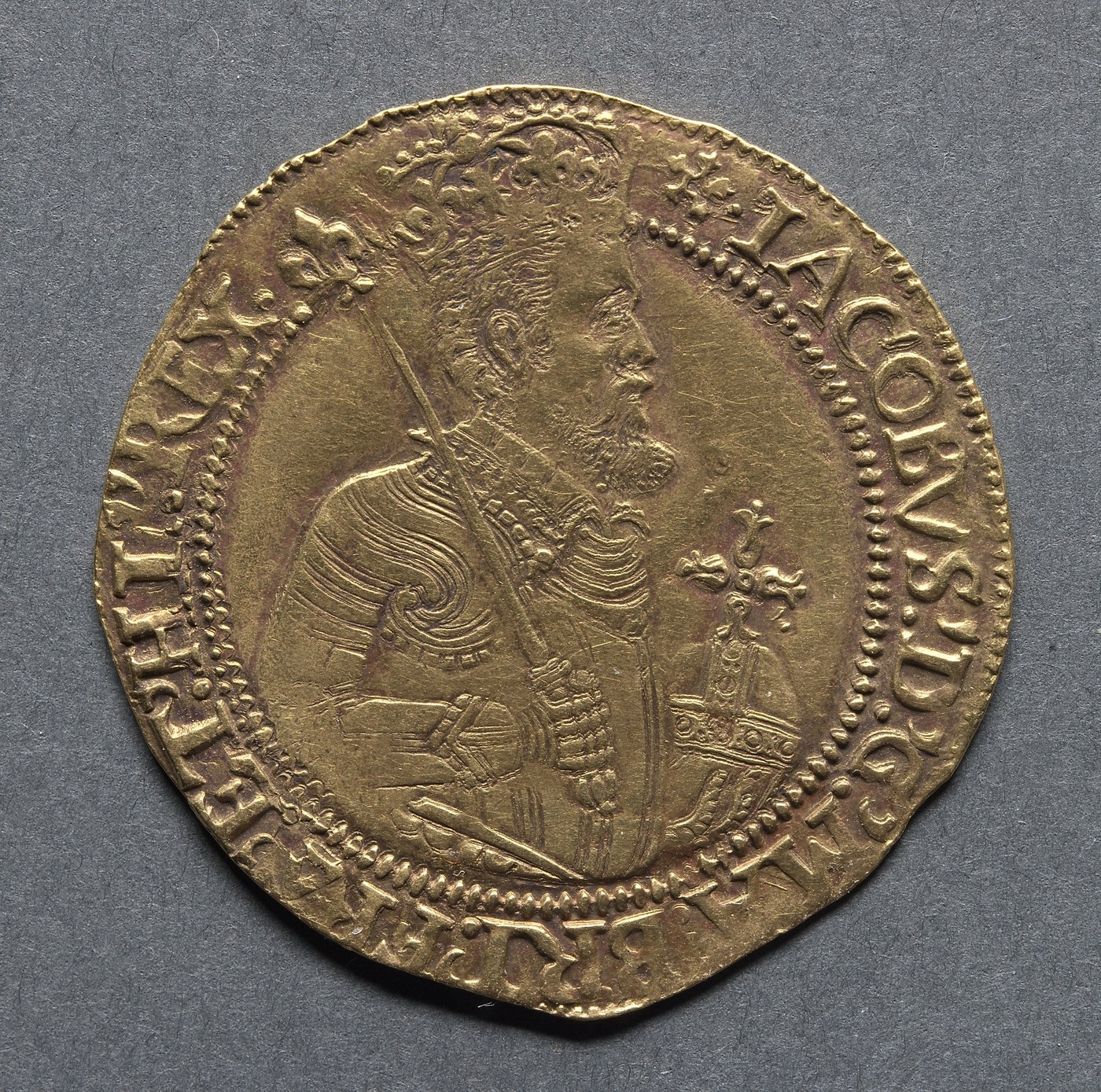
Begin with the obverse portrait, which is the clearest confirmation. A genuine Unite shows a crowned half-length figure of James in ornate armor and robes, facing right, holding an orb and sceptre. Around it runs a Latin legend naming him King of Great Britain, France and Ireland; the appearance of the British title (rather than just England) marks this as post-1603 Stuart coinage. The observed coin's armored, feather-and-robe portrait profile matches this type.
Turn the coin to check the reverse, not shown in this image. Expect a crowned, garnished shield of the quartered royal arms — England, Scotland, Ireland and France combined — surrounded by the union motto FACIAM EOS IN GENTEM VNAM ("I will make them one nation"). This legend is effectively a signature of the Unite and a strong authentication cue.
Assess size, metal, and fabric. The Unite is a broad, thin gold coin of roughly ten grams, considerably larger than the small gold crowns and half-crowns. Because it is hand-hammered, expect a slightly irregular flan, minor off-centring, and lettering that is not machine-perfect. A flawless, perfectly round, sharp-edged piece should raise suspicion of a modern reproduction.
Locate the mint mark (initial mark) at the start of the legends. All Unites were struck at the Tower mint, and the mark (a small symbol such as a rose, thistle, lis, escallop, coronet, key or similar) is the primary tool for dating a coin within the reign. Compare it against a standard reference such as Spink's Coins of England before settling an attribution.
Be alert to look-alikes and cautions. Do not confuse the Unite with the Laurel, the later gold pound of James I that shows a Roman laureate head facing left, or with the sovereign of the First Coinage. Because Stuart gold is valuable, cast copies, tooled coins and forgeries exist: check weight and diameter, look for casting seams or a spongy surface, and obtain independent authentication before any serious purchase.
Frequently asked questions
How do I tell a Unite from a Laurel?
The Unite shows a crowned, armored half-length bust facing right; the Laurel, which replaced it from 1619, shows a Roman-style laureate head facing left. Both are gold pound coins of James I.
What legend confirms a Unite?
The reverse motto FACIAM EOS IN GENTEM VNAM ('I will make them one nation') around a crowned royal shield is the union message that gives the Unite its name and is a strong identification cue.
What does the mint mark tell me?
All Unites came from the Tower mint, so the initial mark at the start of the legend serves mainly to date the coin within the reign. Match it against a standard reference for a reliable attribution.
How can I spot a fake Unite?
Watch for incorrect weight or diameter, casting seams or bubbles, unnaturally uniform lettering, and dull, soft detail. Given the coin's value, seek professional authentication before buying.