
How to Identify the Una and the Lion Five Pounds
A collector's guide to recognizing the 1839 gold Five Pounds — its Una-and-lion reverse, young Victoria portrait, and the copies that imitate it.
Read the full Una and the Lion Five Pounds encyclopedia entry →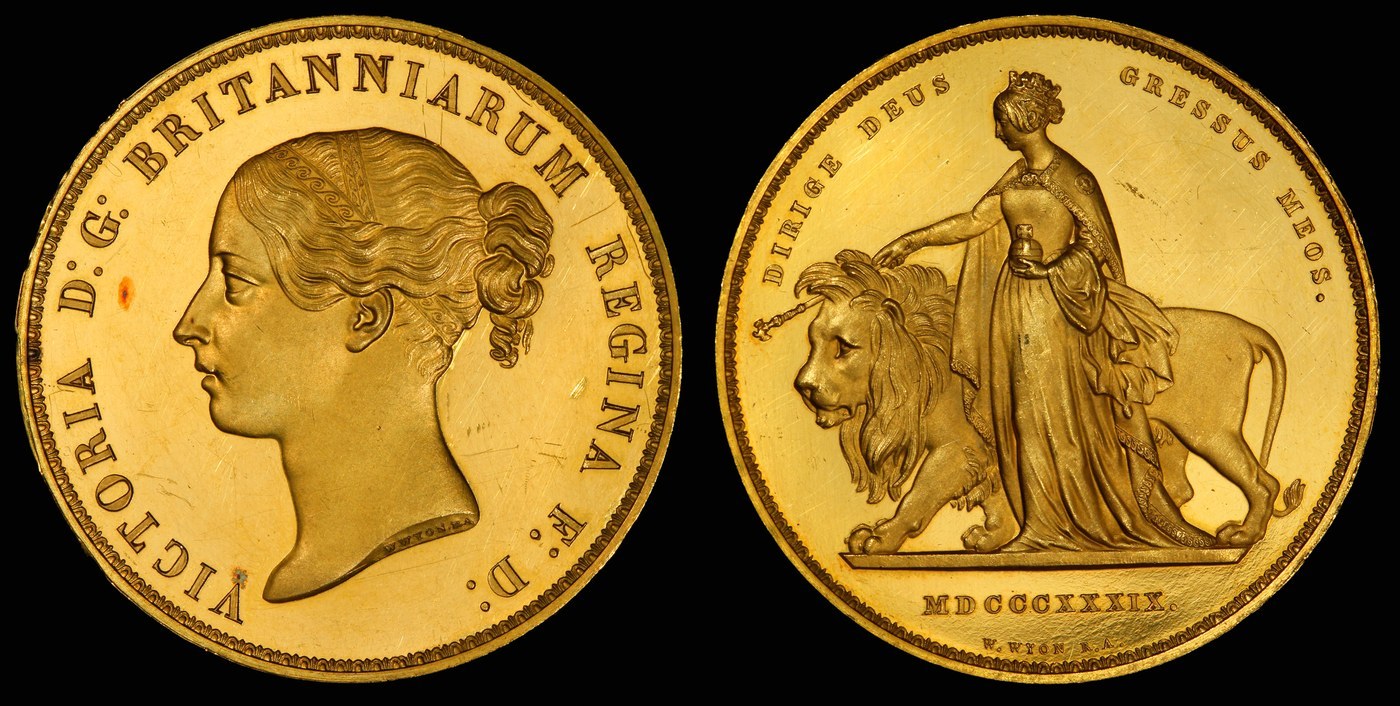
Start with the reverse, because it is the single most diagnostic feature. Look for a standing draped female figure (Una) beside a large lion striding to the left, framed by the coin's legend and the date 1839. No other British coin type carries this scene, so a genuine Una-and-lion reverse dated 1839 is the key identifier. The obverse should show a young, left-facing bust of Queen Victoria with her hair bound back and her Latin titles around the rim.
Confirm the physical basics. This is a gold Five Pounds — a large, substantial coin, far heavier and wider than a sovereign, and it was made as a proof, so genuine pieces have deeply mirrored fields, squared rims, and razor-sharp detail in Una's drapery and the lion's mane. Weigh and measure any candidate: a piece that is underweight, undersized, non-magnetic testing aside, or that has a dull, grainy, or cast-looking surface is a red flag.
Check the edge and the fine detail. Specialists distinguish varieties partly by edge lettering and by small differences in the dies, so examine the edge carefully and photograph it. Crisp, confident lettering and clean die work point toward a proper strike; mushy or uneven lettering suggests a copy. Because varieties matter to value, note exactly what the edge shows rather than assuming.
Be alert to look-alikes. The Una and the Lion is one of the most frequently reproduced British designs, appearing on modern commemorative medals, gold-plated replicas, and privately made restrikes. Some copies are openly sold as tributes, others are deceptive. Any piece lacking the correct weight, diameter, proof surfaces, and edge should be treated as suspect until proven otherwise.
Given the coin's value, do not rely on visual identification alone for a purchase or valuation. Have any candidate examined by a reputable dealer or graded by a recognized third-party service, and give strong weight to documented provenance, which for a rarity of this level is both expected and reassuring.
Frequently asked questions
What is the fastest way to tell a genuine example from a replica?
Verify the fundamentals together: correct gold weight and diameter for a Five Pounds, true proof mirror surfaces, sharp Wyon detail, and proper edge lettering. A miss on any of these points strongly toward a copy.
Does the coin have a mint mark?
It was struck at the Royal Mint in London and does not carry a distinguishing mint letter. Identification relies on the 1839 date, the Una-and-lion reverse, and the young Victoria obverse rather than a mint mark.
Should I clean the coin before identifying it?
No. Never clean a coin of this type. Cleaning damages proof surfaces and can drastically reduce value; leave any assessment and conservation to professionals.
Why does the edge matter so much on this coin?
Edge lettering helps distinguish the recognized 1839 varieties, which affect rarity and value, and a correct edge is also a useful authenticity check against many replicas.