Una and the Lion Five Pounds
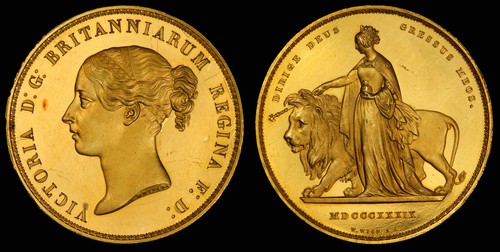
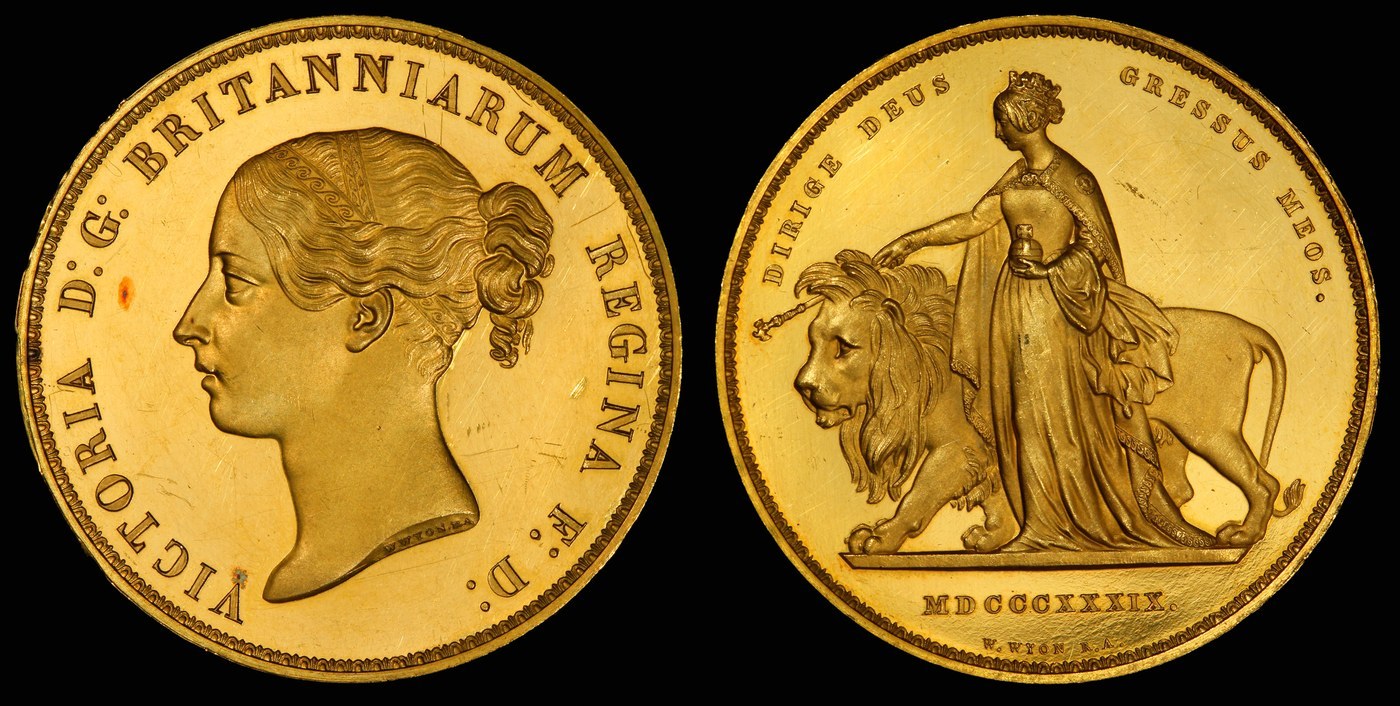
William Wyon's 1839 gold Five Pounds pairs a young Queen Victoria with Una guiding a lion — widely praised as one of the most beautiful British coins ever struck.
- Country
- United Kingdom
- Denomination
- 5 Pounds
- Metal
- Gold
Got a coin like this?
Identify any coin from a photo, free.
Overview
The Una and the Lion Five Pounds is a British gold coin dated 1839, produced early in the reign of Queen Victoria. Its obverse shows a youthful left-facing portrait of the Queen, and its reverse depicts Una, a figure from Edmund Spenser's poem The Faerie Queene, walking beside and guiding a striding lion. The allegory casts the young Victoria as Una leading the British lion.
The coin is celebrated chiefly for its artistry. It was engraved by William Wyon, then Chief Engraver at the Royal Mint, and is routinely described by collectors and auction houses as among the most beautiful coins ever struck in Britain. It was a proof presentation piece rather than a coin made for everyday circulation, and survives today in small numbers.
Because of its rarity, its historical importance at the outset of the Victorian era, and its exceptional design, the Una and the Lion Five Pounds is one of the most sought-after of all British coins and a landmark rarity in the gold series.
History & Background
The coin was issued in 1839, two years into Queen Victoria's reign, as part of a proof set marking the new monarch. William Wyon based the young-head portrait on his own celebrated studies of the Queen, the same artistic tradition that later informed the famous Penny Black postage stamp portrait.
The reverse subject was drawn from Spenser's Elizabethan epic The Faerie Queene, in which the maiden Una represents Truth and leads a lion that has been tamed by her virtue. Choosing this scene to portray the young Queen guiding the might of Britain was a deliberate and flattering allegory for the start of the reign.
Una and the Lion Five Pounds pieces were struck as proofs for collectors and presentation rather than for commerce. Several die and edge varieties are recognized by specialists, reflecting small production runs. All are dated 1839, and no later official strikings share the design, which is part of why the type remains so prized.
How to Identify
Look first at the reverse: a standing female figure (Una) shown with a large lion, the lion striding to the left, with the coin's legend and the date 1839 in the surrounding text. This scene is the coin's defining and instantly recognizable feature. The obverse shows Queen Victoria's young head facing left, with her hair drawn back, encircled by her Latin titles.
The piece is a gold Five Pounds — a large, heavy coin considerably bigger than a sovereign, struck as a proof with sharp, mirror-like fields and finely detailed devices. The denomination corresponds to five pounds, or five sovereigns' worth of gold.
Because it is a rare and valuable proof, careful attention to weight, diameter, edge lettering, and strike sharpness is essential. Genuine examples display crisp Wyon detail; softness, wrong weight, or a cast-looking surface are warning signs. Any coin presented as this type should be considered a candidate for expert authentication given how frequently the design has been copied.
Value & Collectibility
The Una and the Lion Five Pounds is a major rarity and trades in the upper tier of the British coin market. Genuine 1839 proof examples are prized possessions that appear only occasionally at auction, typically realizing very substantial five- to six-figure sums, with the strongest, highest-graded pieces commanding the most.
Value depends heavily on the specific variety, the state of preservation, and the eye appeal of the surfaces, since these are proofs where handling marks and hairlines matter greatly. Provenance and third-party grading also strongly influence price for a coin of this stature.
Prospective buyers should be cautious: the design's fame has made it one of the most reproduced of all British coins, and modern commemorative restrikes, medals, and outright copies are common. Any purchase at this level warrants authentication and, ideally, an established chain of ownership.
Frequently asked questions
Who is the woman with the lion on the reverse?
She is Una, a character symbolizing Truth from Edmund Spenser's poem The Faerie Queene. The scene is an allegory casting the young Queen Victoria as Una guiding the British lion.
Was the Una and the Lion Five Pounds made for everyday spending?
No. It was struck in 1839 as a gold proof presentation piece for collectors and ceremony, not for general circulation, which is one reason so few survive.
Why is this coin considered so special?
It combines great rarity, historical importance at the start of Victoria's reign, and William Wyon's celebrated engraving, and it is widely regarded as one of the most beautiful British coins ever made.
Are there different varieties?
Yes. Specialists recognize several die and edge-lettering varieties of the 1839 proof. All carry the 1839 date, and differences can significantly affect rarity and value.
Is a coin with this design that I own likely to be genuine?
Be cautious. The design is among the most copied of all British coins, so modern restrikes, medals, and replicas are common. A genuine 1839 proof should be authenticated by an expert.
Una and the Lion Five Pounds guides
In-depth guides for identifying, valuing, and collecting Una and the Lion Five Pounds.