
How to Identify the Una and the Lion Five Pound
The 1839 Una and the Lion is a proof gold five pound coin showing young Queen Victoria as the allegorical figure Una guiding a lion, widely regarded as one of Britain's most beautiful coin designs.
Read the full Una and the Lion Five Pound encyclopedia entry →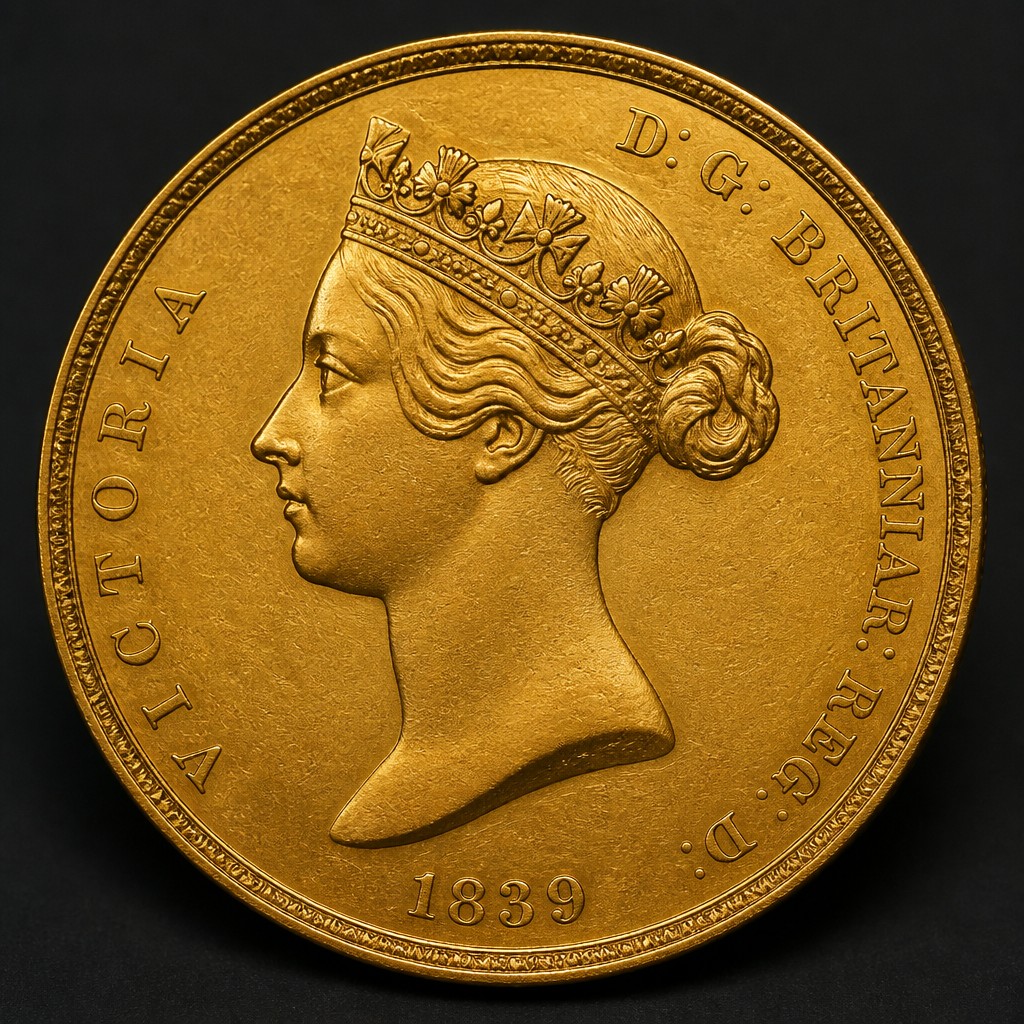
What Is It
The Una and the Lion Five Pound is a gold proof coin dated 1839, struck early in Queen Victoria's reign and designed by William Wyon. It was never issued for general circulation; instead it was produced in limited numbers as part of a special proof set to mark the young queen's accession, and it has since become one of the most celebrated designs in British numismatics, frequently referenced by later commemorative gold issues.
Obverse Design
The obverse shows a youthful portrait of Queen Victoria, bare-headed with her hair drawn back, surrounded by the legend VICTORIA DEI GRATIA and her royal titles. The portrait style matches other "young head" Victoria coinage of the same early period.
Reverse Design
The reverse carries the coin's signature feature: an allegorical scene inspired by Edmund Spenser's poem "The Faerie Queene," showing the figure of Una, representing Truth (and by extension the young queen), gently guiding a large lion, representing the British nation, with a scepter. The Latin legend DIRIGE DEUS GRESSUS MEOS ("Direct my steps, O Lord") arches around the top, and the date appears in Roman numerals, MDCCCXXXIX, in the exergue at the bottom.
Size, Weight, and Metal
Struck in gold, the original 1839 coin is notably large for a British coin of its era, with a diameter of roughly 56mm, considerably bigger than a standard five pound piece of later Victorian coinage. The edge carries an incuse or raised lettered inscription, commonly DECUS ET TUTAMEN ANNO REGNI followed by the regnal year in some varieties.
Mint Marks and Where to Find Them
As a Royal Mint proof coin struck in London for a special occasion, it carries no branch mint mark. Because it was a limited proof issue rather than a circulating coin, surviving examples are scarce and mostly held in major collections or offered occasionally at auction.
Telling It Apart from Similar Coins
The original 1839 issue should not be confused with the many later tribute and commemorative pieces the Royal Mint has issued using the same Una and the Lion imagery in gold, silver, and platinum for anniversaries. These modern strikes typically carry a modern date, updated monarch's portrait or explicit commemorative markings, and different weight and fineness standards than the 1839 original, so checking the date and any modern hallmark or certificate is essential.
Judging Condition at a Glance
On the reverse, the highest relief points are Una's raised arm and scepter and the lion's mane and back; these show handling wear first even on lightly circulated or handled proofs. Because most surviving originals are proof strikes rather than worn circulation pieces, look for mirror-like fields and frosted design elements as signs of an well-preserved, carefully handled example.
Authenticity Red Flags
Given its fame and value, this design is a frequent target for replicas and modern reproduction medals sold as if they were the rare original. Genuine 1839 pieces are gold, of a specific correct diameter and weight, and show the fine, crisp linework typical of William Wyon's engraving; a coin that is noticeably lighter, a different color than gold, or shows soft/blurred detail is very likely a later reproduction, replica, or tribute piece rather than an original 1839 proof.
Frequently asked questions
What does the Una and the Lion scene represent?
It is an allegorical image, inspired by Spenser's Faerie Queene, of Una (representing the young Queen Victoria and truth) leading a lion (representing the British nation) peacefully with a scepter.
Was the 1839 Una and the Lion coin ever spent as money?
No, it was a proof coin struck for collectors and to mark Victoria's accession, not intended for general circulation.
How can I tell an original 1839 piece from a modern tribute reissue?
Check the date and metal composition carefully; modern Royal Mint tributes use the same design but carry a current date, different weight/fineness, and are usually sold with modern certificates or packaging, unlike the original 1839 issue.
Why is this coin considered so significant?
It is widely regarded as one of the most artistically accomplished coin designs ever produced by the Royal Mint, and its rarity as an early Victorian proof adds to its historical importance.