
How to Identify the Type II Silver Three-Cent Piece
A guide to the 1854-1858 Type II trime, explaining the added outlines around its star design and how it differs from the earlier and later three-cent silver types.
Read the full Type II Silver Three-Cent Piece encyclopedia entry →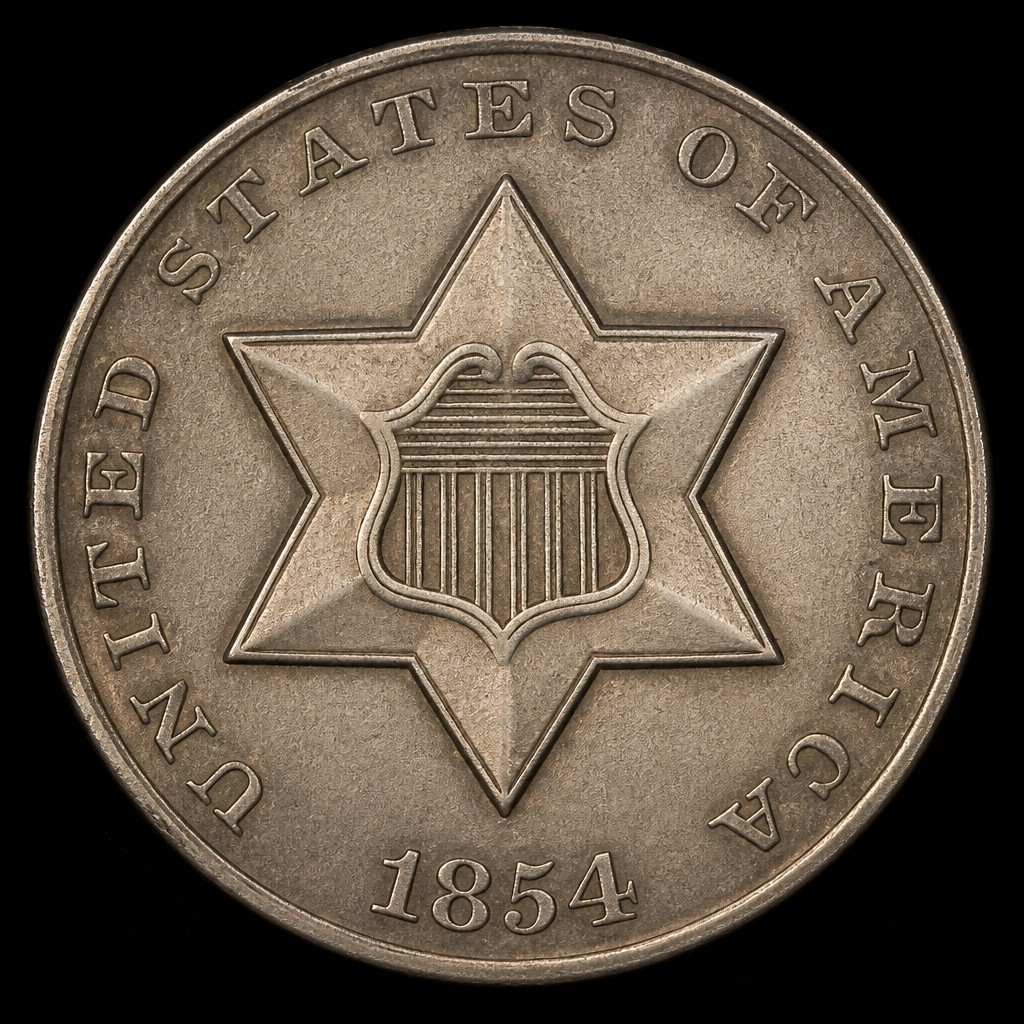
What It Is
The Type II silver three-cent piece was struck from 1854 to 1858, following a change in the coin's design and silver fineness shortly after its introduction. Like other trimes, it was meant for small everyday transactions such as buying postage stamps.
Obverse Design
The obverse still shows a six-pointed star with a small shield at its center and "UNITED STATES OF AMERICA" around the border with the date below, but the star is now framed by three parallel outlines, a change from the plain, unbordered star used on the original 1851-1853 design.
Reverse Design
The reverse centers on a large Roman numeral "III," but Type II added a bundle of arrows below the scrollwork and an olive branch above it, framing the numeral more elaborately than the earlier design.
Size, Weight, Metal, and Edge
To align the coin with the standard used in other U.S. silver coinage, its fineness was raised to 90% silver and 10% copper starting in 1854, and its weight was reduced slightly to about 0.75 grams. The diameter stayed close to 14mm, with a plain edge.
Mint Marks
Type II three-cent pieces were struck only at the Philadelphia Mint, so genuine examples show no mint mark.
Telling It Apart from Similar Coins
The clearest way to identify a Type II trime is the triple outline surrounding the star on the obverse, which the original 1851-1853 Type I lacks entirely. Type III, produced from 1859 to 1873, looks similar but uses only two outlines around the star instead of three — a subtle but reliable difference once you know to look for it. Comparing the number of lines framing the star is the fastest way to sort a trime into its correct type.
Judging Condition at a Glance
Examine the star's outline for completeness, since the added framing lines are delicate and among the first details to wear away. On the reverse, check the arrows and olive branch bundle for separation from the scrollwork, along with the sharpness of the numeral itself.
Authenticity Red Flags
Given the coin's small size, watch for star outlines that look added or engraved after striking rather than raised naturally as part of the coin's original design, and for dates that seem inconsistent with the expected 1854-1858 range for this type. Unusually soft, blurred details across the whole coin can indicate a cast counterfeit rather than a genuine struck piece.
Frequently asked questions
How is a Type II trime different from Type I?
Type II (1854-1858) has three outlines framing the star on the obverse and an added olive branch and arrows around the numeral III on the reverse; Type I (1851-1853) has a plain, unbordered star.
How is a Type II trime different from Type III?
Type III (1859-1873) looks similar but has only two outlines around the star instead of three.
What is the silver content of a Type II three-cent piece?
It's 90% silver and 10% copper, a change from the 75% silver used in the original 1851-1853 design.
Does the Type II trime have a mint mark?
No, all Type II three-cent pieces were struck exclusively at the Philadelphia Mint.