
How to Identify the Type 3 Indian Princess Gold Dollar
The longest-running gold dollar design, struck from 1856 to 1889, identified by an enlarged Indian princess portrait on a thicker planchet than the earlier Type 2.
Read the full Type 3 Indian Princess Gold Dollar encyclopedia entry →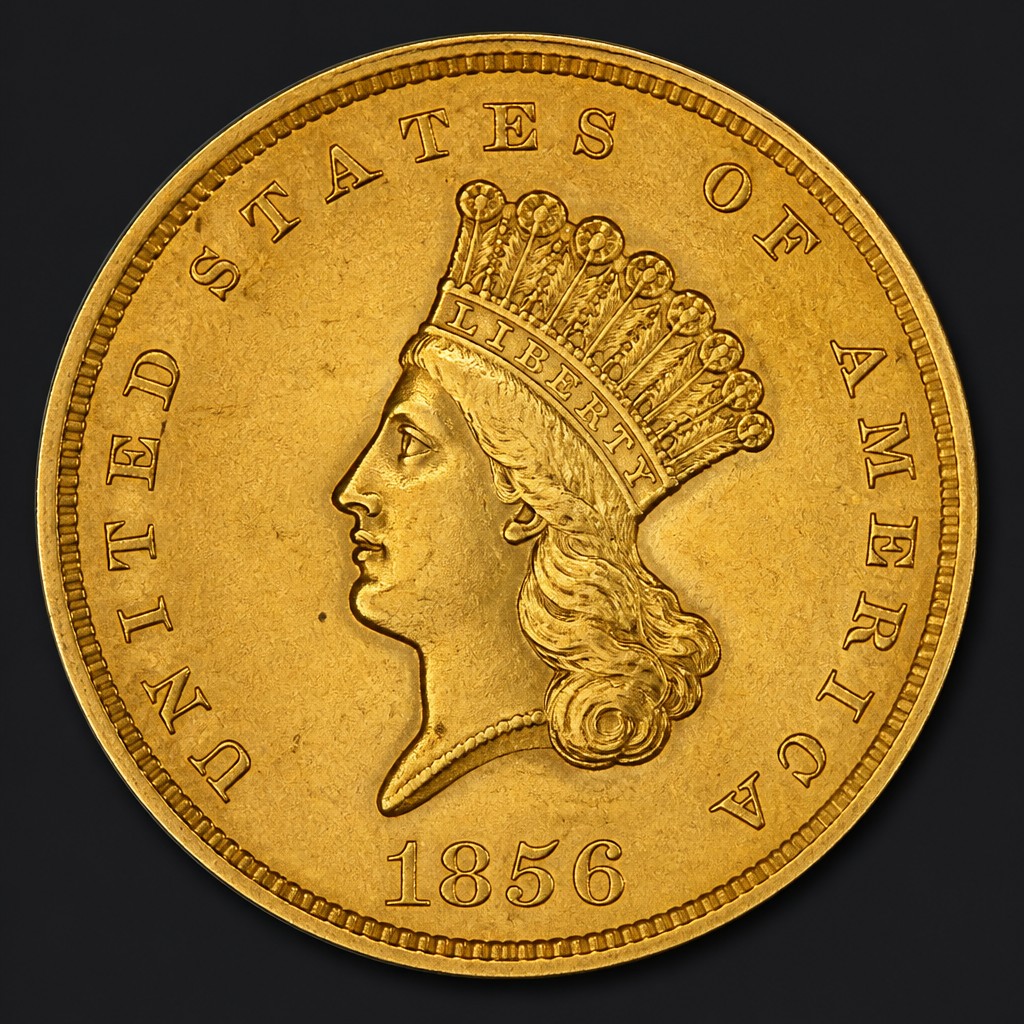
What It Is
The Type 3 gold dollar was struck from 1856 through 1889, making it by far the longest-running of the three gold dollar designs. It was introduced to correct the striking problems of the short-lived Type 2, using an enlarged head and a thicker planchet that allowed the design to strike up much more completely.
Obverse Design
The obverse shows the same allegorical Indian princess portrait used on Type 2, but noticeably larger and more sharply detailed. "UNITED STATES OF AMERICA" wraps around the border, and the date appears below the portrait.
Reverse Design & Inscriptions
The reverse retains the "1 DOLLAR" denomination within an agricultural wreath, enclosed by a beaded border, matching the general reverse layout of Type 2.
Size, Weight, Metal, and Edge
The coin weighs 1.672 grams, is struck in .900 fine gold, measures 15 mm in diameter (the same as Type 2), and has a reeded edge. The key physical difference from Type 2 is a thicker planchet, which allowed for a fuller, sharper strike.
Mint Marks and Where to Find Them
The mint mark is located on the reverse, below the wreath near the bottom rim. Look for "D" (Dahlonega), "S" (San Francisco), though most dates were struck at Philadelphia with no mint mark. Production at Southern branch mints was limited and ended with the Civil War.
Telling It Apart From Similar Coins
The most reliable way to separate Type 3 from Type 2 is the size and sharpness of the portrait — Type 3's head fills more of the coin's field and shows crisper detail even on moderately worn examples, since the design was enlarged specifically to strike more fully. Both share the same 15 mm diameter, distinguishing them from the smaller 13 mm Type 1.
Judging Condition at a Glance
Look at the feather tips of the headdress, the curls of hair near the neck, and the highest wreath leaves on the reverse for the first signs of circulation wear, since these coins generally struck up with much more complete detail than Type 2 examples.
Authenticity Red Flags
As with other small gold denominations, confirm weight and diameter against genuine specifications. Because this type spans over three decades with widely varying mintages — some dates in the 1870s and 1880s were struck in very small numbers, largely for collectors — verify that a claimed low-mintage date shows the mirror-like surfaces and sharp rims expected of a proof coin if that is how it is being represented, rather than the softer look of an ordinary business strike.
Frequently asked questions
What changed between Type 2 and Type 3?
Type 3 uses an enlarged, more sharply detailed portrait on a thicker planchet, correcting the weak strikes common on the earlier Type 2.
How long was Type 3 produced?
From 1856 to 1889, making it the longest-running of the three gold dollar designs.
Where is the mint mark on this coin?
On the reverse, below the wreath near the bottom rim.
Are all Type 3 gold dollars common?
No — some dates from the 1870s and 1880s were struck in very small numbers, mostly for collectors, and are considerably scarcer than the more common 1850s-1860s dates.