
How to Identify the Type 2 Indian Princess Gold Dollar
A short-lived gold dollar design struck 1854–1856, identified by a feathered Indian princess portrait on a larger, thinner planchet than the original gold dollar.
Read the full Type 2 Indian Princess Gold Dollar encyclopedia entry →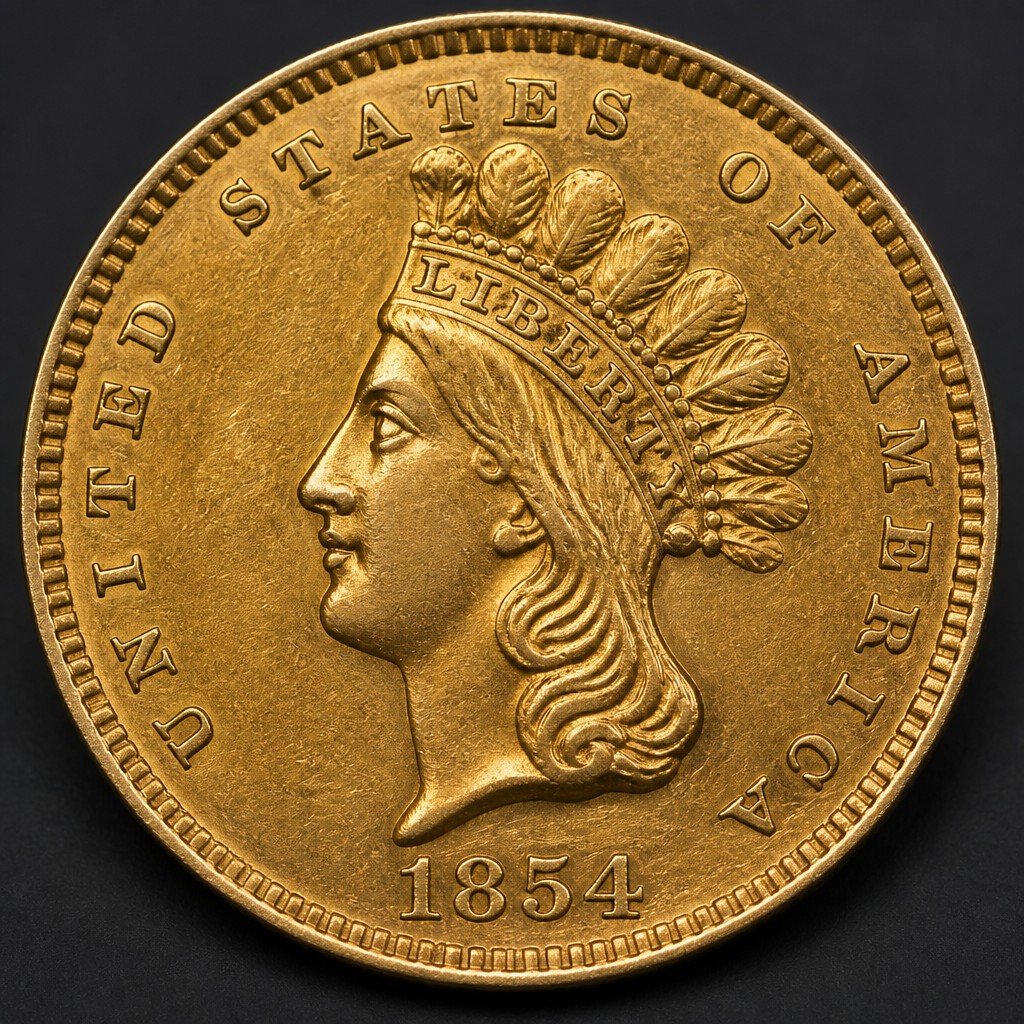
What It Is
The Type 2 gold dollar, also called the Indian Princess Head type, was struck only from 1854 to 1856. It replaced the original Type 1 coronet design with a larger diameter meant to make the tiny coin easier to handle, though the thinner planchet caused persistent striking problems that led to a further redesign just two years later.
Obverse Design
The obverse shows an allegorical portrait of Liberty as a Native American princess wearing a feathered headdress. "UNITED STATES OF AMERICA" wraps around the border close to the rim, and the date appears below the portrait.
Reverse Design & Inscriptions
The reverse shows "1 DOLLAR" within a wreath of agricultural motifs similar to the Three-Dollar gold piece design, enclosed within a beaded border near the rim.
Size, Weight, Metal, and Edge
The coin weighs 1.672 grams, is struck in .900 fine gold, measures 15 mm in diameter (larger than the 13 mm Type 1), and has a reeded edge. The thinner, broader planchet used for this type often resulted in weakly struck details, particularly at the date and the tops of the feathers.
Mint Marks and Where to Find Them
The mint mark is on the reverse, below the wreath near the bottom rim. Look for "C" (Charlotte), "D" (Dahlonega), "O" (New Orleans), or "S" (San Francisco); no mint mark indicates Philadelphia.
Telling It Apart From Similar Coins
Type 2 is easily told apart from Type 1 by its portrait — a feathered Indian princess head here versus a coronet-style Liberty on Type 1 — and its larger 15 mm diameter. Distinguishing Type 2 from the later Type 3 (1856–1889) is harder since both share the same basic design; Type 3 has a noticeably larger, more sharply defined head and a slightly thicker planchet that struck up more fully, so Type 2 examples often look softer and shallower in the portrait even in similar grades.
Judging Condition at a Glance
Because striking weakness was common even on new coins of this type, focus on the feather tips, the curls of hair, and the wreath's highest leaves to judge actual wear rather than assuming softness always means a worn coin — some weakness is simply how the coin left the mint.
Authenticity Red Flags
Given the short mintage window and often weak strikes, be cautious interpreting a soft portrait as damage or wear when it may be an original striking characteristic. Still, verify weight and diameter against genuine specifications, and check the mint mark for correct size and placement, since low-mintage branch issues in this short-lived type are sometimes targeted for alteration.
Frequently asked questions
How is Type 2 different from Type 1?
Type 2 shows a feathered Indian princess portrait on a larger 15 mm planchet, while Type 1 shows a coronet-style Liberty on a smaller 13 mm planchet.
Why do Type 2 gold dollars often look weakly struck?
The broader, thinner planchet used for this type made it difficult for the mint to bring up full design detail, especially at the date and headdress feathers, which is why the design was revised again in 1856.
How can I tell Type 2 apart from Type 3?
They share the same basic design, but Type 3 has a larger, more fully defined portrait on a slightly thicker planchet that struck up more completely than Type 2.
Where is the mint mark located?
On the reverse, below the wreath near the bottom rim.