
How to Identify the Two Cent Piece
A collector's guide to recognizing the Two Cent Piece by its shield-and-motto obverse, "2 CENTS" wreath reverse, bronze color, and 23 mm size.
Read the full Two Cent Piece encyclopedia entry →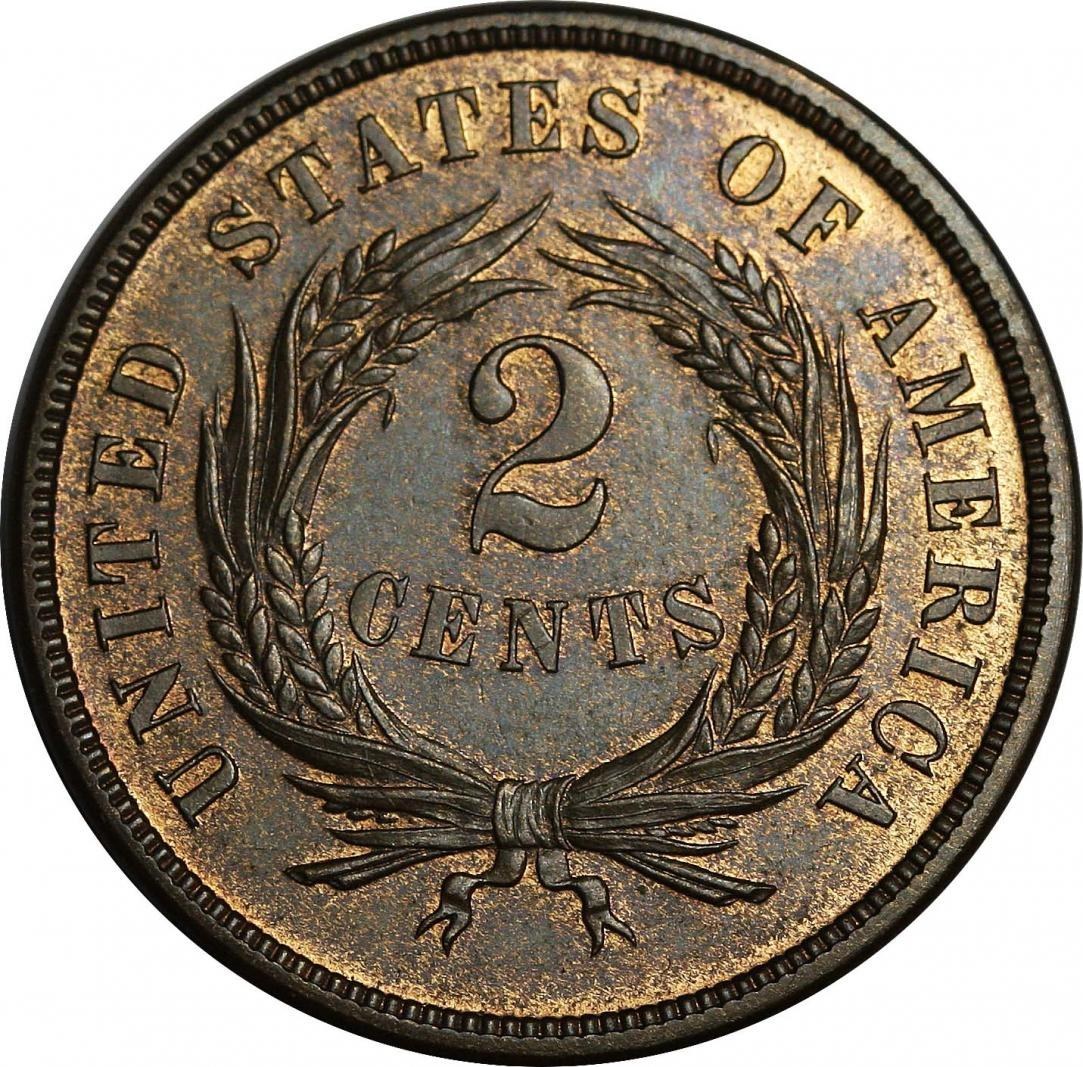
Start with the design on each side. The reverse—often the clearest identifier and the side shown on the pictured coin—displays "2 CENTS" inside a wreath, ringed by "UNITED STATES OF AMERICA." The obverse shows a shield with crossed arrows and a banner reading "IN GOD WE TRUST" across the top, with the date beneath. If a coin of this size shows a portrait, a Liberty head, or a different denomination, it is not a Two Cent Piece.
Confirm size, metal, and edge. A genuine piece is bronze, so it should be brown to reddish-brown rather than pale or silvery, measure about 23 mm in diameter, and have a plain (smooth) edge. That diameter sits between the small cent and the old large cent, which helps rule out look-alikes. There is no mint mark on any genuine example, since all were struck at Philadelphia.
Read the date and check for varieties. Circulation dates run 1864 through 1873. On 1864 coins, compare the motto lettering to separate the scarcer Small Motto from the more common Large Motto; the two differ in the size and spacing of the letters in "IN GOD WE TRUST." A date of 1873 indicates a proof-only issue, and a date of 1863 indicates a pattern rather than a regular coin.
Watch for problem coins and imitations. Bronze pieces of this age are frequently cleaned, corroded, or environmentally damaged, and such issues sharply reduce value even when the coin is correctly identified. Because the 1863 patterns, the 1864 Small Motto, and the 1873 proofs carry premiums, they are the pieces most worth examining closely for alteration or fabrication.
When a coin appears to be a scarce variety, a pattern, or a high grade, seek authentication. A reputable third-party grading service can confirm both genuineness and condition, which is strongly advised before buying or selling any premium Two Cent Piece.
Frequently asked questions
How do I tell the Two Cent Piece apart from a cent?
The Two Cent Piece is larger, about 23 mm, and reads "2 CENTS" in a wreath on the reverse with a shield and "IN GOD WE TRUST" banner on the obverse, unlike the smaller one-cent coins of the era.
What distinguishes the 1864 Small Motto from the Large Motto?
The two 1864 varieties differ in the size and spacing of the letters in "IN GOD WE TRUST" on the obverse scroll; the Small Motto is the scarcer of the two.
What size, metal, and edge should a genuine coin have?
It should be bronze with a brown to reddish-brown color, roughly 23 mm in diameter, and have a plain (smooth) edge, with no mint mark.
Should I have my Two Cent Piece authenticated?
If it appears to be an 1863 pattern, an 1864 Small Motto, an 1873 proof, or a high-grade example, professional authentication is recommended to confirm genuineness and condition before any sale.