Two Cent Piece
America's only two-cent coin, struck in bronze from 1864 to 1873, and the first U.S. coin to carry the motto "IN GOD WE TRUST."
- Country
- United States
- Denomination
- 2 Cents
- Metal
- Bronze (95% Copper, 5% Tin and Zinc)
Got a coin like this?
Identify any coin from a photo, free.
Overview
The Two Cent Piece is a short-lived United States coin denominated at two cents, struck in bronze from 1864 through 1873. It holds a special place in American numismatics as the first regular U.S. coin to bear the motto "IN GOD WE TRUST," which appears on a banner across the obverse shield.
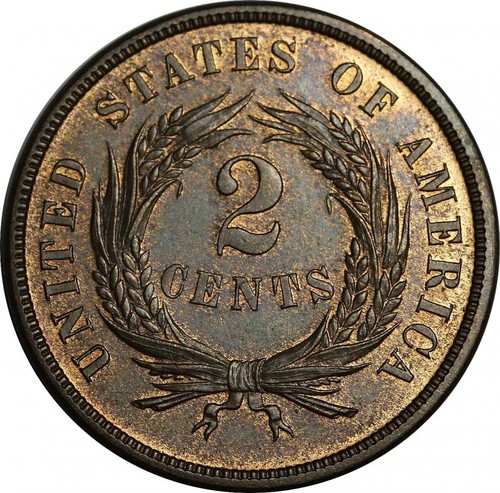
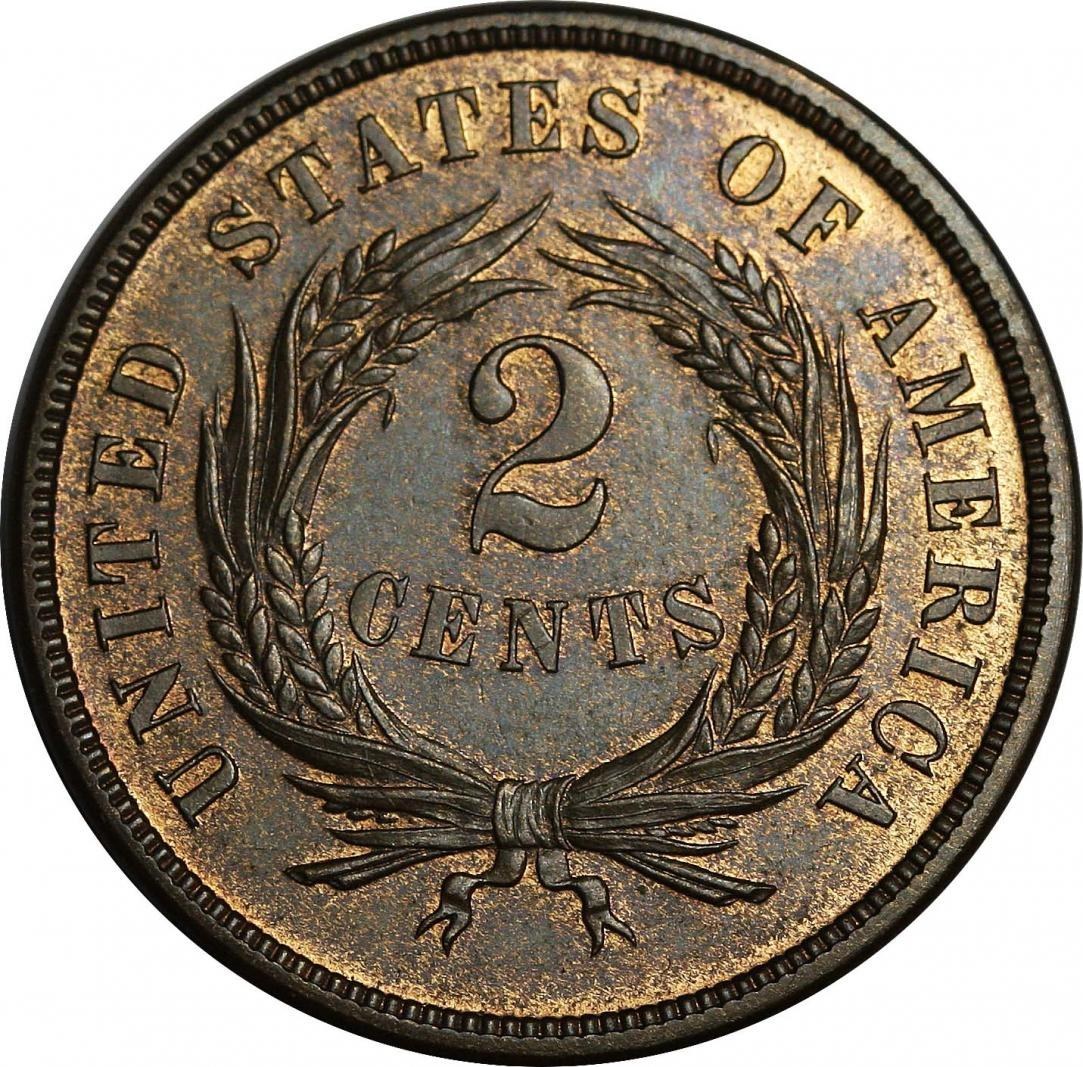
The design pairs a plain shield with crossed arrows on the obverse with a simple wreath enclosing the denomination "2 CENTS" on the reverse, as seen on the pictured 1863-dated piece. The reverse legend "UNITED STATES OF AMERICA" wraps around the wreath.
Because the odd denomination never proved popular and was quickly overshadowed by other small coins, the series ran only about a decade. Its brevity, distinctive motto, and single-type simplicity make it a favorite target for type collectors.
History & Background
The Two Cent Piece grew out of the coin shortages of the Civil War, when hoarding drove small change out of circulation. Mint Engraver James B. Longacre prepared the design, and pattern pieces dated 1863 were produced to test the concept before Congress acted. The denomination was authorized by the Coinage Act of April 22, 1864, the same law that introduced the lighter bronze alloy for the cent.
Regular production began in 1864 and the new bronze coins were struck in large numbers in the first years, when the public needed convenient small change. The Act of 1864 is also notable for placing "IN GOD WE TRUST" on the coin, following wartime petitions urging recognition of the deity on the nation's money; the Two Cent Piece was the first coin to carry the phrase.
Mintages fell steadily as the war ended and other coins, including the nickel three-cent and five-cent pieces, filled the same need. Production dwindled through the late 1860s and early 1870s, and the final year, 1873, saw the coin struck only in proof format for collectors before the denomination was abolished.
How to Identify
The reverse—the side most often used to identify this type—shows the denomination "2 CENTS" enclosed in a wreath, with "UNITED STATES OF AMERICA" curving around the rim. The pictured coin carries this reverse with an 1863 date. The obverse, when present, displays a shield with crossed arrows and a scroll bearing "IN GOD WE TRUST" across the top, with the date below.
The coin is bronze (95% copper with tin and zinc), giving it a brown to reddish-brown color, and measures roughly 23 mm across with a plain edge. That diameter is noticeably larger than a small cent but smaller than the old large cent. All Two Cent Pieces were struck at the Philadelphia Mint, so genuine coins carry no mint mark.
Dates run from 1864 to 1873. The best-known variety is found on 1864 coins, which come with a Small Motto and a Large Motto distinguished by the size and shape of the lettering in "IN GOD WE TRUST." Pieces dated 1863 are patterns rather than circulation issues, so a coin with that date warrants extra scrutiny and, ideally, expert authentication.
Value & Collectibility
Values depend heavily on date and condition. The earlier dates of 1864 and 1865 were struck in the largest quantities and are the most affordable, typically modest in circulated grades and rising with sharper detail and original color. Later dates from the late 1860s and early 1870s had much smaller mintages and command higher premiums.
Certain varieties and the final issues carry the strongest demand. The 1864 Small Motto is scarcer than the Large Motto, and the 1873 was a proof-only issue that trades at a substantial premium. Pattern pieces dated 1863 are a specialist area and can be valuable, but they require authentication to separate genuine patterns from later fabrications.
As with all bronze coins, eye appeal matters: even brown surfaces, strong shield and wreath detail, and freedom from cleaning, corrosion, or damage all raise value. Because condition ranges are broad, consult recent price guides and auction records for current figures.
Frequently asked questions
Is the Two Cent Piece really the first coin with "IN GOD WE TRUST"?
Yes. The bronze Two Cent Piece, authorized in 1864, was the first regular U.S. coin to carry the motto "IN GOD WE TRUST," which appears on a scroll across the obverse shield.
What is my Two Cent Piece made of?
It is bronze, an alloy of about 95% copper with the balance tin and zinc, which gives the coin its brown to reddish-brown color and roughly 23 mm size.
Does the Two Cent Piece have a mint mark?
No. Every Two Cent Piece was struck at the Philadelphia Mint, which used no mint mark for this series, so a genuine coin will not have one.
Why is my coin dated 1863 when the series began in 1864?
Coins dated 1863 are pattern pieces made to test the design before the denomination was authorized in 1864. Because patterns are specialized and sometimes imitated, an 1863 piece should be authenticated.
Why was the Two Cent Piece discontinued?
The odd denomination never became popular and was soon overshadowed by the nickel three-cent and five-cent coins, so mintages fell through the early 1870s and the coin was abolished after 1873.
Two Cent Piece guides
In-depth guides for identifying, valuing, and collecting Two Cent Piece.