
How to Identify the Twenty Cent Piece
A collector's checklist for confirming a U.S. Twenty Cent Piece: reading the reverse, checking the plain edge, size, silver, and mint marks.
Read the full Twenty Cent Piece encyclopedia entry →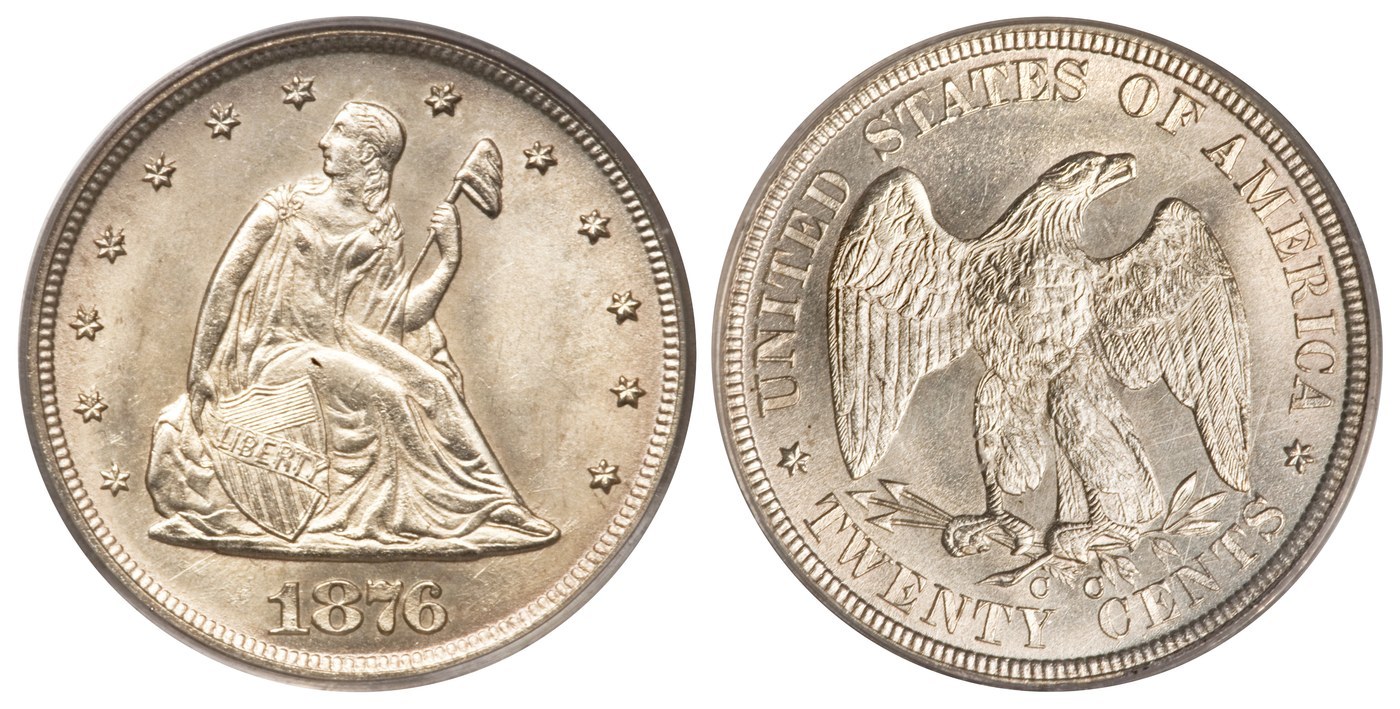
Begin with the reverse, because that is what separates this coin from the many other Seated Liberty silver pieces. A true twenty-cent piece shows a spread eagle with UNITED STATES OF AMERICA above and the denomination spelled out as TWENTY CENTS. If the reverse instead reads QUARTER DOLLAR, HALF DOL., or ONE DIME, you are holding a different denomination that merely shares the seated Liberty obverse.
Confirm the obverse next. Liberty sits on a rock holding a pole topped by a liberty cap, steadying a shield marked LIBERTY, encircled by thirteen stars with the date below. On the pictured coin the date is 1875, the first year of issue and one of the two circulation years. This obverse is intentionally similar to the quarter of the same era, so never identify the coin from the front alone.
Check size, metal, and especially the edge. The twenty-cent piece is 90-percent silver, about 22 mm across, and weighs roughly 5 grams, making it slightly smaller than a quarter. The decisive physical test is the edge: run a fingertip around it. The twenty-cent piece has a plain, smooth edge, whereas the similarly sized Seated Liberty quarter has a reeded edge with fine vertical grooves. That single difference resolves most confusion between the two.
Look for a mint mark on the reverse, below the eagle. It may read CC for Carson City or S for San Francisco; a coin with no mint mark was struck at Philadelphia. Mint mark and date together determine which issue you have, which matters enormously because the series ranges from moderately scarce common dates to the great 1876-CC rarity.
Finally, treat authentication seriously. Because every date in the short series carries a premium and some are extremely valuable, the twenty-cent piece is often counterfeited, and altered mint marks (especially added CC marks) are a known risk. Cleaning and artificial toning are also common on old silver. For anything beyond a low-grade common date, have the coin verified by a reputable third-party grading service before you buy or sell.
Frequently asked questions
What is the fastest way to distinguish it from a quarter?
Feel the edge and read the reverse. The twenty-cent piece has a plain, smooth edge and spells out TWENTY CENTS, while the Seated Liberty quarter has a reeded edge and reads QUARTER DOLLAR.
Where is the mint mark and what letters are possible?
The mint mark sits on the reverse below the eagle. It can read CC for Carson City or S for San Francisco; Philadelphia coins have no mint mark.
What size and weight confirm a genuine coin?
A genuine twenty-cent piece is 90-percent silver, about 22 mm in diameter, and weighs roughly 5 grams. Significant deviations in weight or diameter suggest a fake or a different coin.
What authentication risks should I watch for?
Outright counterfeits, added or altered mint marks (especially fake CC coins), and cleaned or artificially toned silver. Because the series is scarce and valuable, have better pieces certified by a recognized grading service.