Twenty Cent Piece
A short-lived U.S. silver coin worth twenty cents, showing a seated Liberty and a soaring eagle, struck only from 1875 to 1878.
- Country
- United States
- Denomination
- 20 Cents
- Metal
- Silver
Got a coin like this?
Identify any coin from a photo, free.
Overview
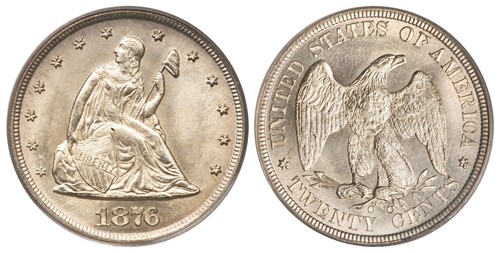
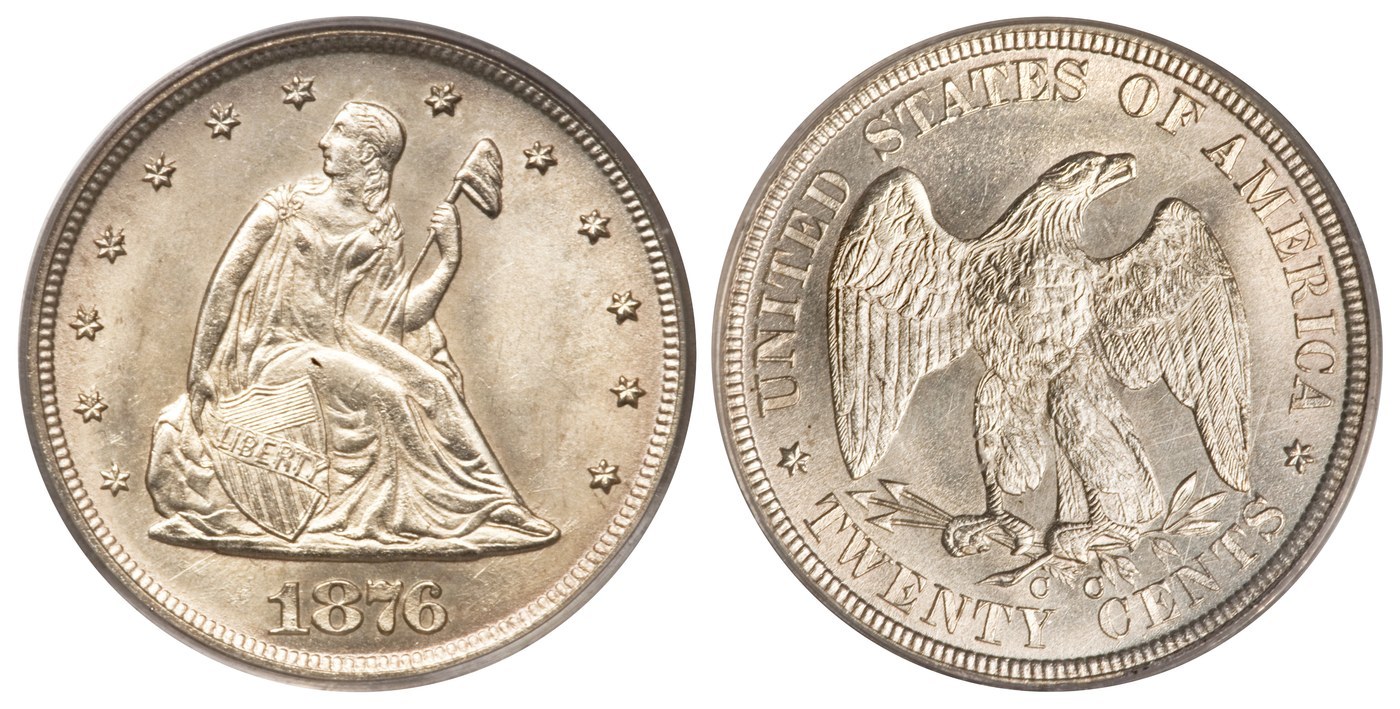
The Twenty Cent Piece is one of the shortest-lived denominations in United States coinage, a silver coin worth one-fifth of a dollar that was struck for only four years, from 1875 through 1878. The obverse shows the seated figure of Liberty holding a liberty cap on a pole and a shield inscribed LIBERTY, surrounded by thirteen stars, with the date below. The reverse carries a spread eagle beneath UNITED STATES OF AMERICA, with the denomination spelled out as TWENTY CENTS. The example shown here is dated 1875, the first year of issue.
Because it was so close in size and design to the quarter dollar, the twenty-cent piece confused the public almost immediately and was quickly abandoned. Only the 1875 and 1876 issues were made for circulation; the 1877 and 1878 dates were struck solely as proofs for collectors. This brief, troubled run makes the denomination a favorite oddity among U.S. type collectors.
As a 90-percent silver coin, the twenty-cent piece carries a small amount of bullion value, but its worth to collectors comes overwhelmingly from its scarcity, its status as a one-off denomination, and the condition of the individual coin.
History & Background
The twenty-cent piece was authorized by the Coinage Act of 1875, promoted in part by Nevada silver interests and by a desire to ease small change shortages in the West, where the five-cent piece was scarce and merchants often could not make exact change. The design was prepared under Mint Chief Engraver William Barber, reusing the familiar Seated Liberty motif that already appeared on other silver coins of the era, paired with an eagle reverse.
The coin failed almost from the start. At roughly the diameter of a quarter and carrying the same seated Liberty obverse, it was constantly mistaken for the twenty-five-cent piece, and its plain edge did little to help the public tell them apart in the hand. Public complaints were immediate and loud. Full circulation strikes were made only in 1875 and 1876, at Philadelphia, Carson City, and San Francisco, after which mintages collapsed.
Congress abolished the denomination in 1878, ending it after just four calendar years. The 1877 and 1878 issues exist only as small proof mintages made for collectors, and the famous 1876-CC is a great rarity of which very few are known to survive. The twenty-cent piece remains the shortest-lived silver denomination in regular U.S. coinage.
How to Identify
Start with the obverse. It shows Liberty seated on a rock, holding a pole topped with a liberty (Phrygian) cap in one hand and steadying a shield lettered LIBERTY with the other, ringed by thirteen stars with the date beneath. This is the same Seated Liberty theme used on the era's dimes, quarters, and half dollars, so the deciding feature is the reverse.
Turn the coin over and read the legend. A genuine twenty-cent piece spells the denomination as TWENTY CENTS beneath a spread eagle, with UNITED STATES OF AMERICA above. The photographed coin's reverse text confirms the value as twenty cents, one-fifth of a dollar. The coin is 90-percent silver, about 22 mm in diameter, and weighs roughly 5 grams.
The single most important physical clue is the edge: unlike the reeded (grooved) edge of the Seated Liberty quarter, the twenty-cent piece has a plain, smooth edge. A mint mark, when present, appears on the reverse below the eagle and can read CC (Carson City) or S (San Francisco); Philadelphia coins carry no mint mark.
Value & Collectibility
Even the most common dates are genuinely scarce by modern standards, so the twenty-cent piece commands a meaningful premium over its silver content in every grade. The two circulation years, 1875 and 1876 from Philadelphia, San Francisco, and Carson City, are the coins most collectors can realistically own, with well-worn examples typically running from about a hundred dollars into the several hundreds and attractive higher-grade pieces climbing well beyond that. Any specific figure should be checked against a current price guide or recent auction results.
Certain issues are famous rarities. The 1876-CC is one of the great U.S. coin rarities, with only a small number known, and the proof-only 1877 and 1878 dates are also scarce and valuable. Mint mark and date therefore matter enormously to value on this series.
Because the type is scarce and valuable, it is a frequent target for counterfeits and for altered coins, and cleaning is common on old silver. For any twenty-cent piece beyond a low-grade common date, certification by a recognized third-party grading service is strongly recommended before buying or selling.
Frequently asked questions
Is the Twenty Cent Piece real, or a novelty?
It is a genuine United States coin. Congress authorized the twenty-cent denomination in 1875, and it was struck as legal tender until it was abolished in 1878.
Why was the twenty-cent piece discontinued so quickly?
It was almost the same size as the quarter and shared the seated Liberty design, so people constantly confused the two. Public complaints led Congress to abolish it after only four years.
How can I tell it apart from a Seated Liberty quarter?
Read the reverse and feel the edge. The twenty-cent piece spells out TWENTY CENTS and has a smooth, plain edge, while the quarter reads QUARTER DOLLAR and has a reeded (grooved) edge.
Is my twenty-cent piece made of silver?
Yes. It is struck in 90-percent silver and weighs about 5 grams, so it carries a small bullion value, though its collector value is usually far higher.
Which dates are the rare ones?
The 1876-CC is a famous rarity with very few known, and the proof-only 1877 and 1878 issues are also scarce. The 1875 and 1876 Philadelphia, S, and CC circulation strikes are the more obtainable dates.
Twenty Cent Piece guides
In-depth guides for identifying, valuing, and collecting Twenty Cent Piece.