
How to Identify the Turban Head Quarter Eagle
Recognize the 1796 $2.50 gold coin by its right-facing capped Liberty, heraldic shielded eagle with E PLURIBUS UNUM, small size, and no mint mark.
Read the full Turban Head Quarter Eagle encyclopedia entry →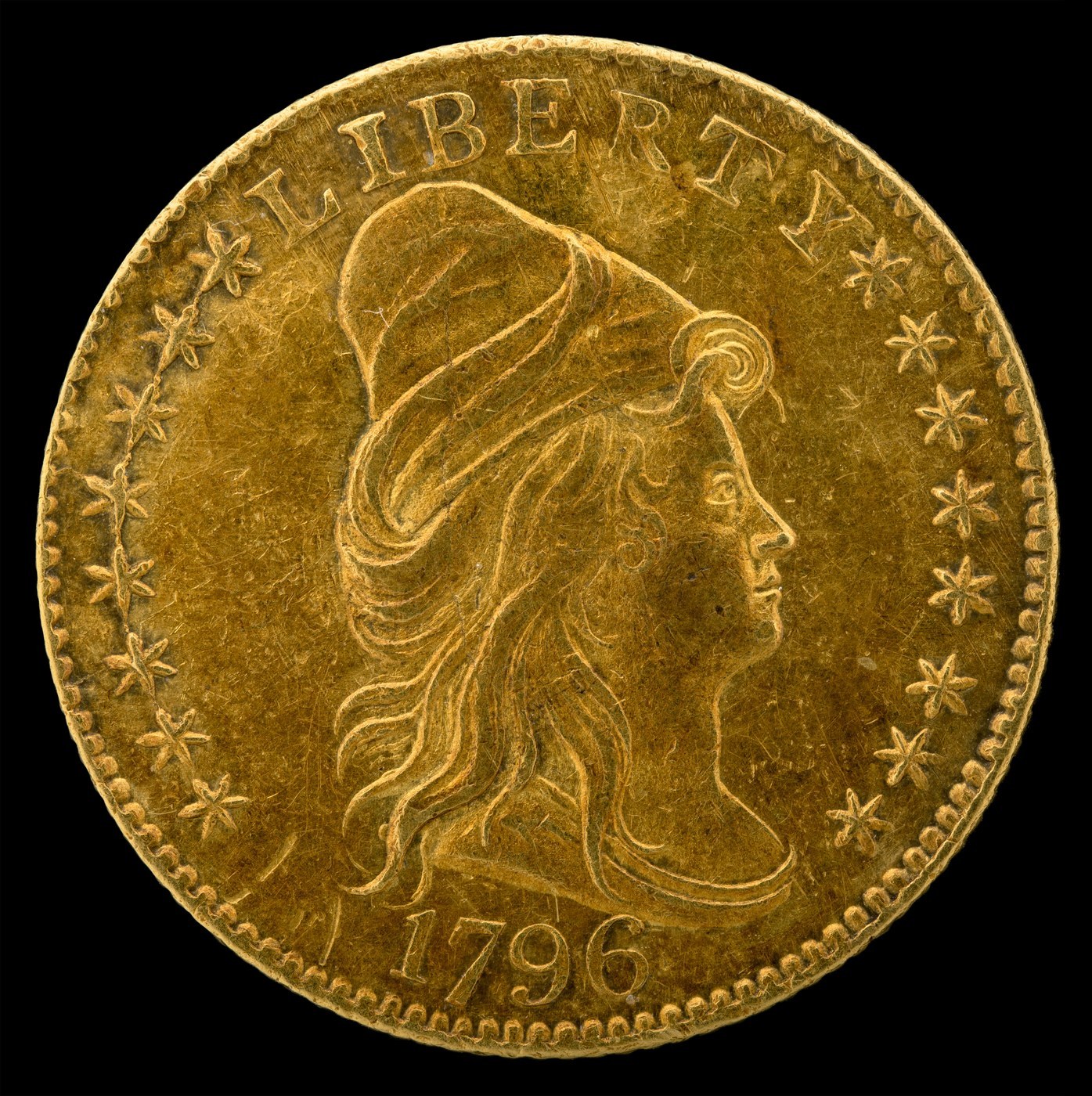
What It Is
The Turban Head, or Capped Bust to Right, quarter eagle is the first United States $2.50 gold coin, introduced in 1796. Identification rests on the capped right-facing Liberty, the heraldic eagle reverse, the small gold planchet, and the 1796 date. Because this coin is both rare and valuable, confident identification matters and should always be backed by professional authentication.
Obverse (Front)
Look for a bust of Liberty facing right, wearing a soft, folded cloth cap — the feature nicknamed a "turban." LIBERTY appears above and the date 1796 below. Note whether stars appear along the border: the earliest 1796 variety has no stars and a plain field, while a later 1796 variety adds stars. The presence or absence of stars is a key variety marker on this date.
Reverse (Back)
The reverse shows a heraldic eagle modeled on the Great Seal, with a shield across its breast, an olive branch and arrows in its talons, and a scroll reading E PLURIBUS UNUM. UNITED STATES OF AMERICA runs around the border. There is no denomination numeral and no mint mark. This shielded-eagle-with-motto reverse separates the type from later quarter eagle designs.
Size, Metal, and Mint Mark
The coin is small — about 20 mm across and roughly 4.37 grams — struck in gold of about .9167 fineness (22 karat). All examples came from the Philadelphia Mint and carry no mint mark, so a genuine piece shows a blank field where a mint mark might otherwise sit. Any "1796 quarter eagle" bearing a mint letter is wrong and a warning sign.
Look-Alikes and Authentication Cautions
Do not confuse this Capped Bust to Right type with the later Capped Bust to Left "Turban Head" quarter eagle (1808 onward), which faces the opposite direction, or with early gold dollars, half eagles, or eagles that share the heraldic-eagle reverse but differ in size and denomination. Because 1796 quarter eagles are so valuable, counterfeits, cast copies, and altered-date coins (for example, a common date reworked to read 1796) are a real hazard. Weigh and measure the coin, but do not rely on that alone: have any suspected 1796 quarter eagle examined and certified by a reputable third-party grading service before treating it as genuine.
Frequently asked questions
How do I tell the 1796 no-stars variety from the with-stars variety?
Check the border around Liberty. The earliest 1796 obverse has a plain field with no stars; the later 1796 obverse adds stars along the edge. The no-stars type is the rarer and more famous of the two.
Which way does Liberty face?
On this 1796–1807 type Liberty faces right. The later Capped Bust to Left "Turban Head" quarter eagle, from 1808 on, faces left — a quick way to separate the two similarly nicknamed types.
There's no $2.50 on the coin — is that normal?
Yes. Early U.S. gold coins did not state the denomination as a numeral. The quarter eagle is identified by its size, weight, and design rather than a printed value.
How can I be sure mine is authentic?
Given the coin's rarity and value, weight and diameter are only a first check. Fakes and altered dates exist, so submit any suspected 1796 quarter eagle to a reputable grading service for authentication before buying, selling, or insuring it.