
How to Identify the Tunisia 20 Francs (Brass)
A collector's guide to identifying the 1950 brass Tunisia 20 francs by its Arabic and geometric design, 'TUNISIE / 20 FRANCS' reverse, brass color, and look-alikes.
Read the full Tunisia 20 Francs (Brass) encyclopedia entry →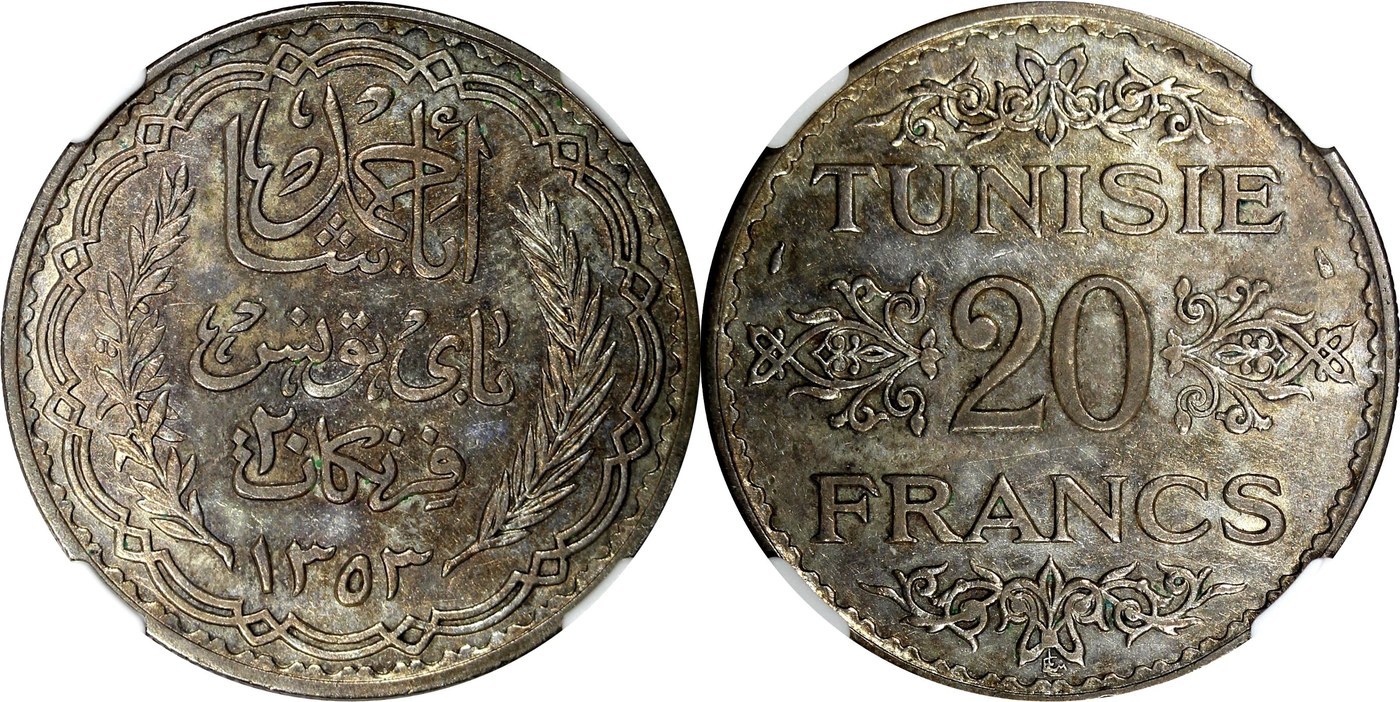
What This Coin Is
The brass Tunisia 20 francs is a mid-century base-metal coin of the French protectorate, combining Arabic legends with the French franc denomination. Identifying one starts with recognizing a yellow, brass-colored coin that shows Arabic script within a geometric design on one face and the Latin value '20 FRANCS' with the country name 'TUNISIE' and the date on the other.
Reading the Two Faces
One face carries Arabic script arranged within an ornamental, geometric frame; this is the side to read for the Beylik legend. The opposite face is the more immediately legible for Western collectors, showing '20 FRANCS' as the value, 'TUNISIE' as the country, and the date — 1950 on the example here. Confirm that both the value and the country name read as expected, since these Latin elements are the quickest positive attribution.
Date and Dual Dating
Check the Gregorian date, which reads 1950 on this coin; the corresponding Islamic year is AH 1370. Protectorate-era Tunisian coins are frequently encountered with dating in both the Gregorian and Islamic (AH) systems, so an accompanying Arabic-numeral date should correspond to the same period. Use the date together with the design to pin down the specific issue.
Size, Metal, and Fabric
This is a mid-size base-metal coin struck in brass, so it shows a golden-brown color rather than the grey-white of silver or the cooler tone of nickel. It is larger and heavier than the smaller franc fractions of the same series but is not a large crown-size piece. Weigh and measure any candidate and compare against published specifications for the type; a coin that is markedly off in weight or diameter, or that is the wrong color for brass, warrants a closer look.
Look-Alikes and Authentication Cautions
Tunisia issued several franc denominations in this era with related bilingual designs, so smaller and larger values can resemble this coin at a glance — always confirm the '20 FRANCS' value to avoid confusing it with the 5 or 10 francs. Silver Tunisian issues share the naming conventions but differ in metal and color, so use the brass tone as a separating clue. As with any collectible coin, watch for cleaned or polished surfaces, corrosion typical of base metal, and the soft detail, seams, or bubbles that can indicate a cast copy; match the coin to a standard catalogue of protectorate Tunisian coinage when in doubt.
Frequently asked questions
How do I tell the 20 francs from the 5 or 10 francs?
Read the Latin value on the 'TUNISIE' face — it should state '20 FRANCS'. The related franc denominations share a similar bilingual style, so the printed value and the coin's size together are the surest way to separate them.
How can I confirm the date?
Look for the Gregorian date on the 'TUNISIE' face, which reads 1950 on this coin; any accompanying Arabic-numeral (AH) date should correspond to the same year, AH 1370.
How do I know it is brass and not silver?
Brass has a distinct golden-brown color, while Tunisian silver issues are grey-white. If the coin is yellow-toned and non-magnetic base metal rather than bright white, it is consistent with the brass 20 francs.
What are common signs of a fake or altered coin?
Casting seams, surface bubbles, soft or mushy lettering, incorrect weight or diameter, altered dates, and unnaturally smoothed or brightened surfaces are all warning signs worth checking against catalogue specifications.