
How to Identify the Tunisia 100 Millimes
A collector's guide to identifying the brass Tunisia 100 millimes by its Arabic calligraphy, bold 100 numeral, metal color, and Gregorian date.
Read the full Tunisia 100 Millimes encyclopedia entry →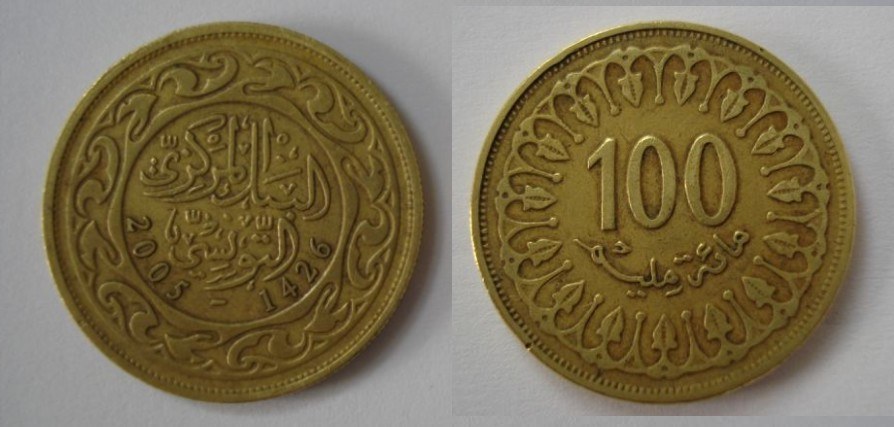
Start with the metal and color. This 100 millimes type is struck in brass, so a genuine example has a warm golden-yellow tone rather than the pale silvery gray of cupro-nickel coins. A brass color combined with the value 100 is your first strong clue toward this Tunisian type.
Read the two faces. One side is dominated by flowing Arabic calligraphy enclosed in an ornate decorative border; the other carries a large numeral 100—the value—with Arabic script and a patterned design around it. The Western-style 100 is helpful because it lets you confirm the denomination even if you cannot read the Arabic legend. Seeing this calligraphy-and-value pairing together points firmly to the coin.
Locate the date. Tunisian coins of this era are dated in the Gregorian calendar, so a four-digit year such as 2005 can be read directly rather than converted from a Hijri date. The date sits with the design and is the main detail that changes from one issue to the next, so it is how you separate one year of striking from another.
Check size and edge against a reference. The 100 millimes is a mid-size circulation coin, larger than the small millime pieces but not large overall, and round with a plain or reeded edge. Weighing and measuring the coin and comparing it to a catalog listing for the Tunisian brass 100 millimes will confirm the denomination rather than a neighboring millime value.
Rule out look-alikes. Brass coins with Arabic inscriptions are issued by many countries across North Africa and the Arab world, and some resemble this piece at a glance. The Arabic legend naming Tunisia and its central bank, together with the value 100, is what distinguishes it. Because these are inexpensive modern coins, deceptive counterfeits are uncommon, but heavily cleaned or corroded pieces exist; a wrong color, wrong weight, or a mismatched legend are reasons to look more closely.
Frequently asked questions
How do I tell this from other Arab-world brass coins?
Read the value and the legend. The numeral 100 confirms the denomination, and the Arabic inscription naming Tunisia and its central bank distinguishes it from similar brass coins of other North African or Arab countries.
Do I need to convert the date from an Islamic calendar?
No. Tunisian coins of this period use the Gregorian calendar, so a year like 2005 is read directly without any Hijri conversion.
The Arabic is worn and hard to read—what should I check?
Fall back on the physical clues: brass golden color, the large numeral 100, an ornate border on the calligraphy side, and mid-size round format. Comparing weight and diameter to a catalog listing confirms the type.
Is it worth authenticating professionally?
Usually not. These are low-value base-metal circulation coins, so paid authentication rarely makes sense. Confirm the metal, value, legend, size, and date against a standard world-coin reference instead.