
How to Identify the Trajan Sestertius
A large brass sestertius from Trajan's long, prosperous reign, identified by its accumulating victory titles and enormously varied reverse types celebrating conquest and public works.
Read the full Trajan Sestertius encyclopedia entry →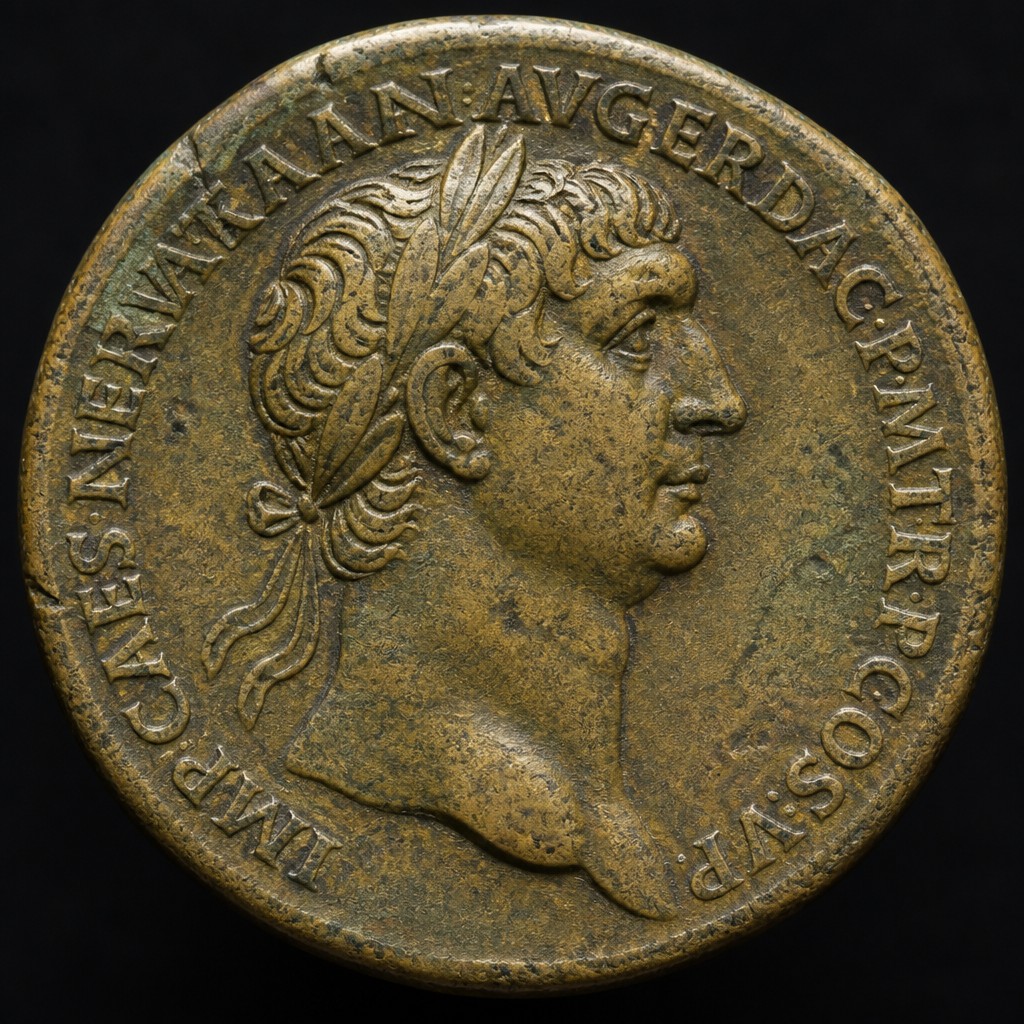
What the Coin Is
Trajan ruled from AD 98 to 117, presiding over the empire's greatest territorial extent following his Dacian and Parthian campaigns. His sestertius coinage is exceptionally large in volume and variety, reflecting an active building and military program commemorated across dozens of reverse designs.
Obverse Design & Inscriptions
The obverse carries a laureate (occasionally laureate and draped) bust of Trajan right, with a distinctive comb-forward fringe of hair and no beard. The legend accumulates titles over the reign: expect combinations of IMP CAES NERVAE TRAIANO AVG GER DAC, with GERM added after his Germanic command, DAC after the Dacian Wars (about AD 101-106), and later PARTHICO following his Parthian campaign near the end of his reign, alongside P M TR P and consular numerals.
Reverse Design & Inscriptions
Reverse themes are unusually varied: standing personifications such as Roma, Victory, Spes, and Fortuna Redux; a reclining river-god type representing the Danube; trophies flanked by bound captives commemorating the Dacian wars; and large building or monument scenes referencing his forum and the column later built in his honor. Many reverses circle the legend SPQR OPTIMO PRINCIPI ("to the best of princes"). The letters S C appear in the field or exergue, marking Senate-authorized bronze.
Size, Weight, Metal & Edge
The sestertius is a large orichalcum (brass) coin, typically 33-36mm in diameter and weighing around 24-27 grams. The edge is plain and flat.
Mint Marks & Where to Find Them
All examples were struck at the Rome mint; there is no separate mint-letter system. The S C notation is the only mark to look for, confirming senatorial bronze status.
Telling It Apart from Similar Coins
Trajan's accumulating titles are the best dating and identification tool: a coin reading DAC PARTHICO belongs late in his reign, after his final campaigns, while earlier issues lack these titles. Compared to his successor Hadrian, whose obverse legend reads COS III P P and who is sometimes shown with a light beard, Trajan is always clean-shaven with his signature forward-combed fringe.
Judging Condition & Grade at a Glance
Because this is a large, high-relief bronze coin, check the crispness of the hair strands on the obverse and the legibility of the S C and surrounding legend on the reverse. Sharp, well-defined figures with visible drapery folds indicate a higher grade; smoothed, low-relief fields with a faint legend indicate substantial circulation wear.
Authenticity Red Flags
Cast forgeries typically show a visible seam line around the edge, a grainy or pitted surface from the mold, and underweight flans relative to their diameter. Because Trajan's large, detailed reverse scenes are popular with collectors, tooled or artificially "sharpened" surfaces are also a concern; examine under magnification for unnaturally crisp edges cut into an otherwise worn or corroded surface, which suggests later re-engraving rather than original strike detail.
Frequently asked questions
How can I roughly date a Trajan sestertius from its legend?
Look at which victory titles appear; DAC generally indicates the coin was struck during or after the Dacian Wars around AD 102-106, while PARTHICO points to the final years of his reign after the Parthian campaign.
What does S C mean on the reverse?
It stands for Senatus Consulto, meaning the bronze coin was issued under the authority of the Roman Senate, distinguishing it from the emperor-controlled gold and silver coinage.
How do I tell Trajan's portrait from Hadrian's?
Trajan is always shown clean-shaven with a distinctive forward-combed fringe of hair, while Hadrian is often shown with a light beard, a style he introduced to Roman imperial portraiture.
Why are Trajan's sestertii so varied in design?
His long, eventful reign included major military victories and an extensive public building program in Rome, both of which were commemorated across a wide range of reverse types.
What should concern me about surface smoothness?
An unnaturally sharp, glossy design on a coin that otherwise shows heavy wear or corrosion can indicate the surface has been tooled or artificially enhanced rather than left in its original struck condition.