
How to Identify the Trade Dollar
A collector's walkthrough for confirming a U.S. Trade Dollar: the seaward Liberty, the 420 GRAINS reverse inscription, mint marks, chopmarks, and fakes.
Read the full Trade Dollar encyclopedia entry →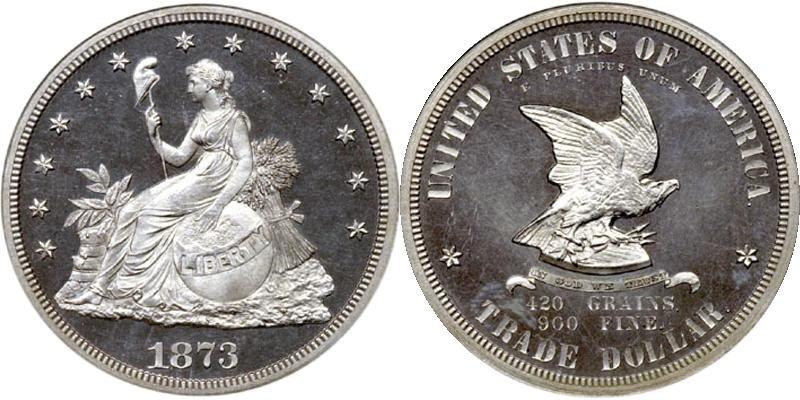
Begin with the obverse and the pose of Liberty. On a Trade Dollar she is seated on bales of merchandise, facing left toward the sea, extending an olive branch, with a ribbon reading LIBERTY behind her and thirteen stars around the rim. This is the quickest way to separate it from the ordinary Seated Liberty dollar of the same era, on which Liberty faces the other way, holds a Liberty pole and cap, and rests a hand on a shield. If your seated figure holds an olive branch toward the ocean, you are likely looking at a Trade Dollar.
Confirm it on the reverse. The eagle has outstretched wings and grips three arrows and an olive branch, but the decisive detail is the inscription arced above it: 420 GRAINS. 900 FINE. No other United States dollar states its weight and fineness this way. Below the eagle you should read the denomination spelled out as TRADE DOLLAR, with UNITED STATES OF AMERICA above and E PLURIBUS UNUM on a ribbon over the eagle's head.
Check the physical specifications, because this is a heavily faked type. A genuine coin is 90% silver, about 38.1 mm across, roughly 27.2 g, with a reeded edge. Counterfeits — including cast copies and base-metal or wrong-weight pieces — often fail on weight, diameter, or edge detail, so a coin that is light, undersized, magnetic, or has a mushy reeded edge should be treated with suspicion.
Find the mint mark on the reverse, below the eagle and above the D in DOLLAR: S for San Francisco, CC for Carson City, or none for Philadelphia. Read it under magnification and be wary of added or altered mint marks, which are used to fake scarcer issues. Also expect chopmarks on many authentic coins — small Chinese merchant punches in the fields are a sign of genuine circulation in Asia, not damage that disqualifies the coin.
Finally, exercise caution with the famous rarities. The 1884 and 1885 dates are worth enormous sums and are prime targets for altered-date forgeries, so any coin appearing to be one of these — or any high-value date or mint mark — should be sent to a reputable grading service such as PCGS or NGC before you accept it as genuine.
Frequently asked questions
How do I tell a Trade Dollar from a regular Seated Liberty dollar?
Look at the reverse inscription and Liberty's pose. The Trade Dollar states 420 GRAINS. 900 FINE. above the eagle and reads TRADE DOLLAR below, and its Liberty faces the sea holding an olive branch. The standard Seated dollar has neither the weight inscription nor that seaward pose.
Do chopmarks make my Trade Dollar worthless?
No. Chopmarks are merchant verification punches from the coin's use in Asian trade and are a normal, collectible feature. They can slightly affect value up or down depending on the buyer, but they do not make a coin fake or valueless.
My Trade Dollar has no mint mark — is that a problem?
No. Coins without a mint mark were struck at the Philadelphia Mint. Mint marks (S or CC) appear on the reverse below the eagle, above the D in DOLLAR.
How can I spot a counterfeit Trade Dollar?
Weigh and measure it: a genuine coin is about 27.2 g, 38.1 mm, 90% silver, non-magnetic, with a crisp reeded edge. Wrong weight or size, a magnetic response, or soft, cast-looking detail are warning signs. Have any suspicious or valuable coin authenticated by a professional grading service.