
How to Identify the Three Graces Pattern Crown
A collector's guide to recognizing the 1817 Three Graces silver pattern crown by its portrait, date, Union reverse, and telltale signs of copies.
Read the full Three Graces Pattern Crown encyclopedia entry →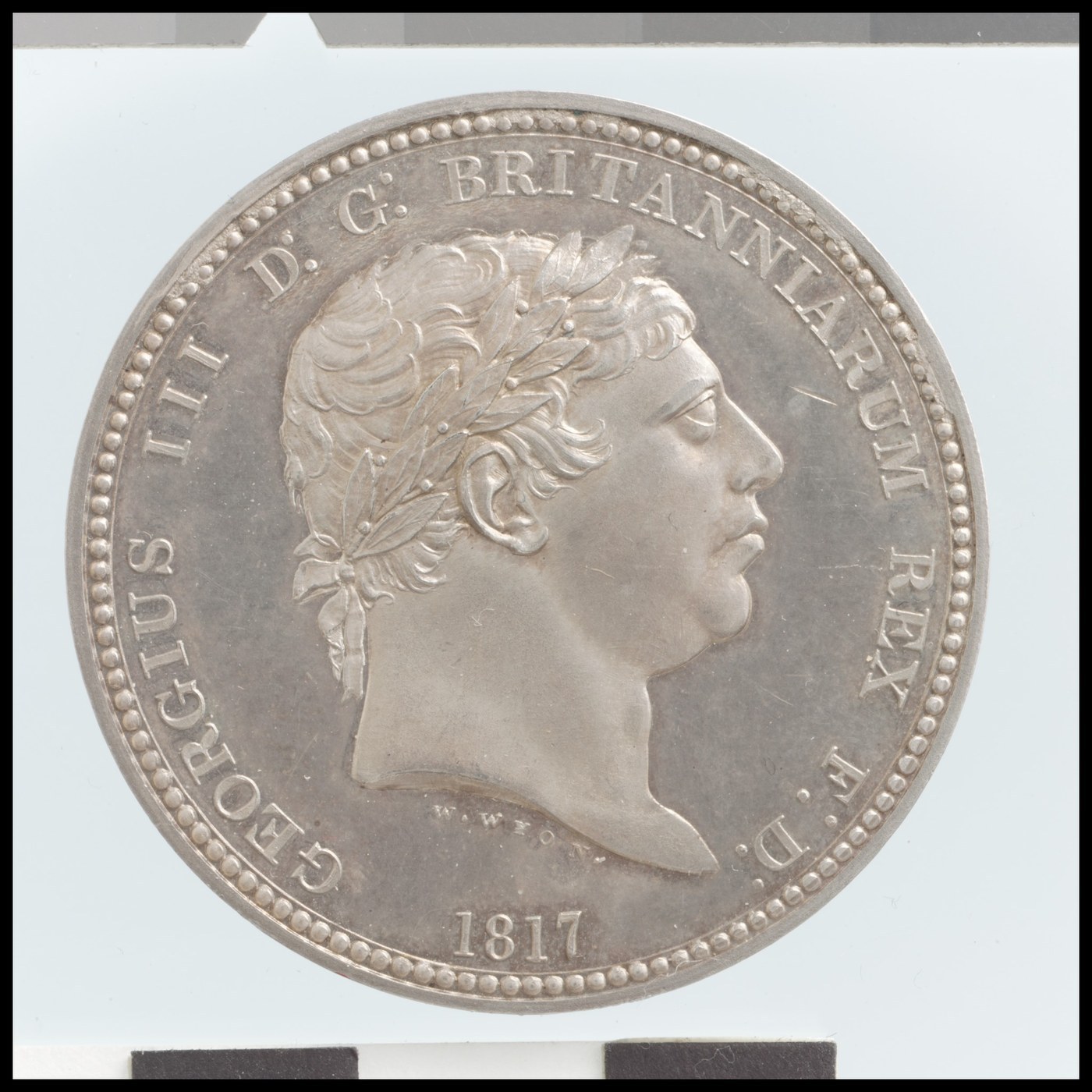
Begin with the obverse portrait and legend. The coin should show George III facing left with curled hair under a laurel wreath, encircled by a Latin legend reading GEORGVS III BRITT REX FID DEF on the photographed example. That legend, naming George III as King of the Britains and Defender of the Faith, immediately places the coin in his reign and rules out later monarchs.
Confirm the date and denomination. A genuine example is dated 1817 and is a full-size silver crown — a large, heavy piece roughly the diameter of later British crowns. Weigh and measure any candidate and compare it against published specifications for a silver crown of the period; a coin that is markedly light, thin, or made of base metal is a strong signal of a replica.
Study the reverse imagery. The photographed coin shows a seated classical allegorical figure with a trident alongside a shield bearing the combined crosses of the Union. This Union symbolism is the heart of the design, and its careful, neoclassical modeling is one of the reasons the type is so prized. Because this was a pattern, the striking should look crisp and proof-like rather than worn.
Be especially cautious about copies. The Three Graces is among the most reproduced British coins, and modern replicas, restrikes, novelty pieces, and medallic copies are common. Warning signs include incorrect weight or diameter, base-metal cores, blurry or mushy detail, seams from casting, and edges that do not match period crowns. Any mismatch against known originals should be treated as disqualifying until proven otherwise.
Given the enormous value gap between a genuine original and a copy, do not rely on visual impression alone. Have any promising example examined by a specialist in British milled and pattern coinage, or submitted to a reputable grading service, before treating it as authentic.
Frequently asked questions
How can I tell an original from a replica at a glance?
You often cannot from a photo alone. Check weight, diameter, and metal first, then look for soft detail, casting seams, or wrong edges. Because copies are common, assume a replica until a specialist confirms otherwise.
Which side is the obverse?
The side with the laureate portrait of George III and the GEORGVS III BRITT REX FID DEF legend is the obverse. The allegorical Union design with the seated figure and cross-bearing shield is the reverse.
Does the 1817 date guarantee it is genuine?
No. Replicas and restrikes copy the 1817 date as well. The date is a necessary feature to check, but on its own it does not prove authenticity — physical specifications and expert review do.