Three Graces Pattern Crown
A celebrated 1817 silver pattern crown of George III, engraved by William Wyon and never issued for circulation — a prized masterpiece of British coinage.
- Country
- Great Britain
- Denomination
- Crown
- Metal
- Silver
Got a coin like this?
Identify any coin from a photo, free.
Overview
The Three Graces Pattern Crown is a silver pattern crown of Great Britain dated 1817, produced during the reign of George III. A pattern is a trial or proposed design struck to demonstrate a possible coinage rather than for everyday use, so this piece was never released into general circulation.
The coin is widely admired as one of the finest products of the early nineteenth-century Royal Mint and is traditionally associated with the engraver William Wyon. Its obverse carries a laureate portrait of the king, while the reverse presents an elaborate allegorical design celebrating the Union of the British kingdoms.
Because it was only ever a pattern, genuine originals survive in very small numbers and are considered classic rarities of the British series, sought after by advanced collectors of English silver and of Wyon's medallic art.
History & Background
The pattern belongs to 1817, a period when the Royal Mint had recently been re-equipped with new steam-powered machinery following the Great Recoinage of 1816. That reform prompted engravers to prepare trial designs for a new large silver crown, and several rival patterns were struck to showcase competing artistic treatments.
The Three Graces design was not the version chosen for circulation. The crown pieces that entered general use in this era instead carried a different reverse, and so the Three Graces remained a pattern, admired but never adopted. This combination of great beauty and non-adoption is exactly what has made it so celebrated among collectors.
As a hallmark of the engraver's early career at the Royal Mint, the piece is regarded as an important step in the neoclassical style that would come to dominate British coin and medal design in the following decades. Surviving examples are treasured today as high points of Georgian numismatic art.
How to Identify
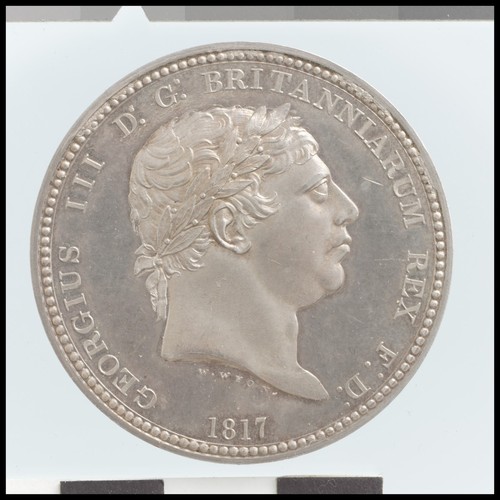
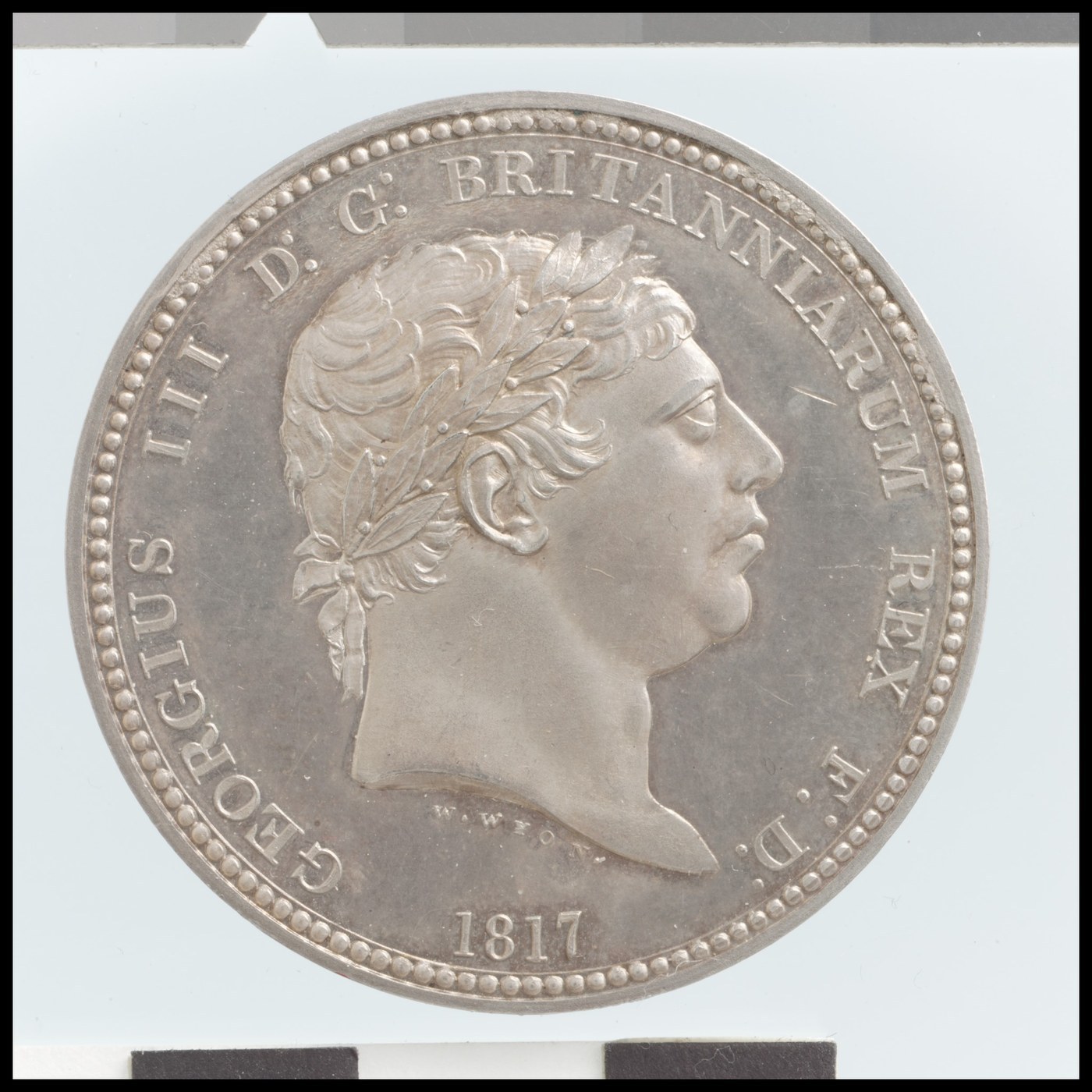
The obverse shows a crowned, laureate portrait of George III facing left, with distinctly curled hair bound by a laurel wreath. The surrounding legend on the photographed example reads GEORGVS III BRITT REX FID DEF — Latin for George III, King of the Britains, Defender of the Faith — a helpful confirmation of both the monarch and the type.
The reverse of the photographed coin presents a seated classical allegorical figure holding a trident, together with a shield bearing the combined crosses of the Union flag. This union imagery — blending the crosses associated with the British kingdoms — is central to the design and to the coin's popular reputation.
The piece is a full-size silver crown, a large and heavy coin, dated 1817. Because it is a pattern rather than a circulation issue, expect sharp, carefully finished detail and proof-like surfaces rather than the wear of a coin that passed from hand to hand. The date, the George III legend, and the allegorical Union reverse together identify the type.
Value & Collectibility
Genuine original Three Graces pattern crowns are major rarities and, when authenticated, rank among the more valuable British silver coins, regularly reaching well into five figures and, for the finest examples, substantially higher at specialist auction. There is no single fixed price; grade, surfaces, provenance, and how a particular striking is catalogued all drive the result.
The design's fame has also made it one of the most reproduced British coins. Modern replicas, commemorative restrikes, and medallic copies exist in large numbers and carry only modest or novelty value, so the gap between a genuine original and a copy is enormous.
For any specific piece, treat published prices as context rather than a guarantee, and base a valuation on recent auction records for authenticated originals of the same type, confirmed by a specialist before any purchase or sale.
Frequently asked questions
What is a pattern crown?
A pattern is a trial or proposed coin design, struck to demonstrate how a coinage might look rather than for circulation. The Three Graces was a pattern for a crown and was never issued for general use.
Why is it so famous?
It is admired as one of the most beautiful British coins ever produced, combining a fine portrait of George III with an elaborate allegorical reverse celebrating the Union of the kingdoms, all from the early Royal Mint machinery era.
Is my 1817 Three Graces crown genuine?
Very likely it is a later replica or medallic copy, because the design has been reproduced extensively. Genuine originals are rare and valuable, so any example should be authenticated by a specialist before assuming it is original.
What metal is it?
It is a silver crown-sized piece. The observed coin is silver, consistent with the large silver crown denomination it was designed to represent.
Three Graces Pattern Crown guides
In-depth guides for identifying, valuing, and collecting Three Graces Pattern Crown.