
How to Identify the Three Cent Nickel
A collector's guide to recognizing the Three Cent Nickel by its Liberty head obverse, Roman numeral III reverse, small size, and pale copper-nickel color.
Read the full Three Cent Nickel encyclopedia entry →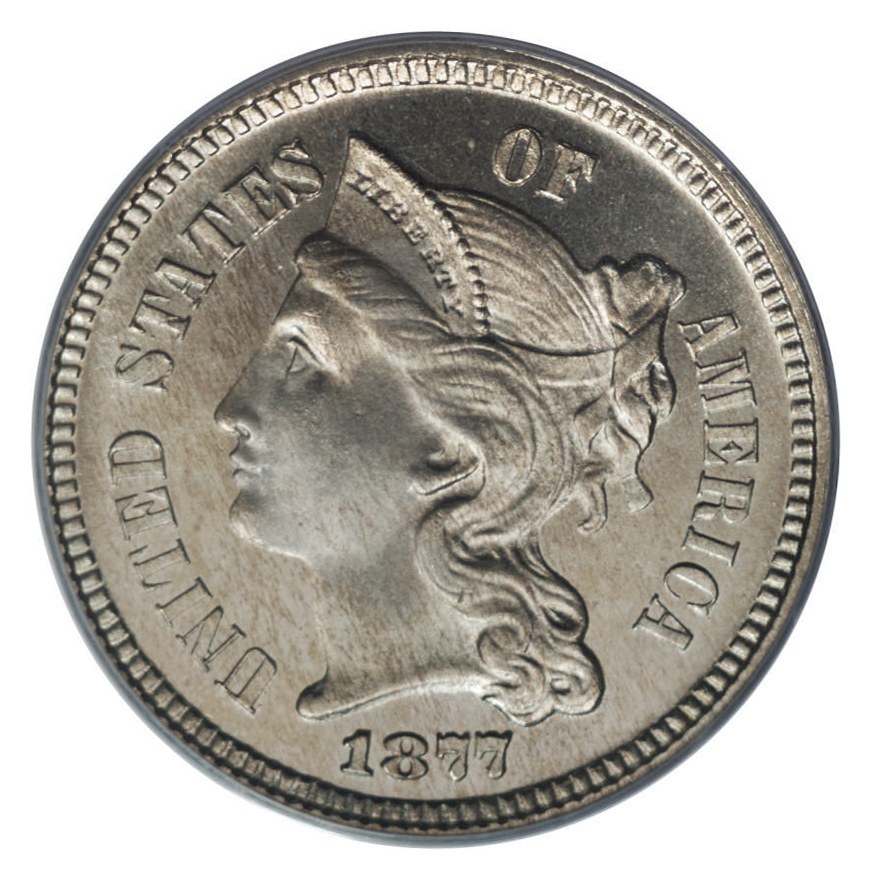
Start with the design pairing. A genuine Three Cent Nickel shows a left-facing Liberty head wearing a coronet on the obverse, encircled by "UNITED STATES OF AMERICA" with the date below, and a large Roman numeral III inside a wreath on the reverse. The Roman numeral, rather than a spelled-out value or an Arabic figure, is the fastest way to confirm the denomination.
Check size, metal, and edge. The coin is small and thin, about 17.9 mm across, with a plain smooth edge. Its 75% copper, 25% nickel alloy gives a characteristic pale gray to tan or slightly whitish appearance; it should not look bright silver like the older three-cent "trime," nor reddish-brown like a copper cent. There is no mint mark on any genuine example, since all were struck at Philadelphia.
Read the date carefully. Correct dates fall between 1865 and 1889. Early years such as 1865 and 1866 were made in large numbers, while many later dates in the 1870s and 1880s are far scarcer, so the date strongly affects both identification and value. Confirm the digits are original and unaltered.
Watch for look-alikes. The silver three-cent piece is smaller and silvery with a star-and-shield motif, and various other small base-metal coins can be confused with it at a glance, but none combine a Liberty head with a Roman numeral III in a wreath. If the numeral, wreath, and pale copper-nickel color are all present, you are almost certainly holding this type.
When a coin appears to be a scarce late date or an especially high grade, seek authentication. Reputable third-party grading services can confirm genuineness and condition, which is worthwhile before buying or selling a more valuable example, and can also flag cleaning or damage that reduces value.
Frequently asked questions
How do I tell a Three Cent Nickel from the silver three-cent piece?
The silver three-cent piece is smaller, brightly silver, and uses a star-and-shield design, while the Three Cent Nickel is a pale copper-nickel coin with a Liberty head on one side and a Roman numeral III in a wreath on the other.
What size and metal should a genuine Three Cent Nickel be?
It should measure about 17.9 mm in diameter with a plain edge and be struck in copper-nickel (75% copper, 25% nickel), giving a pale gray to tan or whitish color rather than a silver or reddish tone.
Which dates are hardest to find?
Early dates like 1865 and 1866 were made in large numbers and are common, while many issues from the late 1870s and 1880s had much smaller mintages and are considerably scarcer.
Is a pale or grayish color a sign my coin is damaged or fake?
Not by itself. The copper-nickel alloy naturally looks pale gray to tan, though harsh cleaning can also alter the surface, so judge color together with detail and surface texture.