
How to Identify the Theodosius I Solidus
A gold solidus of Theodosius I, the last emperor to rule a united Roman Empire, typically showing him enthroned or standing with military and imperial regalia.
Read the full Theodosius I Solidus encyclopedia entry →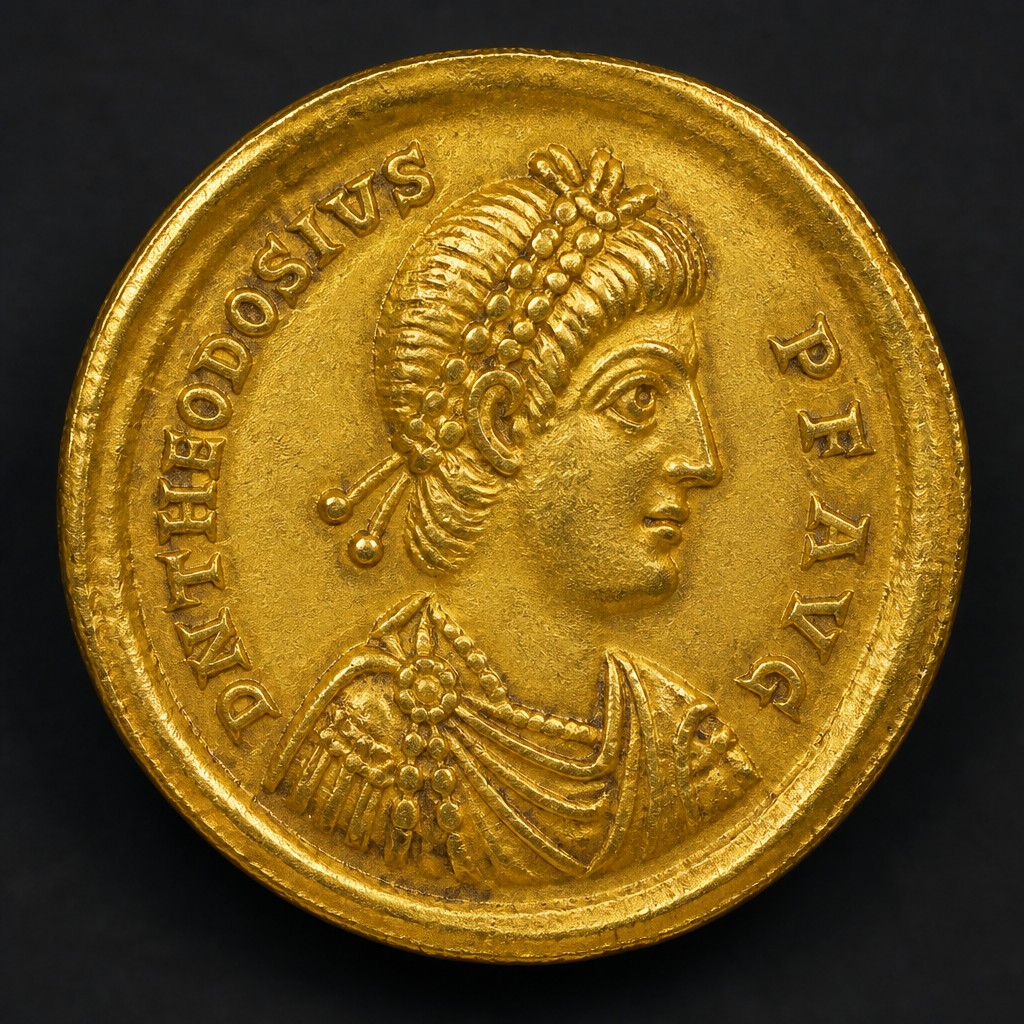
What This Coin Is
This gold solidus was struck for Theodosius I, who ruled from 379 to 395 AD and is remembered as the last emperor to govern the entire Roman Empire as a single realm before it was permanently divided between his two sons. His reign also saw Christianity established as the official state religion, making his coinage an important record of this transitional era.
Obverse Design & Inscriptions
The obverse shows a pearl-diademed, draped-and-cuirassed bust of Theodosius I facing right. The legend reads D N THEODOSIVS P F AVG, spelled out fully across the coin's circumference in the standard imperial format of the period.
Reverse Design & Inscriptions
Common reverse types include the emperor seated facing on a throne, holding a mappa (ceremonial cloth) and a scepter, with the legend CONCORDIA AVGGG (referring to the harmony among the three co-ruling Augusti of the period, denoted by the triple G). Another frequent type shows two or three emperors seated together, or a standing emperor holding a standard and globe with the legend VICTORIA AVGGG.
Size, Weight, Metal, and Edge
As with other solidi of this era, the coin is struck in high-purity gold at a standard weight near 4.5 grams and a diameter of roughly 20-21mm. The edge is plain, as struck, without reeding.
Mint Marks and Where to Find Them
The exergue carries the mint signature combined with an OB gold-purity marker, such as CONOB (Constantinople), TESOB (Thessalonica), or MDOB (Milan), reflecting the wide network of mints active under the late 4th-century administration.
Telling It Apart From Similar Coins
The triple-G ending on legends like AVGGG signals a period when three Augusti ruled jointly, which helps date the coin to Theodosius's reign when he shared power with colleagues such as Gratian, Valentinian II, or later his own sons Arcadius and Honorius. Comparing the specific obverse name is still the most reliable way to separate a Theodosius I coin from contemporary issues struck for his co-rulers, since reverse types were frequently shared across all reigning emperors at a given mint.
Judging Condition at a Glance
Gold does not corrode, so condition assessment focuses on strike sharpness, centering, and wear to the highest points of the design, such as the emperor's cheek and the folds of drapery on the throne scene. A well-struck, well-centered solidus with full legends and minimal handling marks represents a higher-grade example.
Authenticity Red Flags
Given the value of ancient gold coinage, verify weight against the roughly 4.5 gram standard and inspect the coin's color for a rich, even gold tone free of unusual paleness that might indicate a lower-purity alloy. Look closely at the edge for file marks, solder lines, or plugging that would suggest tampering, and be cautious of portraits or legends that appear soft or doubled compared to the crisp detail typical of genuine ancient die engraving.
Frequently asked questions
What does the triple G in AVGGG signify?
Each G represents one reigning Augustus, so AVGGG indicates a period when three emperors ruled jointly, which helps date coinage bearing this legend to specific multi-ruler periods like that of Theodosius I.
Why is Theodosius I historically significant?
He was the last emperor to rule the entire Roman Empire as one unified state before it was permanently split between his sons Arcadius and Honorius after his death.
How can I tell this coin apart from one of his sons?
The obverse legend spells out the ruler's specific name, so checking for THEODOSIVS versus ARCADIVS or HONORIVS is the reliable way to attribute the coin correctly.
What does CONOB mean in the exergue?
It combines the mint abbreviation CON for Constantinople with OB, indicating pure refined gold, a common formula seen on solidi from that mint.