
How to Identify the Testoon
The Testoon was an early Tudor silver coin and forerunner of the shilling, notable for introducing a realistic royal portrait to English coinage.
Read the full Testoon encyclopedia entry →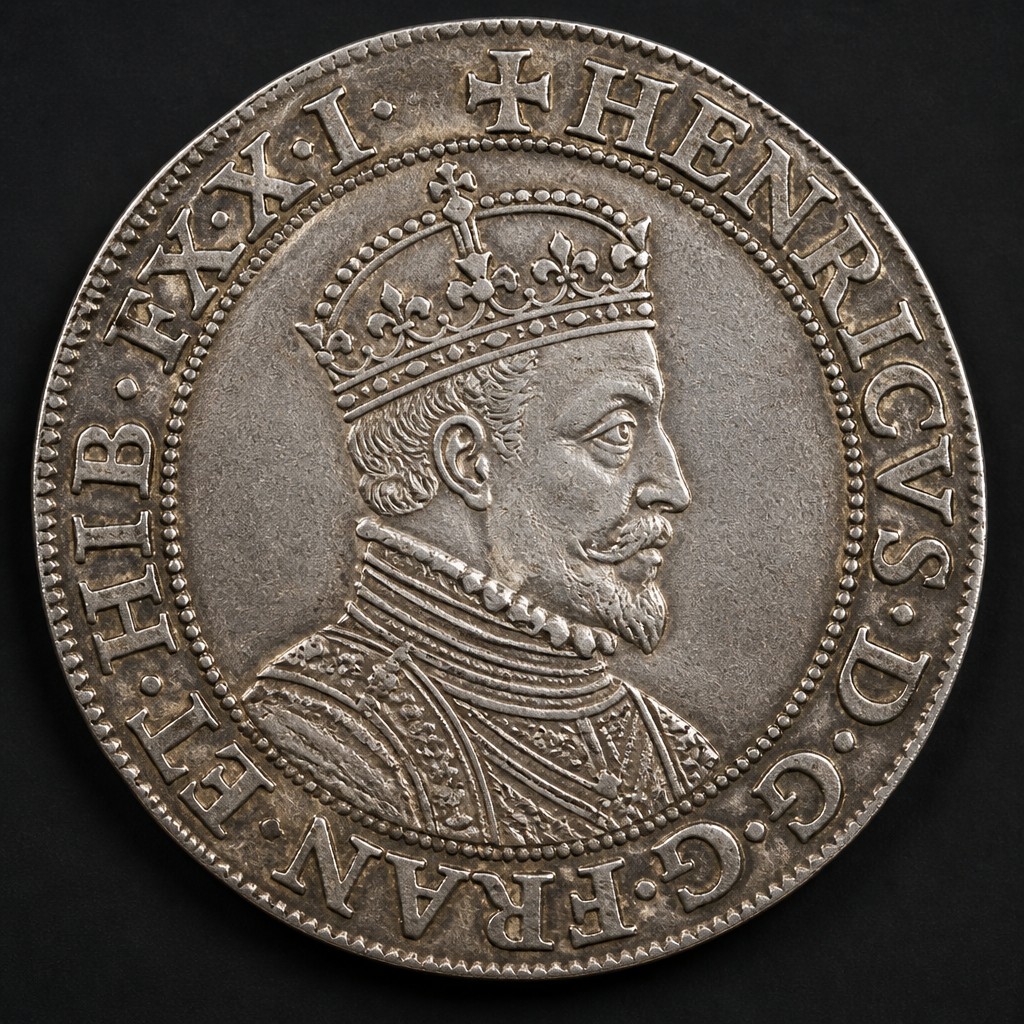
What It Is
The Testoon was an early English silver coin, first introduced under Henry VII and later produced in greater quantity under Henry VIII, valued at twelve pence. It is historically significant as the direct forerunner of the shilling and one of the first English coins to carry a realistic royal portrait rather than a stylized image, marking a turning point in English coin design.
Obverse Design
The obverse shows a crowned bust of the king in profile, rendered with more lifelike detail than earlier hammered coinage, surrounded by the king's name and title in Latin. This shift toward portraiture was a notable departure from the flat, generic royal images used on earlier medieval coins.
Reverse Design
The reverse typically displays a crowned shield bearing the royal arms, with a Latin legend around the border. Some later issues also include a rose or other heraldic elements flanking the shield, depending on the specific issue and period of striking.
Size, Weight, Metal & Edge
Testoons were struck in silver, though later Henry VIII issues were made from debased silver with reduced fineness. They measure roughly 27-30mm across, with weight varying based on the silver standard of the specific issue. As hand-hammered coins, their edges are irregular rather than milled, and the flan can be slightly uneven.
Mint Marks & Dating
Testoons do not carry numeral dates in the modern sense. Instead, a small mintmark near the top of the obverse legend indicates the approximate period of striking, and sometimes the specific mint, useful for narrowing down when a piece was produced within a long and eventful reign.
Telling It Apart From Similar Coins
The Testoon is often compared to the later shilling, which it directly influenced in both value and size. It can also be confused with the groat, which is smaller and worth only four pence. Comparing overall diameter and the level of portrait detail helps separate these denominations from one another.
Grading at a Glance
Because many later Testoons were struck from debased silver, wear often reveals a duller, sometimes reddish tone where copper content shows through - famously nicknamed for how the king's raised nose would wear to reveal the base metal beneath a thin silver wash. Sharp, high-relief portrait detail with an even silver tone indicates a well-preserved example.
Authenticity Red Flags
Be alert to coins with an unnaturally uniform, perfectly round shape inconsistent with hand-hammering, or a portrait style too refined and symmetrical for the period. A metal color that seems entirely silver without any hint of the known debasement in later issues can also be a sign of a modern reproduction rather than a genuine historical piece from the period. Comparing the mintmark against a reliable reference chart adds another layer of confidence.
Frequently asked questions
What was the Testoon's original value?
Twelve pence, the same value later inherited by the shilling.
Why is Henry VIII's Testoon sometimes called 'copper nose'?
Because the debased silver used in later issues wore away at the king's raised nose in the portrait, exposing the copper alloy underneath.
Did the Testoon lead directly to the shilling?
Yes, it is generally regarded as the coin type that evolved into the English shilling.
How is a Testoon dated if it has no year on it?
By identifying the small mintmark in the legend, which corresponds to specific periods within a monarch's reign.