
How to Identify the Terina Nike Nomos
A South Italian silver nomos from Terina in Bruttium, famous for its varied and graceful depictions of the winged goddess Nike on the reverse.
Read the full Terina Nike Nomos encyclopedia entry →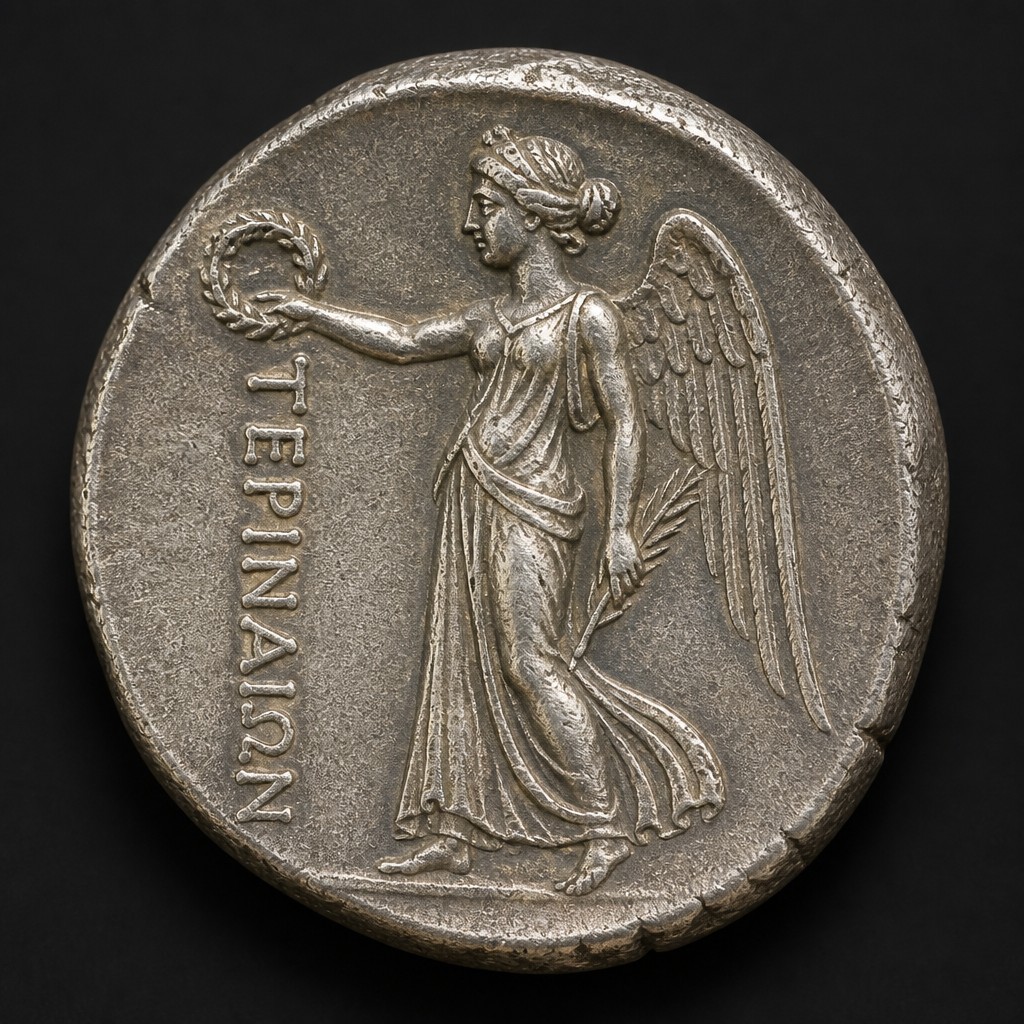
What the Coin Is
Terina was a small city on the Gulf of Sant'Eufemia in Bruttium (modern Calabria), and its silver coinage from the fifth and fourth centuries BC is celebrated for its elegant portrayal of Nike, goddess of victory. The nomos (also called a didrachm) was the standard silver unit used across the Greek cities of South Italy.
Obverse Design
The obverse carries a female head, usually identified as the nymph Terina, the city's namesake. Her hair is bound close to the head, sometimes under a simple band, sphendone, or wreath, and the modeling is typically soft and youthful. The ethnic TERINAION or an abbreviation of it often appears in the field around the head.
Reverse Design
The reverse is where Terina's coinage stands out: Nike appears in several distinct poses across different issues, including seated on a stool, cippus, or rock with her wings folded and hands resting or holding a small bird; standing and holding a caduceus and wreath; or flying with wings spread wide, offering a wreath. Because so many different Nike compositions exist, the reverse pose is one of the best clues for narrowing down which specific issue a coin belongs to.
Size, Weight, and Metal
These are silver coins struck on the South Italian nomos standard, generally weighing close to 7.5 to 7.9 grams. The flans are broad and thin compared to some other regional issues, giving the design room to breathe, and the edges are plain.
Mint Marks and Control Symbols
Terina did not use a fixed mint mark system; instead, small symbols, letters, or monograms appear in the field near Nike or the nymph's head to distinguish different issues and officials. These small details, combined with the exact Nike pose, are what specialists use to place a coin within the city's coinage sequence.
Telling It Apart from Similar Coins
The nymph head obverse resembles those of other South Italian and Sicilian cities, so the reverse is the key to identification: no other Bruttian city pairs a nymph head with this range of seated or standing Nike figures. Confusion is most likely with Sicilian coins that also feature Nike (such as some Syracusan issues), but those typically show Nike driving a chariot or crowning a portrait rather than appearing alone as the main reverse type.
Judging Condition at a Glance
Look first at the nymph's hair detail and profile on the obverse, and at Nike's wings and drapery folds on the reverse; these fine lines wear away quickly. A well-centered strike that shows the full figure of Nike without flan cracks or excessive die wear is considered a strong example of the type.
Authenticity Red Flags
Because Terina's coins are admired for their artistry, they have attracted modern replicas. Be cautious of coins with unnaturally crisp, uniform surfaces that don't match the soft, slightly worn look of genuine circulated silver, or of pieces where Nike's proportions look subtly off compared to published die studies. Cast fakes often show a fuzzy, indistinct edge and a slightly grainy surface rather than the sharp metal flow lines produced by striking.
Frequently asked questions
Why does Nike appear in so many different poses on this coin?
Terina issued its coinage over an extended period with many different officials and die engravers, each producing a distinct composition of Nike, so pose and pairing symbols help date individual issues.
Who is shown on the obverse?
The obverse depicts a female head generally identified as the nymph Terina, the personification of the city, rather than a specific historical person.
What weight standard was used?
It follows the South Italian nomos (didrachm) standard, with genuine examples weighing around 7.5 to 7.9 grams in silver.
How do I distinguish this from a similar Sicilian Nike coin?
Sicilian Nike types usually show her driving a chariot or crowning a name, while Terina's reverse presents Nike alone, seated or standing, as the primary and only reverse figure.